

Industry research
Video Production
Scope
Europe
Companies
85
Table of contents
Report collaborator:

Tabitha Elwes and Will Reid, Partner and Engagement Manager respectively at CIL Strategy Consultants, provided expert insights for this report. They cover CIL’s media production and broadcast practice as sector specialists.Read the full interview transcript here
Key takeaways
What is the scope of this industry report?
The European video production market comprises businesses engaged in the scripting, shooting, distribution and exhibition of films and series across physical and digital channels. We segmented the market by primary business activity with players operating either as separate video production studios or diversified media holdings into: (i) integrated media production and (ii) video production.
What does the Video Production landscape look like in Europe?
The European landscape is concentrated, characterised by large integrated media production players, followed by a long tail of SMEs, particularly at the studio production level. Herein, the European landscape is dominated by US-based incumbents, such as Comcast (US) and Warner Bros. Discovery (US). In this context, the market is experiencing consolidation, with identified players primarily engaging in strategic M&A to (i) tap into new geographies, (ii) acquire additional target audiences, (iii) expand content libraries and secure talent, (iv) increase technological capabilities, (v) create holistic networks for creativity exchange and (vi) optimise financing via tax breaks.
What does the Video Production market landscape look like in Europe?
Sponsor-led interest has been sizable, with ~42% of identified European assets being backed by investors (as of April 2026).
This interest is mainly driven by:
Ongoing developments in AI, expected to boost efficiency in VFX and post-production operations,
“Netflixisation” trends fostering the distribution of European content in foreign languages into many geographies globally,
A talent-rich ecosystem infrastructure coupled with appealing tax incentives, which solidify Europe’s attractiveness as a leading production hub.
On the other hand,
Decreasing IP ownership eroding profitability for pure play video production studios,
Rising production costs with further pressure by “super inflation” exerted by large US players,
Subscription fatigue and churn risk trends among younger generations, serve as detractors for investors.
What are the key ESG considerations in the European Video Production industry?
ESG topics are primarily related to environmental and social challenges. Environmental issues revolve around mitigating CO₂ emissions from filmmaking activities.
To address this, players:
adopt climate protection protocols to systematically reduce waste and greenhouse emissions across their production chain,
Set milestone targets to achieve significant decarbonisation,
Certify their content with industry-leading environmental sustainability standards.
On the social front, challenges arise from the influence players can have on society’s attitudes and beliefs, conveyed through audiovisual content. To address these, incumbents attempt to spread awareness and educate consumers about specific (current) societal topics through the production of awareness programmes and documentaries, thereby raising visibility on important world challenges.
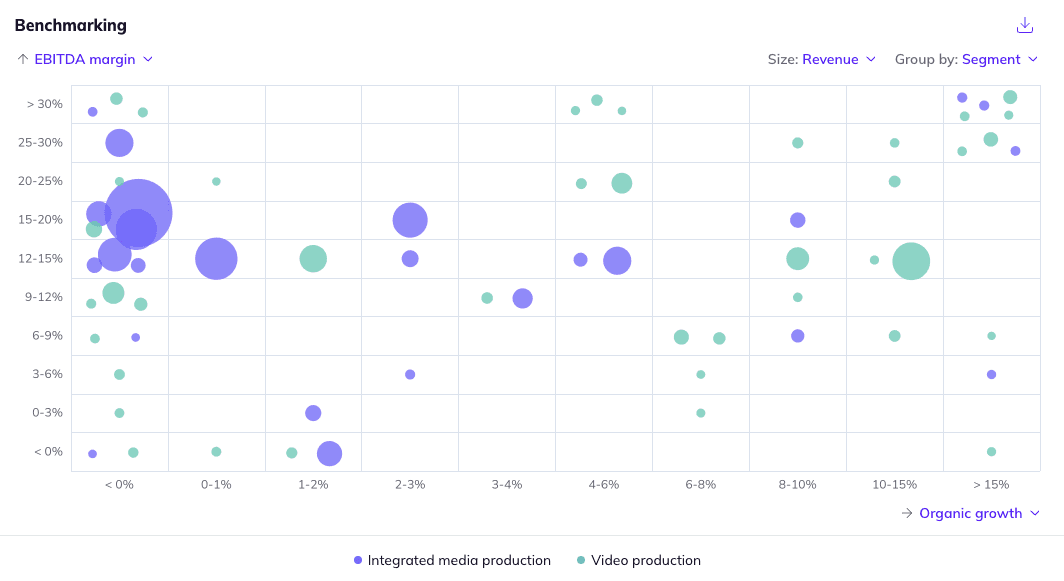
Company benchmarking
Market growth
The global entertainment & media market is forecasted to grow from ~$2.9tn in revenue in 2024 to ~$3.5tn in 2029 (+3.7% CAGR 2024-2029; PwC, July 2025)
The European TV and video market is projected to grow from ~€133.1bn in revenue in 2025 to ~€151.6bn by 2030 (+2.7% CAGR 2025-2030). This growth is mainly driven by rising revenue from over-the-top (“OTT”) video, which is expected to increase from ~€50.1bn in sales in 2025 to ~€69.3bn by 2030 (+6.7% CAGR 2026-2030; Statista, December 2025)
Positive drivers
Developments in AI are driving significant efficiency gains across visual effects and post-production. These developments are expected to enable faster and more cost-effective video production and accelerate time to market (CIL expert interview; Deloitte, March 2026)
“Netflixisation” trends, in which local productions can be more easily marketed globally at low marginal cost, increase the total addressable end market for identified video producers. This is supported by a higher acceptance of foreign languages (e.g. supported by subtitles) and increased investment in European audiovisual content by global streamers, going from ~8% in 2020 of total spending to ~24% in 2024 (interview by Gain; European Audiovisual Observatory, March 2026)
Europe’s talent base, production infrastructure and incentives are expected to keep the region attractive for global content production (e.g., the UK accounts for ~3% of global commissions but ~12% of global production, while tax incentives remain strong in Central and Eastern Europe). For video production players, this should support inward investment, higher volumes and a stronger position versus the US, reinforcing Europe’s filmmaking hub role (CIL expert interview; Screen Daily, January 2025)
Negative drivers
Shifting content ownership and licensing models jeopardise royalty streams and reduce long-term monetisation avenues. As studios increasingly produce content for external platforms without retaining full rights, the resulting erosion of backend participation, paired with rising disputes over licensing terms and revenue sharing, undermines traditional profit models and limits the capture of future value for independent studios (Ankura, July 2024; Forbes, December 2023)
Rising production costs, driving average per-episode spend (e.g. UK drama rising from ~£1.6-1.8m per episode to >£2.2m), have squeezed production budgets in European film and TV and curbed production volumes. This impact is exacerbated by “super inflation” caused by major streaming platforms (e.g. Apple, Netflix, Amazon) overpaying for on- and off-screen talent, further eroding the profitability of incumbents (CIL expert interview; Ikon London Magazine, February 2025)
Rising price sensitivity and growing subscription fluidity are increasing SVOD churn as platforms continue to raise prices to improve profitability, with ~35% of global consumers planning to cancel at least one service in 2026 and ~63% citing a lack of content value as the main trigger. As a result, video production players may face curbed demand, as platforms commission fewer titles and tighten scrutiny on titles, budgets and ROI (CNET, April 2026; Simon Kucher, April 2026; NCS, January 2026)
Fill out the form to request your copy of the Video Production industry report
With the full report, you’ll gain access to:
Detailed assessments of the market outlook
Insights from c-suite industry executives
A clear overview of all active investors in the industry
An in-depth look into 85 private companies, incl. financials, ownership details and more.
A view on all 758 deals in the industry
ESG assessments with highlighted ESG outperformers
Discover hundreds of niche industry reports on Gain
Deep dive into additional industries to understand their market outlook, positive and negative drivers, and more!