

Industry research
LegalTech
Scope
US
Companies
67
Table of contents
Report collaborator:

Ian Cook, Associate Director at CIL Strategy Consultants, provided expert insights for this report. He works within CIL’s business services practice, specializing in education and training, human capital management and professional services. Read the full interview here
Key takeaways
What is the scope of this industry report?
The US LegalTech industry comprises businesses that develop and operate software platforms used by law firms and in-house legal teams to manage legal workflows, process legal data and support compliance across legal operations. These platforms structure how legal work is executed, from matter management and litigation support to contract lifecycle management and enterprise legal workflows, enabling automation, standardization and data-driven decision-making across the legal function.
Accordingly, we segmented the market into:
Practice management,
Litigation and eDiscovery technology,
Legal operations technology.
What does the LegalTech landscape look like in the US?
The industry remains fragmented across all three segments, reflecting both the highly fragmented structure of the US legal services market and the modular nature of LegalTech products, where vendors often specialize in specific workflows rather than offering unified platforms. This fragmentation is further reinforced by the diversity of end users, ranging from small and mid-sized law firms with niche workflows to large enterprises requiring highly customized and integrated systems, which limits convergence toward a single dominant platform. Scaled players differentiate through breadth of workflow coverage, integration depth and positioning as systems of record across legal processes, enabling ownership of core workflows such as matter management, contract lifecycle management and document review. By contrast, smaller providers compete through specialization within discrete use cases, including contract analytics, litigation support and practice-area-specific workflows, where tailored functionality and domain expertise create defensible niches. Consolidation activity is ongoing across segments, as platform providers pursue acquisitions to expand functionality and integrate adjacent capabilities, aligning with a shift in client preference toward fewer, integrated technology providers. PE activity focuses on roll-up opportunities across fragmented product categories, while VC investment is increasingly directed toward AI-first players
What does the LegalTech market landscape look like in US?
Sponsor-led interest remains strong, with ~81% of identified assets being investor-backed (as of April 2026). Herein, sponsors are attracted by (i) rising adoption of LegalTech platforms driven by AI-enabled operational efficiency gains across core legal workflows, (ii) growing regulatory complexity and need for stronger compliance necessitating investments in LegalTech and (iii) sustained demand driven by increasingly data-intensive litigation workflows. Deterring factors primarily relate to (i) extended deployment timelines due to implementation complexity arising from fragmented technology stacks (ii) data privacy, confidentiality and discoverability risks associated with AI-driven workflows, which constrain deployment in sensitive use cases and (iii) resistance to change among legal professionals and fragmented decision-making within law firms, slowing down LegalTech adoption.
What are the key ESG considerations in the US LegalTech industry?
ESG considerations primarily relate to social and governance factors. From a social perspective, AI introduces risks related to bias, accuracy and transparency, with hallucinations already resulting in sanctions in legal proceedings. To address this, players implement human-in-the-loop review, model validation and explainability features to ensure outputs are accurate and auditable before use in legal workflows. On the governance front, players operate within fragmented regulatory environments requiring compliance with attorney-client privilege, professional conduct rules and data protection standards, alongside formal recordkeeping and supervision obligations. To meet these requirements, platforms incorporate compliance-driven system design, including encryption, access controls, audit trails and governance frameworks to support secure and auditable legal operations.
Company benchmarking
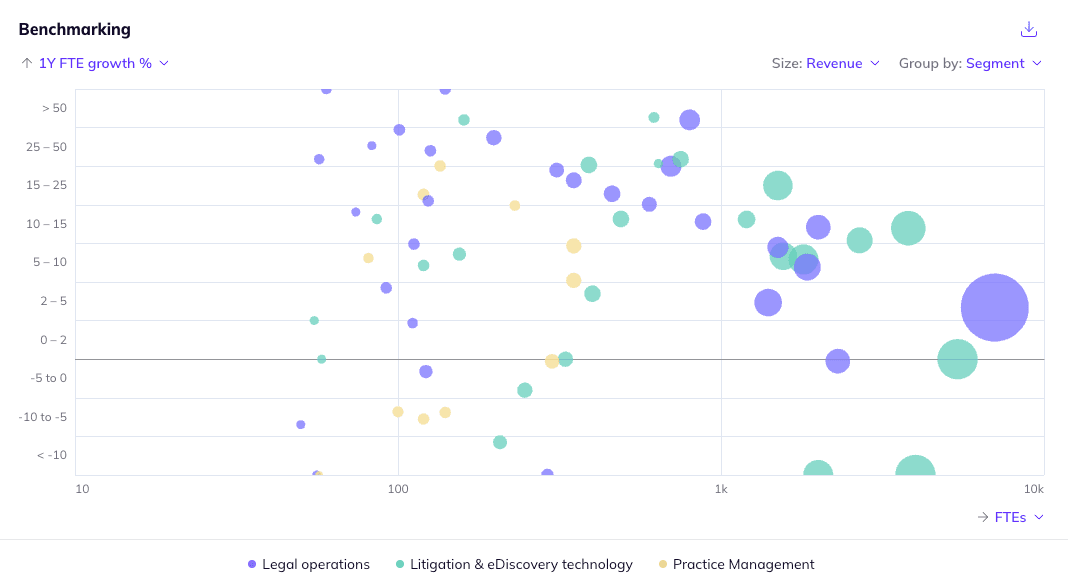
Market growth
Gartner (April 2024) estimates the global legal technology market to reach ~$50bn by 2027
The global AI legal tech market size is expected to grow from ~$1.0bn in 2025 to ~$7.4bn by 2030 (+32.1% CAGR 2025-2030; Technavio, April 2026)
Positive drivers
LegalTech adoption is set to accelerate as law firms increase technology spending to deploy agentic AI systems that execute multi-step legal workflows across core processes. Technology spend grew at ~20% annually between 2015 and 2025 and this momentum is expected to continue as AI has the potential to automate ~40% of legal work, reducing manual effort, accelerating data processing and improving productivity (Meridian Capital, 2025; Daimagister; November 2023)
Increasing regulatory complexity is expected to drive demand for LegalTech platforms, as US corporate legal departments navigate evolving federal, state and industry-specific compliance requirements that raise the need for stronger risk oversight. This is expected to increase adoption of tools that support compliance tracking, contract governance, monitoring, reporting and auditability, enabling legal teams to manage regulatory obligations more efficiently across enterprise workflows (Spellbook, April 2026; Laurence Simons, April 2026)
Growth in data volumes and complexity within US litigation is expected to increase reliance on LegalTech platforms, as expanding volumes of emails, messages, collaboration data and digital records require scalable processing, review and storage capabilities. In turn, demand is expected to persist for eDiscovery and litigation technology that can manage large-scale document workflows, particularly in complex and data-intensive cases such as antitrust investigations, regulatory enforcement and multi-party litigation (Reveal, January 2026; Complex Discovery, December 2025)
Negative drivers
Fragmented enterprise legal technology stacks are expected to increase implementation complexity, as legal departments operate across multiple vendors, legacy systems and function-specific tools spanning contracts, compliance, document management and litigation workflows. As a result, integration challenges are expected to lengthen deployment timelines, require additional customization and coordination across stakeholders and reduce the realized value of LegalTech investments, particularly in large, multi-jurisdictional and decentralized organizations (Onit, March 2026; GLS, January 2026)
Data privacy, confidentiality and discoverability risks are expected to constrain the adoption of AI-driven LegalTech, particularly in sensitive legal workflows involving privileged, regulated or litigation-relevant data. Therefore, legal teams are expected to limit deployment of AI tools in high-risk use cases and introduce additional layers of human review, governance and approval, increasing operational complexity and slowing enterprise-wide adoption of AI-enabled LegalTech platforms (Hamilton Locke, April 2026; Spellbook, April 2026)
Resistance to change among legal professionals is expected to slow broader LegalTech adoption, as automation disrupts established legal workflows and raises concerns around reliability, professional judgment and role disruption. This friction is likely to be amplified by fragmented decision-making within law firms, where individual partners often influence technology choices, making firm-wide adoption harder despite clear efficiency benefits (CIL expert interview; Reuters, December 2025)
Fill out the form to request your copy of the LegalTech industry report
With the full report, you’ll gain access to:
Detailed assessments of the market outlook
Insights from c-suite industry executives
A clear overview of all active investors in the industry
An in-depth look into 67 private companies, incl. financials, ownership details and more.
A view on all 427 deals in the industry
ESG assessments with highlighted ESG outperformers
Discover hundreds of niche industry reports on Gain
Deep dive into additional industries to understand their market outlook, positive and negative drivers, and more!