

Industry research
Pallet pooling
Scope
Europe
Companies
29
Table of contents
Report collaborator:

Nicholas Farhi, Bram Kuijpers and Casper Roex, Partners at OC&C Strategy Consultants, provided expert insights for this report.
Key takeaways
What is the scope of this industry report?
The pallet pooling market comprises businesses that facilitate the shared use and management of pallets (i.e. flat platforms for storing and moving goods). Core pooling activities include procurement, rental, collection, sorting, transport, repair and cleaning, which eliminate the need for individual ownership and management of inventory. Wooden pallets are more common (accounting for ~90% of the pallets used in Europe), cost-effective and easy to repair, whereas plastic pallets are lighter in weight and offer increased durability with resistance to moisture and chemicals, making them more suitable for industries requiring high hygiene standards (OC&C expert interview). Based on the pallet types offered, we segmented the European market into: (i) mixed, (ii) plastic pallets and (iii) wooden pallets.
What does the Pallet pooling landscape look like in Europe?
The pallet pooling market is characterised by 3 primary operating models: (i) open pooling, (ii) closed pooling and (iii) direct exchange (OC&C expert interview). Under an open pooling system, providers supply producers (e.g. consumer goods manufacturers) with standardised pallets from their depots, which circulate interchangeably without individual tracking and are exchanged for equivalent units upon return. Under a closed pooling system, providers manage a pool of standardised, identifiable pallets (often colour-coded), which are collected, inspected and repaired after each cycle to ensure consistent quality and extended asset life. Under the direct exchange model, producers procure pallets from manufacturers and exchange them directly with retailers, bearing responsibility for maintenance, availability and replacement costs (OC&C expert interview). The direct exchange system is typically less expensive. However, producers face the risk of pallet shortages, as supply depends on timely returns from retailers. By contrast, under open and closed pooling models, providers manage circulation, thereby ensuring continuous availability and consistent quality (OC&C expert interview).
What does the Pallet pooling market landscape look like in Europe?
Direct exchange remains prevalent in Southern and Eastern Europe, whereas Western European markets tend to favour open and closed pooling models. This reflects both cost considerations, as pooling systems are typically more expensive and therefore more suited to wealthier markets, as well as retailer influence. Enjoying significant bargaining power, large retailers typically dictate pallet specifications and operating systems, with producers adapting accordingly. As such, retailers tend to favour standardised pallet formats (e.g. closed pooling) which enhance operational efficiency, as retailers always handle the exact same type of pallets. Accordingly, in Western Europe, higher retail concentration and ongoing consolidation (e.g. driven by the growth of discount retail and private label models) have reinforced closed pooling as the dominant operating model (OC&C expert interview).
What are the key ESG considerations in Europe's Pallet pooling industry?
The European closed pallet pooling market is highly consolidated, with Chep-Brambles (AU), La Palette Rouge (Euro Pool Group) and IPP (Faber Group) collectively accounting for almost the entirety of the market across most European countries. Specifically, in the UK, Chep-Brambles accounts for ~75% of the market, La Palette Rouge for ~15% and IPP for the remaining ~10%. In France, Chep-Brambles holds a ~55% market share, followed by La Palette Rouge (~30%) and IPP (~15%; OC&C expert interview). This high market concentration is primarily driven by scale advantages, particularly in closed pooling systems. By serving an extensive client base of consumer goods manufacturers and retailers, large providers achieve significant network density. This scale drives logistics efficiency by shortening transport distances and minimising empty repositioning flows as pallet movements are coordinated across a diverse user group (OC&C expert interview). Moreover, the sector’s high ongoing CAPEX requirements further drive consolidation, as ~6% of pallets in a pool require annual replacement, with wooden pallets costing ~€15 and plastic pallets ~€70 (OC&C expert interview). To exemplify, Euro Pool Group’s average CAPEX/sales ratio stood at ~28% between 2019-2024. Finally, leading closed pooling players further benefit from widespread retailer acceptance of their standardised pallets (IPP, March 2026).
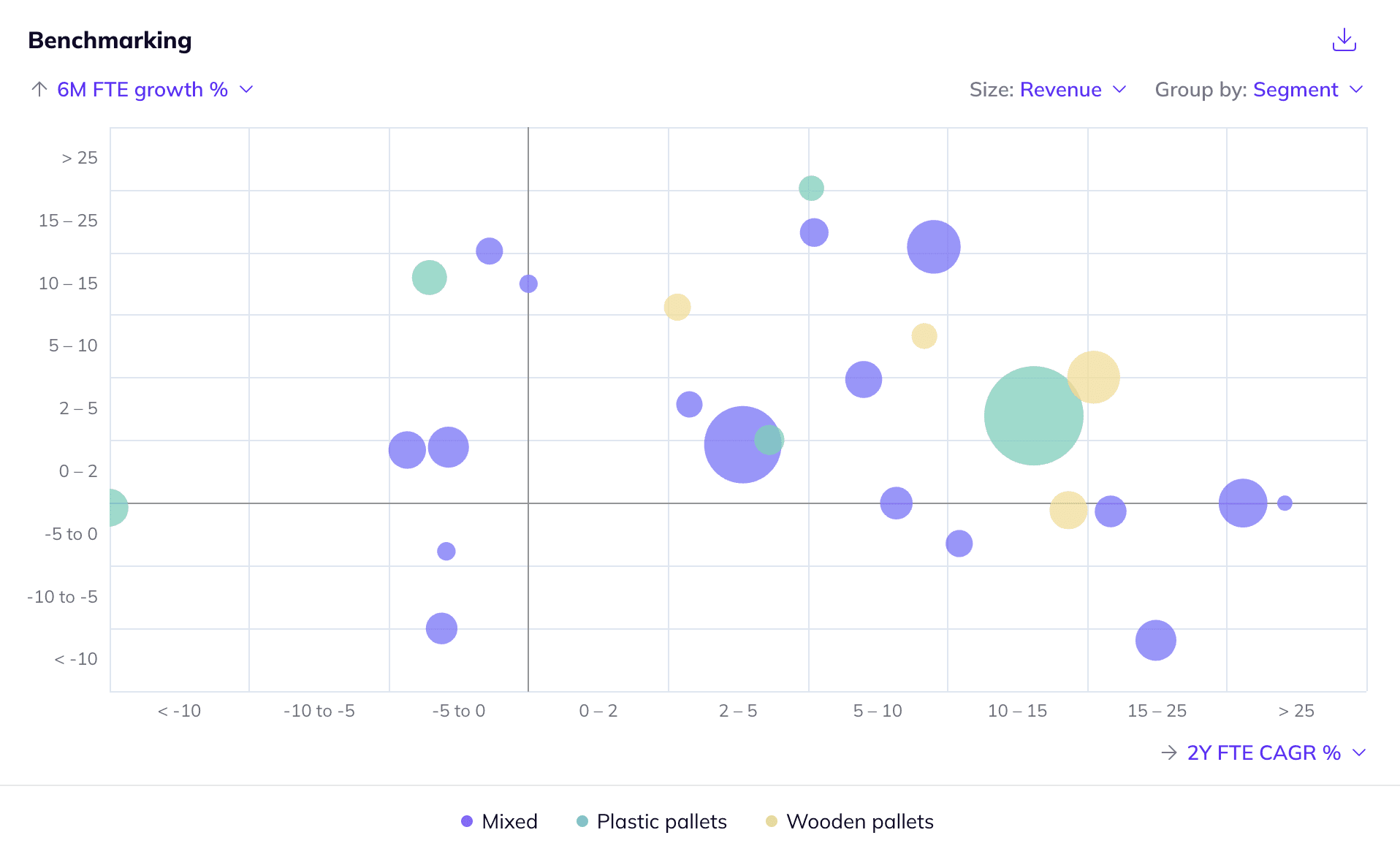
Company benchmarking
Market growth
The European pallet market generated an estimated ~$26.4bn in revenue in 2025 and is expected to grow to ~$34.0bn by 2030 (+5.2% CAGR 2025-2030; Technavio, March 2026)
Industry experts forecast the European pallet pooling market to grow at mid-single digits over the next decade (OC&C expert interview)
Positive drivers
Significant tailwinds, including the rise in packaged goods consumption and population-driven food demand, are bolstering the pallet pooling industry. Because the consumer-packaged goods and food sectors are the primary end-users, these trends are expected to drive sustained, long-term demand for pallet pooling services (OC&C expert interview)
Closed pooling systems are expected to gain market share from legacy open pooling and direct exchange models, particularly in less mature European markets (e.g. Germany and Southern Europe), driven by advantages in supply availability, quality assurance and flexibility. This development is further reinforced by the sustainability advantages of closed pooling, as pallets benefit from longer lifespans through sharing, maintenance and reuse (OC&C expert interview; Chep-Brambles, March 2026)
Adoption of IoT technologies and increased pallet tracking digitalisation are enhancing network efficiency. With ~33m pallets lost annually across Europe and the US, this creates significant financial, operational and sustainability losses. Real-time visibility helps reduce stockpiling, improve utilisation and minimise downtime from maintenance and replacement, thereby supporting pooling providers’ profitability (Turckvilant, March 2026)
Negative drivers
Ongoing end-market consolidation, particularly in the retail segment, is expected to diminish the negotiating leverage of pallet pooling providers. This shift in market power will likely intensify pricing pressure and lead to margin compression across the sector (McKinsey & Company, April 2025)
Anticipated volatility in raw material and fuel prices represents a primary downside risk. With timber accounting for the vast majority of the cost base (~70%), any upward pricing pressure will likely lead to sustained margin erosion. This risk is further exacerbated by geopolitical uncertainty, disrupting supply chains and driving oil price volatility, thereby pressuring pooling players’ profit margins (Ad-hoc news, February 2026)
Growing retailer preference for plastic over wooden pallets, mostly driven by greater durability, improved hygiene and sustainability advantages, may require pooling providers to shift their asset base. Given the higher upfront cost of plastic pallets and the sector’s already high maintenance CAPEX, this transition could increase investment needs and limit short-term cash generation (Go Plastic Pallets, August 2024)
Fill out the form to request your copy of the Pallet pooling industry report
With the full report, you’ll gain access to:
Detailed assessments of the market outlook
Insights from c-suite industry executives
A clear overview of all active investors in the industry
An in-depth look into 29 private companies, incl. financials, ownership details and more.
A view on all 108 deals in the industry
ESG assessments with highlighted ESG outperformers
Discover hundreds of niche industry reports on Gain
Deep dive into additional industries to understand their market outlook, positive and negative drivers, and more!