

Industry research
Online Food Delivery Services (EU)
Scope
Europe
Companies
42
Key takeaways
What is the scope ?
The European online food delivery services market comprises businesses that facilitate the digital ordering, payment and fulfilment of prepared meals, groceries and meal kits by connecting consumers with restaurants and retailers. Herein, meal delivery platforms provide on-demand access to restaurant-prepared food and typically manage last-mile delivery through owned or contracted courier networks. Meal kit delivery firms deliver pre-portioned ingredients and recipes directly to consumers' homes, primarily on a subscription basis. Additionally, grocery delivery providers enable consumers to purchase packaged foods, fresh produce and household essentials online, with picking, packing and last-mile delivery handled directly by the platform.
Accordingly, we have segmented the European market into:
Meals,
Meal kits,
Groceries.
What does the online food delivery services landscape look like in Europe?
The European online food delivery services landscape varies by segment, though all verticals showcase a rather consolidated nature. The meal delivery segment is dominated by Delivery Hero, Just Eat Takeaway.com and Uber Eats (US; part of Uber), with Just Eat Takeaway.com leading in Germany and the UK, while Uber Eats and Delivery Hero are more prominent in France and Spain, respectively. When zooming in on meal kit delivery, HelloFresh Group emerges as the clear European leader, with market shares ranging from ~70% to ~95% in some of its geographical markets. The meal kit market is further complemented by a range of smaller, niche players. Lastly, grocery delivery players face increasing competition from traditional supermarkets expanding their delivery services. As a result, traditional grocery incumbents such as REWE Group (DE) and Sainsbury's (UK) hold a dominant position in the market. In contrast, pure-play incumbents play a more limited role due to their lack of required scale. As scale and critical mass are key to achieving profitability, the broader online food delivery industry exhibits a "winner-takes-most" dynamic, with players leveraging strategic M&A to expand internationally and build share in core markets.
What does sponsor-led interest look like in the European online food delivery services market?
Sponsor-led interest has been significant, with ~76% of identified assets being investor-backed (April 2026).
Investors are primarily attracted by :
Rising food delivery demand, particularly among younger consumers (e.g. Gen Z) who value convenience,
Platforms' shift toward broader, non-food product offerings (e.g., pharmaceuticals, pet items),
AI-driven personalisation and logistics optimisation that increase order frequency, reduce costs and support margin expansion.
On the other hand,
The cost of living crisis across Europe reducing the portion of disposable income being allocated to non-essential items (e.g. meal delivery),
Tightening labour regulations and worker classification requirements,
Structurally weak unit economics for food delivery players (e.g. high CAC)
The significant scale needed to reach positive profits serve as key deterrents for investors.
What are the key ESG considerations in Europe's online food delivery services industry?
ESG topics primarily relate to environmental and social issues. From an environmental perspective, reducing delivery-related waste, mitigating emissions from delivery-related transport and minimising food waste figure as the most pressing topics. To address these, incumbents pursue fleet electrification and adhere to more sustainable packaging to reduce plastic waste. From a social perspective, the classification of workers (e.g. as self-employed or as formal employees) is a central topic, as food delivery players increasingly face government scrutiny that has led to several fines and ongoing lawsuits. Another key social concern is riders' exposure to traffic accidents during deliveries, which identified players address through telematics programmes that provide real-time driving feedback and safe driving training.
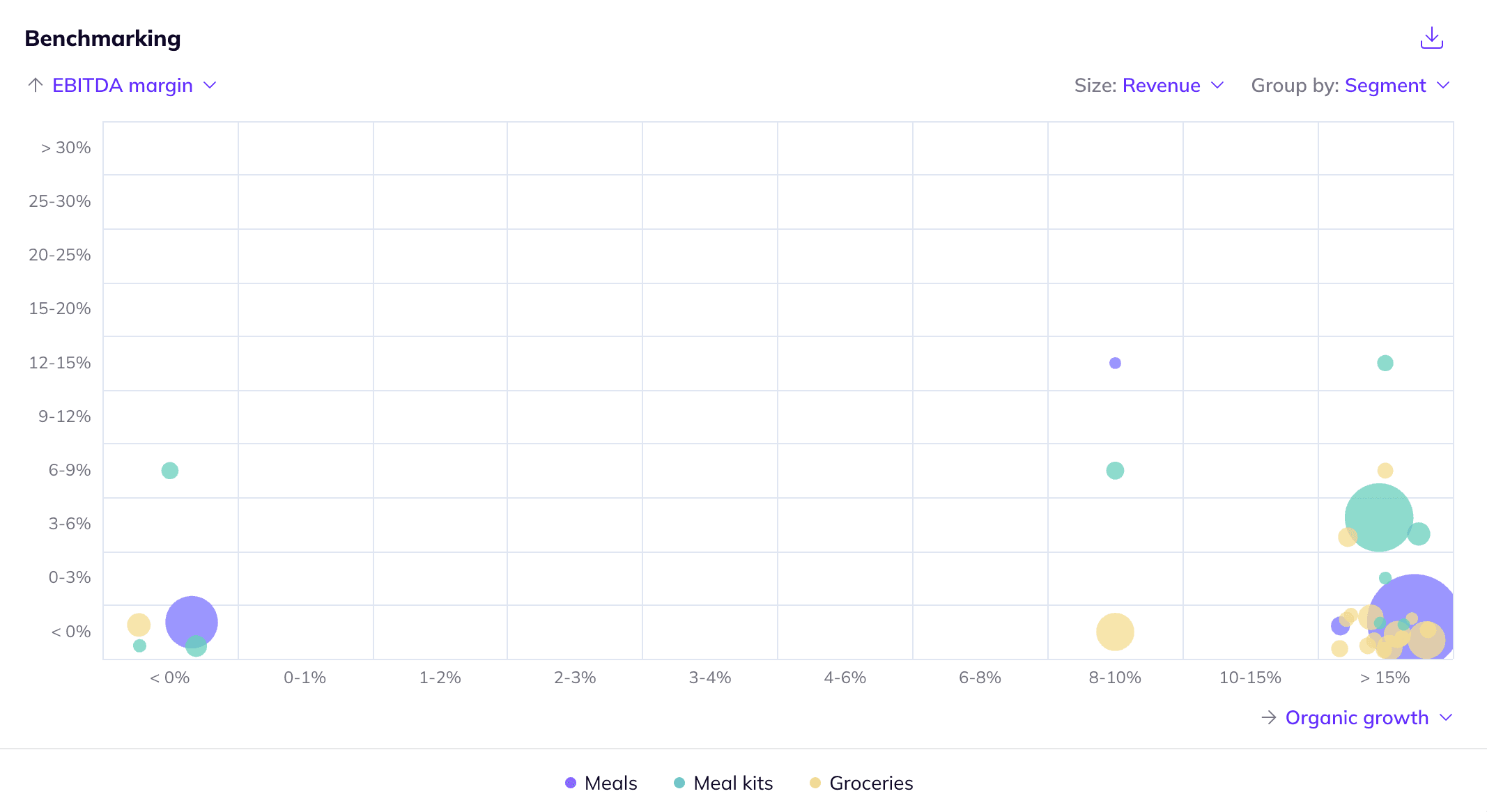
Company benchmarking
Market growth
The European online food delivery market is forecasted to grow from ~€159.0bn in size in 2026 to ~€208.2bn in 2031 (+5.5% CAGR 2026-2031; Statista, March 2026)
The global meal kit market is expected to grow from ~$20.6bn in revenue in 2025 to ~$38.2bn by 2030 (+13.2% CAGR 2025-2030; Technavio, March 2026)
Positive drivers
Persistent penetration of online food delivery services, on the back of a more digitally-affine society. This trend is further reinforced by Gen-Z's strong preference for convenience, ease of access and time savings that translate into significantly higher food ordering frequency (~6x vs. older cohorts), facilitating greater revenue expansion potential for online meal delivery platforms (interview by Gain; News Medical, April 2025; Deliverect, June 2024)
Growth in consumer demand for convenience is driving platforms to expand into multi-category delivery (e.g. pre-cooked meals, pharmacy products, pet food). This increases customer touchpoints and platform stickiness, particularly among high-frequency users, resulting in a higher average spend per customer (Deliveroo, April 2026; McKinsey & Company, April 2025)
The continued improvements in AI enable advanced personalisation that anticipates consumer preferences, purchase timing and underlying demand drivers, thereby enhancing engagement. In parallel, AI-driven routing and demand forecasting optimise last-mile delivery using real-time data (e.g. traffic, weather, order density), thereby lowering last-mile delivery costs (accounting for ~30–35% of total delivery expenses) and supporting margin expansion (Deloitte, March 2026; Oyelabs, December 2025; Medium, October 2025)
Negative drivers
The persistent cost-of-living crisis across Europe, driven by sustained inflation and high energy prices, is expected to curb food delivery spending, especially among price-sensitive consumers. At the same time, food providers are experiencing rising input costs and are therefore compelled to pass part of these increases on to consumers to remain financially viable, further reducing the attractiveness of discretionary spending in this category (interview by Gain; BBC, March 2026)
Regulatory risk surrounding couriers' employment status remains a key challenge for incumbents. As policymakers tighten platform work regulations, the potential reclassification of riders from freelancers to employees could materially increase labour costs (e.g. Delivery Hero Group), while non-compliant operators risk facing regulatory restrictions or even suspension of their operations in certain regions (e.g. Uber; CEPR, December 2025; NL Times, December 2025; Reuters, December 2024)
Weak unit economics remain a structural challenge, driven by elevated customer acquisition costs from heavy marketing spend and discounting, as well as limited delivery scalability. As a result, the combination of these dynamics with aggressive price competition among players will continue to weigh on incumbents' progress toward profitability (interview by Gain; Delivery Hero Group, April 2025)
Fill out the form to request your copy of the Online Food Delivery Services (EU) industry report
With the full report, you’ll gain access to:
Detailed assessments of the market outlook
Insights from c-suite industry executives
A clear overview of all active investors in the industry
An in-depth look into 42 private companies, incl. financials, ownership details and more.
A view on all 231 deals in the industry
ESG assessments with highlighted ESG outperformers
Discover hundreds of niche industry reports on Gain
Deep dive into additional industries to understand their market outlook, positive and negative drivers, and more!