

Industry research
Radiology services
Scope
Europe
Companies
95
Table of contents
Report collaborator:

Craig Abrahams, director at CIL provided expert insights for this report. He within CIL’s Healthcare & Life Sciences practice and supports clients across the healthcare sector with strategy, performance improvement, and commercial due diligence. Read the full interview transcript here
Key takeaways
What is the scope of this industry report?
The European market for radiology services comprises businesses that offer medical imaging services (e.g. CT, MRI and PET scans). These radiology services are provided by specialised radiology clinics and generalist healthcare providers.
Accordingly, we segmented the market into:
Radiology clinics,
Private hospitals,
Clinics.
What does the radiology services landscape look like in Europe?
The European radiology services market remains highly fragmented, largely driven by regulatory differences across countries (e.g. variations between private and publicly funded healthcare systems), which complicate cross-border expansion. As a result, investors typically prioritise domestic consolidation strategies, focusing on acquiring players and expanding their service offerings within individual markets. Consequently, only a limited number of pan-European players have successfully scaled across geographies, such as Fresenius Group in the private hospitals segment and Affidea in specialised radiology clinics, both of which continue to strengthen their positions through active M&A strategies. The sector is expected to undergo further consolidation in the medium term, driven by high CAPEX requirements and persistent structural labour shortages. In this context, larger platforms benefit from greater investment capacity to acquire advanced imaging equipment (e.g. MRI and PET scanners), which are increasingly equipped with AI-enabled functionalities that streamline workflows and partially alleviate workforce constraints.
What does the radiology services market landscape look like in Europe?
Sponsor-led interest has been significant, with ~56% of identified assets being investor-backed (April 2026).
Investors are primarily attracted by:
An ageing European population and the rising rate of chronic diseases,
Efficiency gains achieved by using AI in medical imaging diagnostics,
The sector's resilience paired with attractive profit margins (e.g. ~20% EBITDA margins) and stable cash flows.
On the other hand:
Structural labour shortages,
Lower radiology-related budget allocations from public healthcare authorities in Europe,
Increased regulatory scrutiny over AI usage within radiology services serve as key deterrents for investors.
What are the key ESG considerations in the European radiology services industry?
ESG topics primarily relate to environmental and social issues. From an environmental perspective, the energy intensity of radiology equipment remains a key concern, with a single MRI machine consuming energy equivalent to that of ~16-34 four-person households annually. To mitigate this, incumbents invest in modern, energy-efficient machinery and integrate renewable energy sources (e.g. on-site solar energy production). From a social perspective, the main challenges relate to reducing waiting times for diagnostic imaging, minimising radiation exposure for both patients and healthcare professionals and improving diagnostic accuracy. The latter is particularly important given that ~3-5% of imaging results may contain errors.
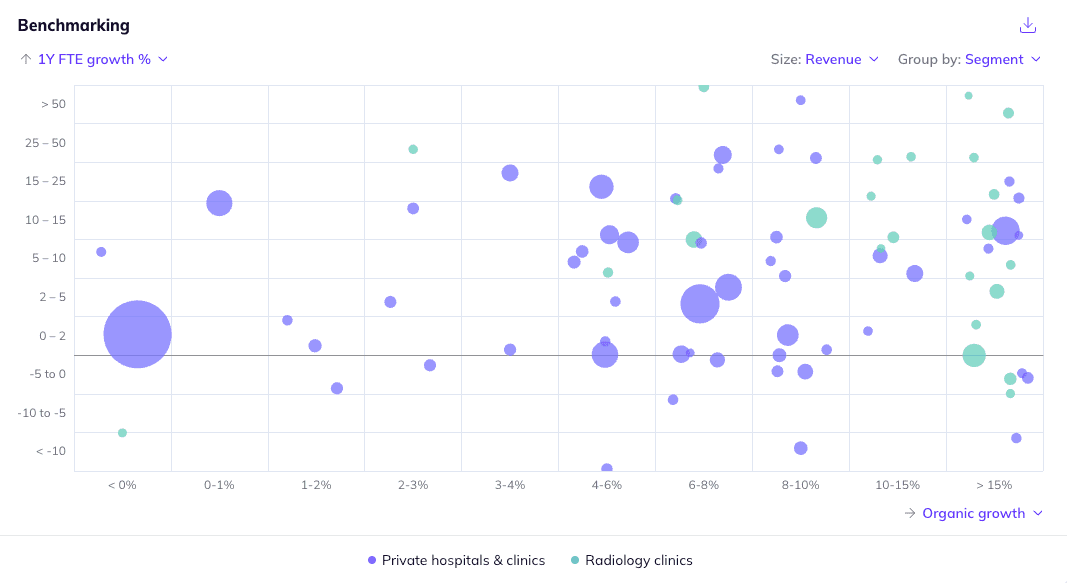
Company benchmarking
Market growth
The European diagnostic imaging market is forecasted to grow from ~$8.5bn in size in 2023 to ~$11.3bn in 2028 (+5.5% CAGR 2023-2028; Technavio, December 2024)
The European outpatient care market is expected to grow from ~€203.7bn in revenue in 2026 to ~€260.2bn in 2030 (+6.3% CAGR 2026-2030; Statista, August 2025)
Positive drivers
Europe's rapidly ageing population is expected to drive sustained demand for radiology services. With ~20% of citizens aged >65 and the share of those aged >80 projected to increase from ~6% in 2024 to ~15% by 2100, the prevalence of chronic conditions is set to rise, supporting increased demand for radiology scans in the long term (CIL expert interview; EuroNews, February 2025; EMJ, April 2024
Rising medical imaging backlogs across Europe are accelerating the shift from public services to private clinics. For example, >1.6m patients were awaiting tests in the UK in 2024. To reduce waiting times, governments are expected to increasingly outsource diagnostic capacity, supporting structural demand for private operators (CIL expert interview, Alvarez & Marsal, November 2024)
AI-driven diagnostic imaging is expected to improve operating models and profitability. By enhancing image interpretation, automating routine tasks (e.g. triage and reporting) and streamlining workflows, AI enables providers to increase throughput and asset utilisation without a proportional increase in staffing, resulting in margin expansion for incumbents (PubMed Central, April 2025; World Health Expo, October 2024)
Negative drivers
Structural workforce shortages among radiologists across Europe are expected to worsen, with >45% of current practitioners projected to retire within the next decade. As a result, radiology service providers are likely to face capacity constraints, limiting their ability to meet growing demand for imaging tests and ultimately constraining top-line growth (CIL expert interview; Azmed, June 2025)
The growing public finance constraints across Europe are increasing pricing pressure on imaging diagnostic test tariffs negotiated with public healthcare providers, with some countries already implementing cost-containment measures (e.g. France cutting radiology spending). As a result, identified players are likely to face operational challenges and pressure on profitability (IMAP, April 2026; AuntMinnie, November 2025)
Increasing regulatory scrutiny (e.g. the EU AI Act) is expected to raise compliance requirements for AI-based radiology tools, as many applications are classified as high-risk and subject to obligations regarding risk management, data governance and human oversight. This heightens regulatory and legal risks (e.g. misdiagnosis, data breaches), which may translate into higher liability exposure and compliance costs and ultimately pressure margins (Deepc, July 2025)
Fill out the form to request your copy of the Radiology services industry report
With the full report, you’ll gain access to:
Detailed assessments of the market outlook
Insights from c-suite industry executives
A clear overview of all active investors in the industry
An in-depth look into 95 private companies, incl. financials, ownership details and more.
A view on all 625 deals in the industry
ESG assessments with highlighted ESG outperformers
Discover hundreds of niche industry reports on Gain
Deep dive into additional industries to understand their market outlook, positive and negative drivers, and more!