
Industry research
EV Charging EU
Scope
Europe
Companies
84
Key takeaways
What is the scope of this industry report?
The European EV charging market comprises businesses engaged in the development, production, installation and/or operation of hardware and software for electric vehicle (EV) charging.
We segmented the market along the value chain into:
Charger producers,
Charge point operators,
Smart charging platforms.
What does the EV Charging landscape look like in Europe?
The European market is fragmented across subsegments. In particular, the landscape for charger producers and charge point operators (“CPOs”) is characterised by the presence of national leaders, large industrial, utility and oil companies with specialist EV divisions, as well as a long tail of regional specialists. These segments are expected to undergo consolidation in the coming years as larger competitors absorb smaller players. Reasons include limited financial capacity to achieve scale and develop commercially viable business models, as well as new regulations requiring significant investments (e.g. software to improve cybersecurity), thereby increasing entry barriers. Furthermore, the smart charging platforms segment faces competitive threats from players seeking to vertically integrate (e.g. CPOs, charger producers). Still, pure players can retain their competitive profile by developing compatibility with various types of hardware.
What does the EV Charging market landscape look like in Europe?
Investor-led interest has been strong, with ~84% of identified assets being sponsor-backed (as of May 2026).
This interest is mainly driven by:
A growing number of EVs across Europe,
A favourable EU and local regulatory framework fostering the transition to EV mobility
Extra revenue generation and margin expansion opportunities for charging station operators.
On the other hand,
Continuous grid access problems leading to energy capacity constraints and capped scalability,
Increasing product commoditisation on the back of Chinese competitive pressure,
Slow local government tender application approvals serve as detractors for investors.
What are the key ESG considerations in the European EV Charging industry?
ESG topics in the EV charging market primarily relate to environmental and social issues. Environmentally, players face rising electricity demand as EV adoption increases across Europe, driving efforts to rely fully on renewable energy sources. In parallel, incumbents aim to reduce value-chain emissions from charging hardware manufacturing and transport by increasing product recyclability and adopting carbon-neutral operations. Socially, EV charging infrastructure increasingly faces cybersecurity risks as it becomes part of the EU’s critical infrastructure. As a result, operators must continue to invest in cybersecurity to prevent system outages, grid disruptions and consumer data theft.
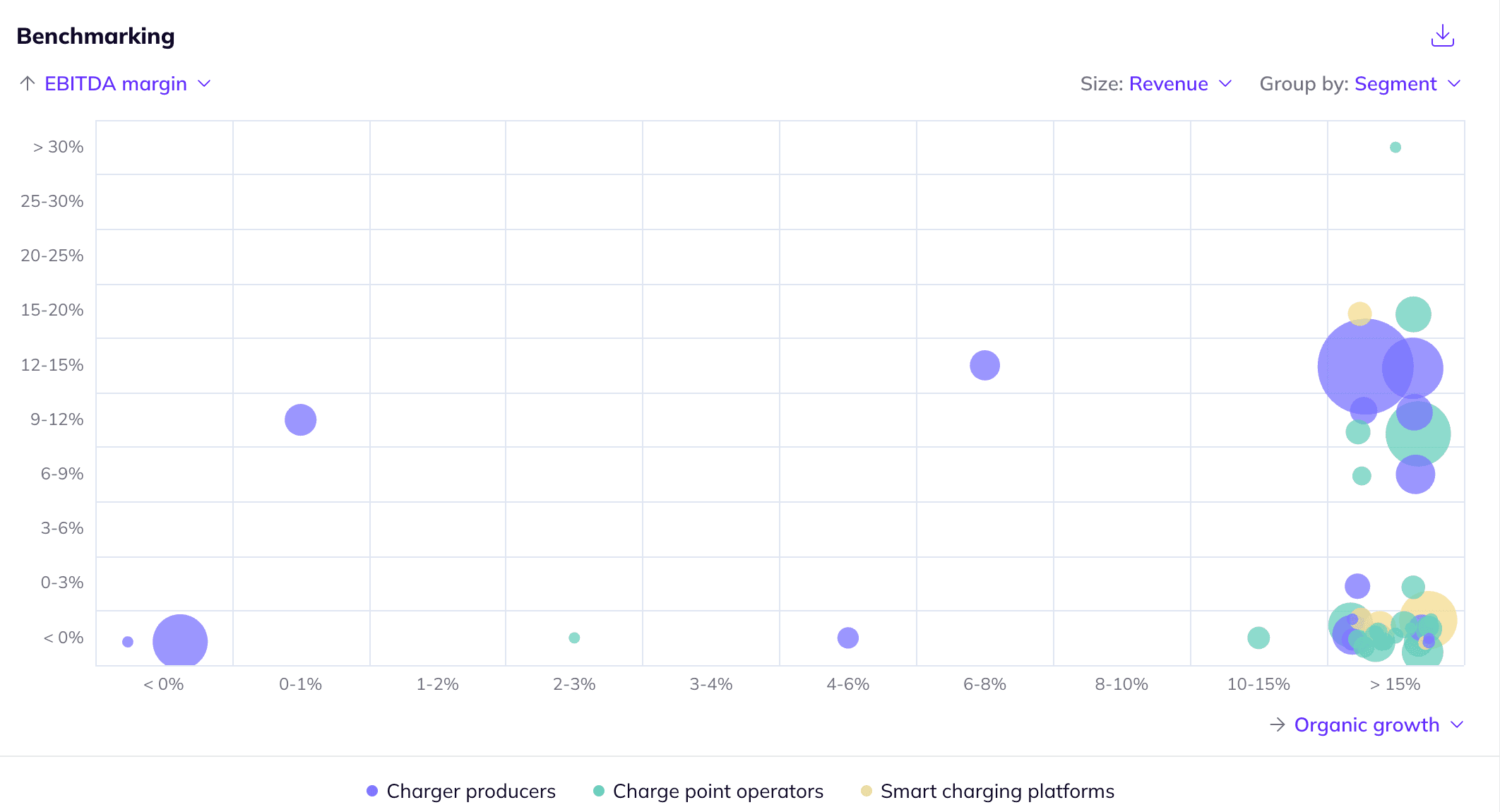
Company benchmarking
Market growth
The number of EV charging points in the EU reached ~10.5m in 2025 and was projected to grow to ~47.3m by 2035, registering a +16.2% CAGR for the period (ChargeUp Europe, May 2025)
Industry executives estimate that the European EV charging market will grow at a ~30-40% CAGR in the short term. Charger-wise, the highest growth rates will be recorded in the DC vertical, while Southern Europe and CEE are expected to be the most attractive growth regions (interviews by Gain)
Positive drivers
Accelerating EV adoption requires charging capacity and infrastructure, fostered by both supply-side (e.g. BMW expecting ~50% of its car sales to be electric by 2030) and demand-side drivers (e.g. a rising preference for EVs amid geopolitical fuel price spikes). Europe’s new energy vehicle penetration rate is projected to rise to ~67% by 2030 (up from ~12% in 2021), surpassing both China and the US (interviews by Gain; Reuters, April 2026; Motor1, March 2026; Eleport, January 2026; Citi, January 2023)
Favourable regulatory measures are accelerating the rollout of EV charging infrastructure across Europe, including the EU’s Alternative Fuels Infrastructure Regulation ("AFIR"), which sets binding targets for charging network expansion. At the same time, national governments are also supporting EV charging deployment through funding programmes (e.g. France’s ~€330m public charging subsidies; interviews by Gain; Eleport, January 2026; Fraunhofer ISI, October 2025; Rabobank, September 2025)
Growth opportunities for CPOs stemming from additional revenue streams, including (i) monetising advertisement across stations (e.g. via LED screens), (ii) carbon credit trading (backed by the EU’s RED III scheme), (iii) turning CPOs into virtual power plants ("VPPs") and (iv) the rollout of higher-margin fast and ultra-fast charging infrastructure with higher vehicle throughput and improved asset utilisation (JOLT ENERGY, March 2026; RetailSonar, January 2026; Huawei, January 2026; EnBW New Ventures, September 2025; Rabobank, September 2025)
Negative drivers
Rising and prevailing grid access issues represent the main growth constraint for European CPOs. For example, the city of Utrecht (NL) stopped all new connections to its power grid, citing limited ability to cope with increasing electricity demand. This leads to energy capacity constraints and minimal or moderate scalability opportunities, acting as core EV charging bottlenecks in the mid-term (NL Times, April 2026; Eleport, January 2026; Business Wire, May 2025; Driivz, May 2025)
Increasing commoditisation, paired with strong competitive pressure from China, leads to price drops for both hardware and software producers. To illustrate, the prices of ultra-fast chargers have fallen by ~20% between 2022-2024. China is responsible for ~80% of global growth in these product categories and remains the main “global pricing anchor” in the EV market (interviews by Gain; Medium, March 2026; IEA, May 2025)
Regulatory fragmentation across Europe, combined with permitting delays at the local government level responsible for implementing EV infrastructure rollout plans. Industry experts foresee project waiting times to further increase, with tender applications being processed at an increasingly slower rate aside from frequent permit and subsidy delays, curbing growth potential for incumbents (interview by Gain)
Fill out the form to request your copy of the EV Charging EU industry report
With the full report, you’ll gain access to:
Detailed assessments of the market outlook
Insights from c-suite industry executives
A clear overview of all active investors in the industry
An in-depth look into 84 private companies, incl. financials, ownership details and more.
A view on all 248 deals in the industry
ESG assessments with highlighted ESG outperformers
Discover hundreds of niche industry reports on Gain
Deep dive into additional industries to understand their market outlook, positive and negative drivers, and more!