

Industry research
Marketplaces
Scope
US
Companies
71
Key takeaways
What is the scope of this industry report?
The US marketplaces industry includes companies that operate digital platforms connecting buyers and sellers, suppliers and customers or service providers and users. The industry includes B2B marketplaces focused on procurement and supplier access, automotive marketplaces supporting vehicle sales and rental, as well as real estate marketplaces enabling property sales and rental. As such, this is focused on vertical or workflow-led marketplaces and does not include pure-play B2C consumer product marketplaces or broad generalist marketplaces.
Accordingly, we segmented the market into:
B2B commercial,
Automotive,
Real estate.
What does the marketplaces landscape look like in the US?
The industry structure varies by segment, reflecting differences in buyer behavior, transaction complexity and workflow depth. B2B marketplaces are split across broad procurement platforms(e.g. Faire) and vertical-specific marketplaces (e.g. Xometry), as business purchasing varies by category, buyer type and workflow. Automotive marketplaces are fragmented, with platforms split across dealer-facing demand-generation platforms that connect car buyers with dealer inventory, software platforms that support online retail and wholesale platforms that help dealers source and sell used-vehicle inventory. . Real estate marketplaces are concentrated among scaled property-search platforms (e.g. Zillow), while specialist platforms (e.g. Crexi) compete in narrower asset classes or transaction types. Across segments, scaled players differentiate through audience reach, proprietary data and embedded tools that help buyers search, finance or transact while helping sellers generate and manage demand. As such, scale remains important because deeper inventory attracts more buyers, which draws more sellers and advertisers and strengthens the platform’s ability to improve discovery, pricing and conversion. By contrast, specialist marketplaces compete in narrower use cases, where transaction trust, category-specific supplier networks, technical purchasing requirements or asset-class expertise create defensible positions. M&A and funding activity remain focused on expanding beyond marketplace discovery into adjacent transactions, financing, logistics and workflow tools that help platforms capture more value before and after buyer-seller matching.
What does the marketplaces market landscape look like in the US?
Sponsor-led interest remains high, with ~60% of identified assets being investor-backed (as of May 2026).
Herein, sponsors are attracted by:
B2B digital procurement adoption, which supports B2B marketplaces that reduce supplier discovery and sourcing friction,
Agentic AI adoption in procurement, which could expand the role of B2B marketplaces in supplier discovery, RFQ creation and quote comparison,
Tariff-driven new-vehicle price pressure, which is likely to shift demand toward used vehicles and support automotive marketplace traffic.
Deterring factors primarily relate to:
Weak housing affordability, which constrains real estate marketplace conversion,
Continued reliance on in-person vehicle evaluation, which limits full transaction capture in automotive marketplaces,
Rising scrutiny of data use, targeted advertising and lead-generation practices, which raise compliance costs.
What are the key ESG considerations in the marketplaces industry?
ESG considerations primarily relate to social and governance factors. From a social standpoint, marketplaces can face unequal-access risks when platform rules, ranking algorithms or service thresholds limit how certain users access listings, advertising or support. They can also face platform trust risks when fake reviews, misleading listings or unreliable seller information influence buyer decisions. To address this, players use listing review processes, discriminatory-content checks, AI safeguards, review moderation and seller verification tools to reduce biased access, misleading content and low-quality marketplace interactions. On the governance side, marketplaces face cybersecurity and data privacy risks because platforms process user, seller, supplier and transaction data. To mitigate this, incumbents implement encryption, restricted-access controls, secure hosting environments and vulnerability disclosure processes to reduce unauthorized access and data misuse.
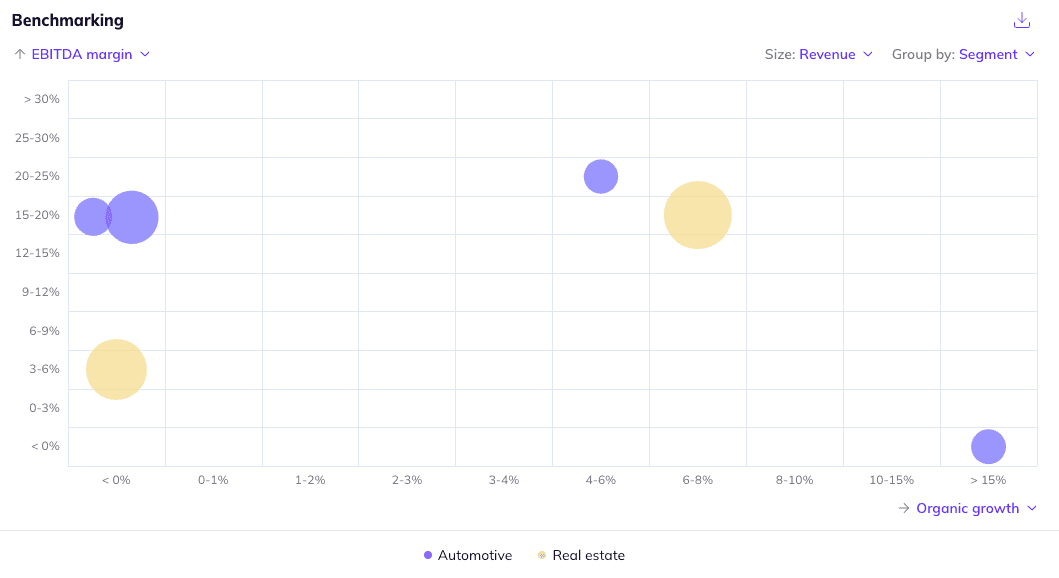
Company benchmarking
Market growth
The global automotive e-commerce market is expected to grow from ~$100.5bn in 2024 to ~$266.2bn in 2029 (+21.5% CAGR 2024-2029; Technavio, June 2025)
US B2B e-commerce gross merchandise value (GMV) is expected to grow from to grow from $10.1tn in 2025 to $11.4tn in 2030 (+2.5% CAGR 2025-2030; Capital One, July 2025)
Positive drivers
Digital procurement adoption in the US is expected to increase demand for B2B marketplaces, as enterprise and SMB buyers seek broader supplier access, pricing transparency and more efficient sourcing workflows. Marketplaces are well-positioned to capture this shift by aggregating fragmented supplier bases, standardizing product discovery and embedding procurement workflows that reduce manual vendor search, quote comparison and repeat-order friction (Coax Software, November 2025; BCG, June 2024)
Adoption of agentic AI in procurement is expected to support B2B marketplace demand, as US buyers seek to automate supplier discovery, RFQ creation and quote comparison across fragmented vendor bases. Marketplaces with structured supplier data, pricing intelligence and procurement workflow integrations are well-positioned to capture this shift by moving from product discovery toward more automated sourcing and purchasing workflows (Deloitte, May 2026; The Hackett Group, July 2025)
Higher new-vehicle prices from tariffs are expected to shift some price-sensitive US buyers toward used vehicles, supporting traffic and lead activity for automotive marketplaces. Tariff-driven cost pressure on new vehicles is likely to increase used-vehicle consideration and comparison activity, benefiting platforms that aggregate dealer inventory, pricing data and vehicle availability (Cox Automotive, July 2025; Reuters, April 2025)
Negative drivers
Elevated mortgage rates and home prices are expected to continue constraining real estate marketplace conversion. Affordability pressure is likely to keep many buyers on the sidelines or extend search timelines, reducing purchase decisions, transaction volumes and the value of paid leads for agents, brokers and listing platforms and marketplaces (Reuters, May 2026)
Consumer preference for in-person vehicle evaluation is expected to limit full transaction capture by automotive marketplaces in the US. Since buyers continue to rely on physical inspection, test drives, negotiation and dealer-led finalization for key purchase steps, marketplaces are likely to remain more exposed to lead generation, dealer advertising and subscription revenue than direct transaction monetization (Cox Automotive, January 2026; CarGurus, December 2025)
Greater scrutiny of data use, targeted advertising and lead-generation practices is expected to raise compliance costs for US marketplace operators. Platforms that monetize sponsored placements, customer leads, pricing tools or seller-ranking products may need stronger consent, disclosure, data governance and monitoring processes, reducing flexibility in how they convert buyer-intent data into advertising and lead-generation revenue (DLA Piper, March 2026; Covington & Burling, August 2025)
Fill out the form to request your copy of the Marketplaces industry report
With the full report, you’ll gain access to:
Detailed assessments of the market outlook
Insights from c-suite industry executives
A clear overview of all active investors in the industry
An in-depth look into 71 private companies, incl. financials, ownership details and more.
A view on all 347 deals in the industry
ESG assessments with highlighted ESG outperformers
Discover hundreds of niche industry reports on Gain
Deep dive into additional industries to understand their market outlook, positive and negative drivers, and more!