
Industry research
Event and Exhibition Management
Scope
Europe
Companies
90
Table of contents
Report collaborator:

Max Kneissl and Ilya Erokhin, Partners at OMMAX provided expert insights for this report. Read the full interview here
Key takeaways
What is the scope of this industry report?
The European event and exhibition management market comprises players that organise, execute and provide logistics services for trade shows, conferences, expos, conventions and other gatherings across various industries. As such, we segmented the European market by the nature of players’ business models into: (i) venue operators, (ii) event managers, (iii) logistics and (iv) integrated service providers.
What does the Event and Exhibition Management landscape look like in Europe?
The European event and exhibition management market varies significantly in terms of fragmentation across segments. Specifically, venue operators and event managers operate in a highly fragmented market, as these players are typically anchored to specific locations (e.g. the venues they manage) and shaped by local demand characteristics, with event formats often proving difficult to replicate across countries. By contrast, the market for logistics providers is relatively concentrated, largely reflecting scale advantages that favour the emergence of large multinational players. Finally, while international scaling remains challenging for event managers, developing a strong brand equity is widely regarded as a critical enabler for overcoming geographic barriers.
What is the level of investor activity in Europe's Event and Exhibition Management industry?
Sponsor-led interest has been moderate, with ~49% of identified assets being backed by financial sponsors (February 2026). This is primarily driven by the strong cash flows and high revenue visibility from forward event bookings, paired with a growing demand for sport-related events and increased customer reach from the rise of hybrid events (due to no geographical barriers). Conversely, weaker corporate demand, driven by elevated transport costs and carbon-emission considerations, together with rising operating expenses (e.g. stricter security requirements) and lower consumer willingness to pay for leisure events amid higher living costs across Europe, represent key deterrents for investors.
What are the key ESG considerations in Europe's Event and Exhibition Management industry?
ESG issues primarily relate to environmental and social topics. Environmentally, the key concern is the emissions generated by transporting attendees and equipment to event venues, which are estimated to account for ~87% of the total emissions of the event and exhibition management industry. From a social perspective, issues concern ensuring the safety of crowds and employees (e.g. mitigating weather-related risks during events) and supporting social institutions, such as donating surplus food from events to charitable organisations.
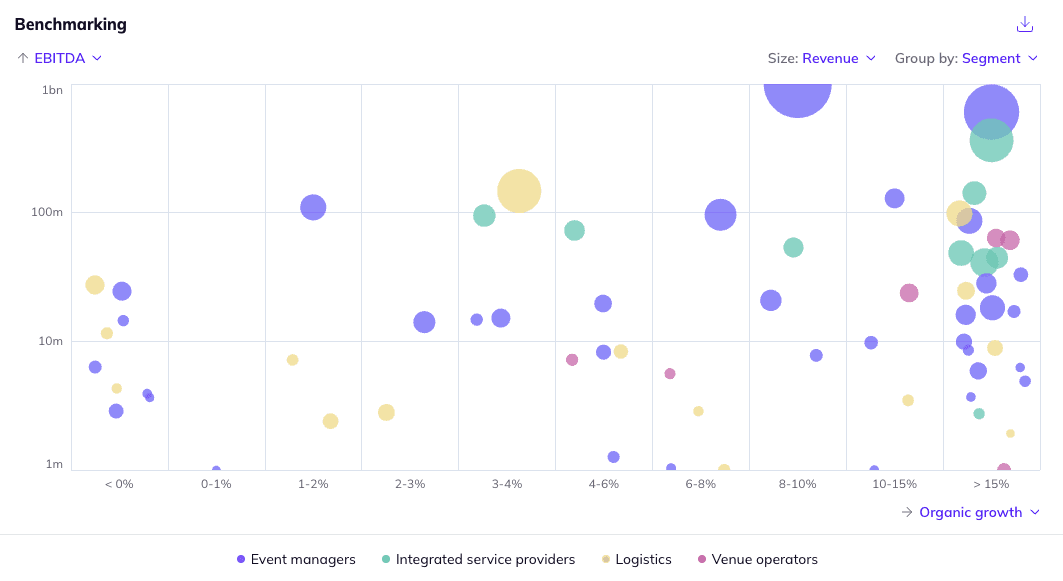
Company benchmarking
Market growth
The global exhibition organising market was valued at ~$28.6bn in 2024 and is expected to reach ~$37.6bn by 2029 (+5.6% CAGR; Technavio, March 2025)
In 2024, ~32k corporate exhibitions were held globally, which were attended by ~4.7m exhibiting companies and ~318m visitors (UFI, May 2025)
Positive drivers
The emergence of alternative event structures, such as community-led initiatives and indoor mass-participation concepts (e.g. fitness events in RAI Amsterdam) expands the overall addressable market for incumbents. The greater frequency of events, often organised across various European cities, also provides greater revenue potential for identified players (RAI Amsterdam, December 2025; Sport Tourism News, January 2026)
The hybrid events are set for further growth across Europe. By lowering geographical barriers and improving digital analytics, hybrid formats can expand attendance and reduce selected operational costs, supporting profitability for event organisers (Eventtia, January 2025)
Europe’s leading position in large-scale event venues, together with its long-standing heritage in corporate events and industrial trade fairs, is expected to prevail. Moreover, as Europe moves toward reindustrialisation amid deglobalisation trends, corporate trade fairs are increasingly being incentivised to be hosted within the region, supporting strong demand for corporate event managers (OMMAX expert interview; European Commission, October 2025)
Negative drivers
Event organisers across Europe face rising operating costs, driven in part by heightened security requirements (e.g. dedicated security zones, metal detectors). At the same time, the industry faces structural labour shortages. Together, these factors put pressure on profit margins for European incumbents (Skift Meetings, September 2024; Event Industry News, December 2025)
The substantial carbon footprint associated with long-distance travel forces large corporates and SMEs to reassess their live event participation in order to reduce CO₂ emissions. This structural shift is expected to curb demand for fully physical trade fairs (Global Switzerland Enterprise, May 2024)
Client acquisition becomes more difficult and expensive as prospects explore alternative methods to promote their businesses (e.g. D2C channels). Moreover, leisure event audiences are more price-sensitive amid the cost-of-living crisis. These dynamics are set to reduce pricing power and profitability for both leisure and corporate event organisers (interview by Gain; Exhibitor, January 2024)
Fill out the form to request your copy of the Event and Exhibition Management industry report
With the full report, you’ll gain access to:
Detailed assessments of the market outlook
Insights from c-suite industry executives
A clear overview of all active investors in the industry
An in-depth look into 90 private companies, incl. financials, ownership details and more.
A view on all 543 deals in the industry
ESG assessments with highlighted ESG outperformers
Discover hundreds of niche industry reports on Gain
Deep dive into additional industries to understand their market outlook, positive and negative drivers, and more!