
Industry research
DIY retail
Scope
US
Companies
62
Key takeaways
What is the scope of this industry report?
The US do-it-yourself (DIY) retail market comprises companies that distribute home improvement, repair, construction and gardening products through brick-and-mortar stores, branch-based formats and online channels. These players serve a mix of professional contractors and DIY consumers across use cases and project types, including large-scale renovations, preventative maintenance, seasonal upkeep cycles and small-scale trade fulfillment. Accordingly, we segment the US market into: (i) building materials, (ii) gardening and (iii) generalists.
What does the DIY retail market landscape look like in the US?
The US DIY retail industry is anchored by the concentrated generalist segment, led by a small number of national big box platforms (e.g. The Home Depot, Lowe’s) that leverage broad assortments on the back of centralized merchandising and fulfillment to support both DIY and professional use cases. These players operate at scale, competing with regional and cooperative formats on convenience and localized service, while responding to digital-first competition through expanded online engagement. By contrast, the remainder of the market is structurally fragmented across the building materials and gardening segments, with distinct degrees of specialization. Herein, building materials retail combines a limited number of national and multi-regional distributors (e.g. ABC Supply) with a long tail of local and specialty operators (e.g. Curtis Lumber), where scale advantages are driven by branch density and captive job-site logistics rather than consumer footfall. Similarly, the gardening segment is locally anchored and execution-sensitive, with performance shaped by seasonality and live-goods perishability, leading regional specialists (e.g. Mahoney’s Garden Centers) to differentiate through service-led support rather than footprint scale.
What is the level of investor activity in the US's DIY retail industry?
Sponsor-led interest remains limited, with ~11% of identified assets being investor-backed (February 2026). Herein, financial sponsors are primarily attracted to (i) structurally resilient repair and maintenance demand supported by an aging US housing inventory, (ii) skilled trade labor shortages that shift smaller projects toward homeowner self-execution and sustain DIY penetration, as well as (iii) rising e-commerce and omnichannel adoption that improve margins and increase average basket values. Conversely, key detractors include (i) ongoing input cost volatility in price-transparent categories that constrain margin recovery, (ii) rising preference for do-it-for-me execution in complex and design-led projects that cap DIY penetration, as well as (iii) low revenue visibility from primarily transactional sales.
What are the key ESG considerations in the US's DIY retail industry?
ESG topics relate to environmental and social issues. Herein, environmental risks arise from the carbon intensity of construction materials, packaging waste and high electricity consumption across large-format stores, yards and distribution facilities. To address this, identified players emphasize responsible sourcing of materials, packaging redesigns and energy-efficiency initiatives such as LED retrofits, HVAC upgrades and the selective adoption of renewable electricity. Social risks are driven by labor-intensive operations involving heavy goods handling, equipment use and customer interaction, which elevate workplace safety exposure, as well as customer injury risk linked to complex DIY tasks and tool use. In response, players focus on standardized safety training, operating protocols and monitoring systems, alongside simplified customer guidance and instructional content, to reduce incidents and improve safety outcomes for both employees and DIY consumers.
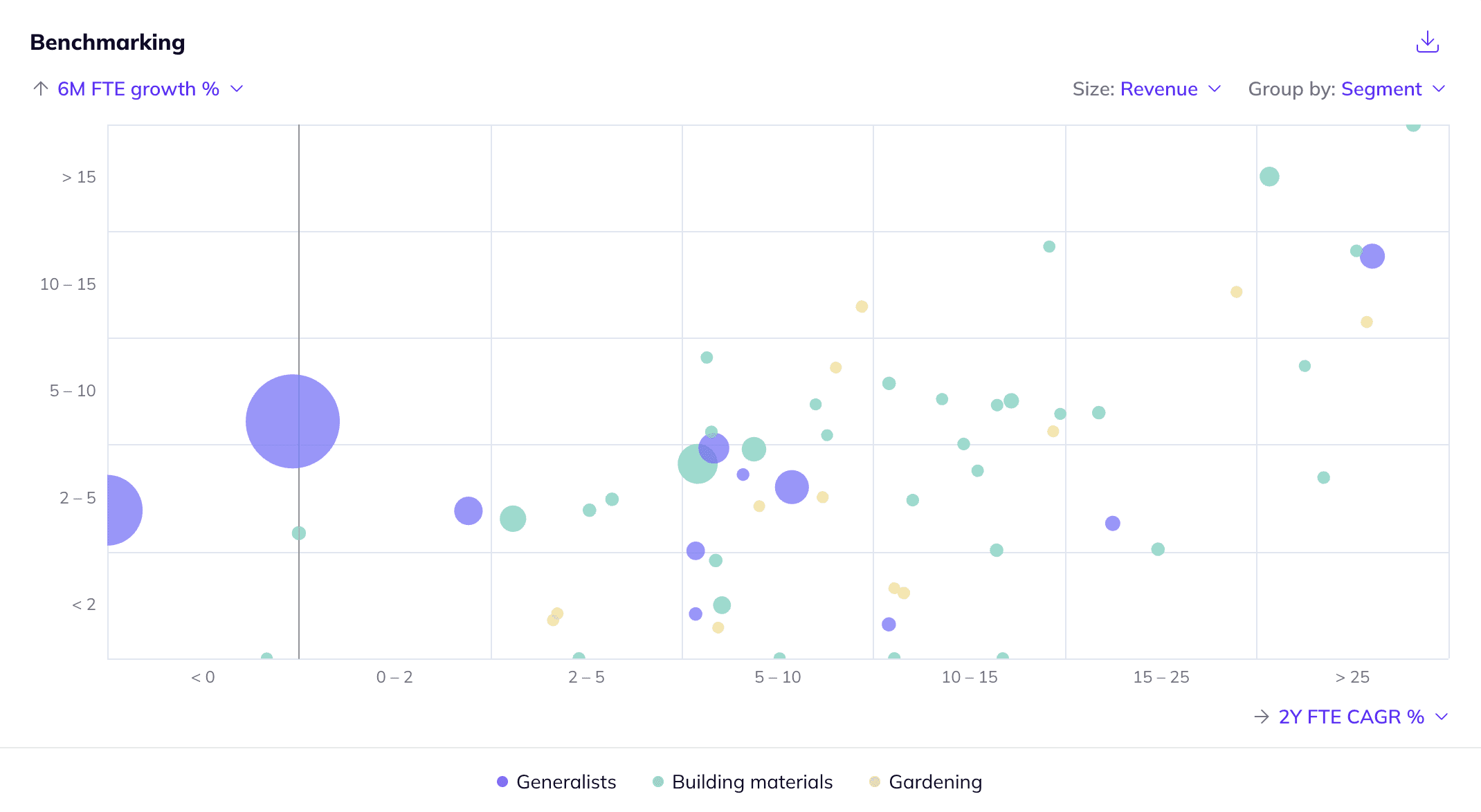
Company benchmarking
Market growth
According to Statista (February 2026), US DIY sales were valued at ~$526.1bn in 2024 and are expected to grow to ~$589.3bn by 2028 (+2.9% CAGR 2024–2028)
Technavio (May 2025) estimates that the global garden and lawn tools market generated ~$24.7bn in revenue in 2024 and forecasts it to reach ~$27.8bn by 2029 (+2.4% CAGR 2024–2029)
Positive drivers
Maturing US housing inventory, with the rising need to replace core systems and finishes, creates a structural tailwind for identified DIY retailers. This aging trend ensures consistent, replacement-led demand that is less sensitive to broader economic volatility (The Farnsworth Group, April 2025)
Scarcity of skilled tradespeople is limiting contractor availability and driving up service premiums. These structural labor constraints are pushing homeowners to tackle smaller repairs and upgrades themselves. To illustrate, industry estimates indicate the sector must attract ~349k net new workers in 2026 and ~456k in 2027 to meet demand, reinforcing DIY substitution for routine maintenance and light renovation work (ABC, January 2026)
Rising e-commerce adoption expands addressable demand by enabling customers to plan projects online, build multi-item baskets and coordinate fulfillment for bulky and heavy items that still rely on physical stores. To illustrate, US e-commerce is projected to account for ~29% of total retail sales by 2030 (vs ~16.4% in 2025), reinforcing investment in click-and-collect and ship-to-home workflows that support full project purchases rather than single SKUs (Forrester, January 2026)
Negative drivers
Ongoing volatility from tariffs and supplier repricing is expected to compress margins within price-sensitive DIY segments. This pressure is exacerbated by a pricing lag, in which retail adjustments fail to keep pace with rising input costs and the slow pace of inventory resets. Trade policy uncertainty reinforces this risk, as recent US actions to escalate steel and aluminum tariffs to ~50% increase the likelihood of recurring landed-cost inflation for metal-heavy products (Global Tax News, June 2025)
Omnichannel fulfillment continues to raise return volumes and reverse-logistics complexity for bulky and high-value DIY items, which increases freight, labor and markdown costs while slowing inventory recirculation over the coming years. To illustrate, National Retail Federation (NRF) data show returns accounted for ~17% of US retail sales in 2024, reinforcing that elevated return rates constrain margin recovery and inventory efficiency as online and ship-to-home channels remain integral to the DIY purchasing journey (NRF, December 2024)
Persistent stagnation in home turnover weakens a key source of project demand tied to new occupancy, as reduced mobility limits purchase-linked renovation activity. To illustrate, JP Morgan forecasts existing home sales to recover only marginally from 30-year lows in 2026, thereby reducing the customary uplift in finishes and fixture demand associated with ownership transitions (JP Morgan, January 2026)
Fill out the form to request your copy of the DIY retail industry report
With the full report, you’ll gain access to:
Detailed assessments of the market outlook
Insights from c-suite industry executives
A clear overview of all active investors in the industry
An in-depth look into 62 private companies, incl. financials, ownership details and more.
A view on all 163 deals in the industry
ESG assessments with highlighted ESG outperformers
Discover hundreds of niche industry reports on Gain
Deep dive into additional industries to understand their market outlook, positive and negative drivers, and more!