
Industry research
Blockchain technology
Scope
US
Companies
73
Key takeaways
What is the scope of this industry report?
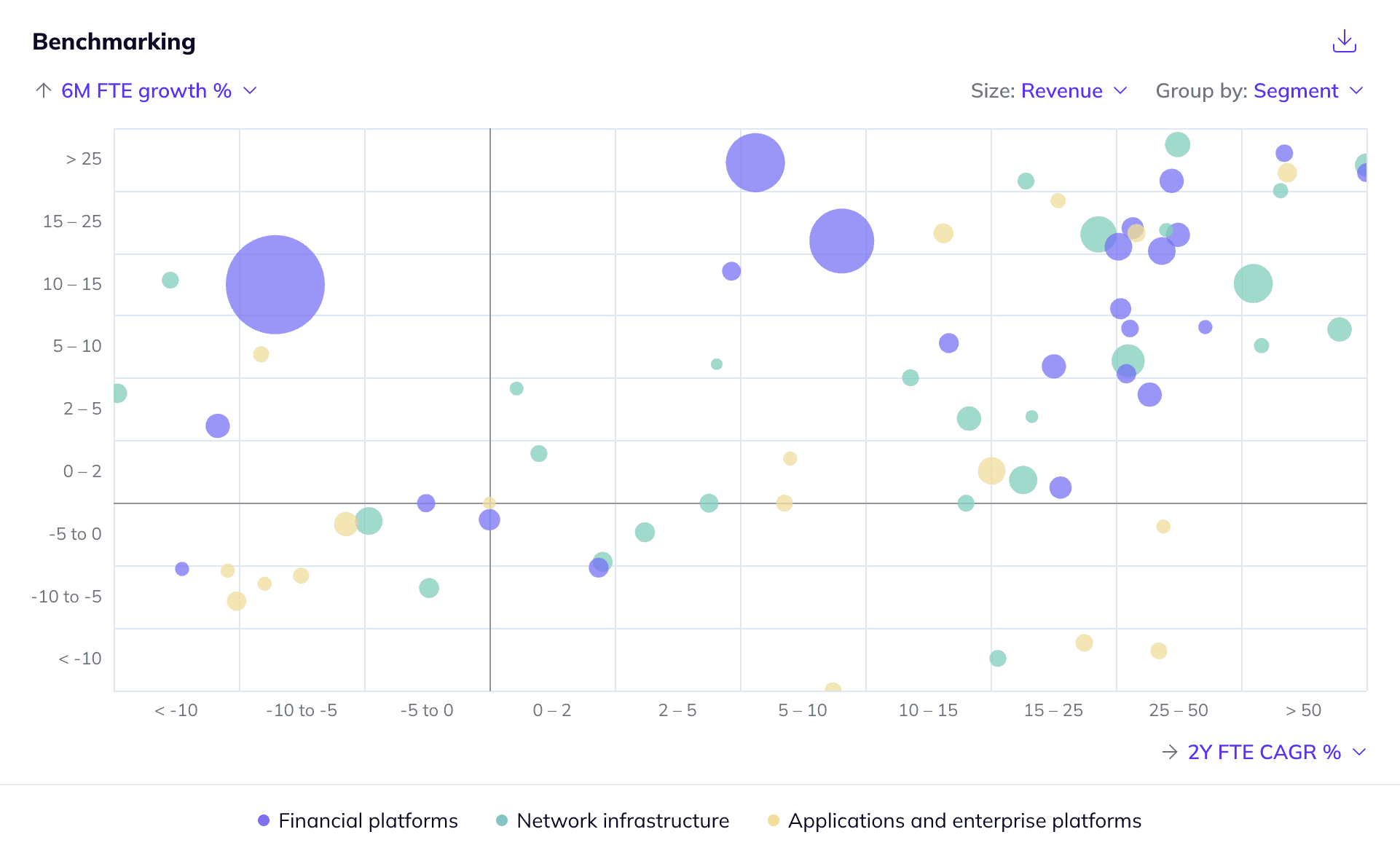
The US blockchain technology industry comprises businesses that develop and operate digital infrastructure, financial platforms and application-layer systems that enable the creation, exchange and utilization of digital assets across decentralized networks. Operators provide core network infrastructure, trading and custody platforms, as well as analytics, enterprise software and application-layer services that support a wide range of use cases. Service delivery is typically organized across distinct layers of the ecosystem, with infrastructure providers enabling network functionality, financial platforms facilitating market access and asset movement and application-layer platforms delivering end-user functionality and data-driven insights. Accordingly, we segmented the market into: (i) network infrastructure, (ii) financial platforms and (iii) applications & enterprise platforms.
What does the Blockchain technology landscape look like in US?
The industry exhibits varying levels of consolidation, core blockchain activity is concentrated among a limited number of dominant protocol developers and large trading platforms, while the broader infrastructure layer (e.g. node operators, validators) and application-layer businesses operate across more specialized and vertical-specific niches. Large players typically differentiate through scale, regulatory positioning and integrated product ecosystems that combine multiple services across the value chain. By contrast, smaller and emerging operators focus on niche positioning, developer tooling, analytics capabilities or embedded infrastructure that support specific workflows and user segments. Across segments, operators have increasingly adopted multi-chain architectures, API-driven infrastructure and data analytics capabilities to improve scalability, interoperability and customer engagement. At the same time, consolidation activity persists as platforms pursue acquisitions to expand product breadth, acquire regulatory licenses and strengthen institutional capabilities. VC investment activity is relatively high in the data, applications & enterprise platforms segment, reflecting the segment's early-stage, innovation-led nature.
What does the Blockchain technology market landscape look like in US?
Sponsor-led interest has been significant, with ~78% of assets being sponsor-backed (March 2026). Herein, sponsors are attracted to (i) improving regulatory clarity in the US, (ii) increasing institutional adoption of digital assets across trading, custody and asset management and (iii) expanding real-world use cases driven by stablecoin adoption and blockchain-based payment and settlement systems. Deterring factors for investment mainly relate to (i) ongoing fragmentation across blockchain networks and lack of standardized infrastructure, which increases integration complexity and development costs, (ii) persistent cybersecurity risks, fraud and illicit financial activity that require continued investment in monitoring, compliance and security infrastructure and (iii) scalability limitations across blockchain networks.
What are the key ESG considerations in US's Blockchain technology industry?
ESG topics primarily relate to environmental, social and governance considerations. Key environmental concerns stem from the high energy intensity of blockchain validation infrastructure, particularly within proof-of-work networks, which contribute to elevated carbon emissions and electronic waste from hardware replacement cycles. Operators mitigate these risks through renewable energy sourcing, demand-response participation and infrastructure optimization, alongside initiatives to extend hardware lifecycles through refurbishment and repurposing. Social factors include the industry’s exposure to financial fraud, illicit activity and consumer protection risks, particularly as digital asset adoption expands across retail and institutional users. Companies respond through transaction monitoring, compliance systems and user protection mechanisms designed to detect suspicious activity and ensure regulatory adherence. From a governance perspective, increasing regulatory scrutiny requires operators to strengthen compliance frameworks, transparency and risk management practices, including the adoption of proof-of-reserves, custodial segregation and enhanced data privacy measures to address the tension between transparency and confidentiality in blockchain systems.
Company benchmarking
Market growth
According to Gartner (March 2026), the value generated in the global blockchain technology industry was estimated at $176bn in 2025 and expected to grow to ~$3.1tn by 2030 (+77.5% CAGR 2025-2030)
Technavio (December 2025) expects the global blockchain-as-a-service market to increase from ~$7.3bn in 2025 to ~$145.3bn by 2030 (+82% CAGR 2025-2030)
Positive drivers
Improving regulatory clarity in the US with the passing of the GENIUS Act, is expected to reduce uncertainty and encourage operators to scale blockchain-based products. Clarifications from regulators on staking, custody and digital asset classification, alongside progress toward market structure frameworks, support product innovation, institutional participation and long-term capital allocation into blockchain infrastructure and applications (Covington, February 2026; Global X, December 2025)
Ongoing advancements in stablecoin infrastructure and increasing institutional engagement are expected to accelerate blockchain adoption across payments, settlement and treasury use cases in the US. The introduction of federal stablecoin frameworks alongside growing interest from banks and payment providers enables faster, lower-cost transaction rails, expanding real-world use cases across cross-border payments and enterprise financial operations (Tom’s Hardware, August 2025; McKinsey & Company, July 2025)
Institutional participation in digital assets is expected to increase, driving demand for blockchain infrastructure, custody and execution services. As asset managers, banks and wealth platforms expand exposure through ETFs, managed products and trading services, supporting providers should benefit from higher assets under custody, transaction volumes and demand for compliance and data infrastructure (Morgan Stanley, February 2026; Axelar Network, August 2025)
Negative drivers
The lack of standardized infrastructure and fragmentation across blockchain networks is expected to continue increasing integration complexity. As protocols, tooling and standards continue to evolve, operators should face higher development costs, frequent system upgrades and interoperability challenges, which may delay enterprise adoption and reduce efficiency across blockchain-based applications (Bank for International Settlements, March 2026; CoinDesk, March 2026)
Cybersecurity risks and illicit finance concerns are expected to persist despite the inherent security of blockchain protocols, as vulnerabilities continue to arise across exchanges, smart contracts and interoperability layers. With the growing stablecoins accounting for ~63% of all illicit transactions, operators might incur sustained costs related to custody infrastructure, transaction monitoring, smart contract auditing and regulatory compliance, which may constrain institutional adoption and increase operating complexity across the ecosystem (Bank for International Settlements, August 2025; US Department of Treasury, April 2023)
Scalability limitations are expected to persist across blockchain ecosystems, as increasing transaction demand continues to drive network congestion, elevated fees and latency constraints, while reliance on layer 1 and layer 2 architectures introduces additional complexity and fragmentation. This should continue to constrain performance consistency and delay the deployment of high-volume blockchain-based applications at scale(Hedera, March 2026; Crypto.com, March 2026)
Fill out the form to request your copy of the Blockchain technology industry report
With the full report, you’ll gain access to:
Detailed assessments of the market outlook
Insights from c-suite industry executives
A clear overview of all active investors in the industry
An in-depth look into 73 private companies, incl. financials, ownership details and more.
A view on all 587 deals in the industry
ESG assessments with highlighted ESG outperformers
Discover hundreds of niche industry reports on Gain
Deep dive into additional industries to understand their market outlook, positive and negative drivers, and more!