

Industry research
Video analytics
Scope
US
Companies
65
Key takeaways
What is the scope of this industry report?
The US video analytics market comprises companies delivering software that ingests and interprets video streams from surveillance cameras and embedded capture environments to generate searchable metadata, automated alerts and workflow outputs. These platforms apply computer vision and AI models to support security operations and define operational use cases across commercial, industrial and public-sector settings. Deployments span cloud, edge and hybrid architectures and may incorporate dedicated edge appliances or integrated capture systems to support performance and reliability. We segmented the US market into: (i) video security platforms, (ii) analytics overlay platforms and (iii) vertical video intelligence.
What does the video analytics market landscape look like in the US?
The US video analytics landscape remains structurally fragmented, with a limited number of scaled cloud and enterprise-oriented providers competing alongside a broad base of mid-market and integrator-focused vendors. Differentiation in this space is driven by deployment scale, centralized administration, metadata search capabilities and the depth of native functionality. Meanwhile, the vertical video intelligence segment exhibits scale within defined operational niches such as retail store operations (e.g. Focal Systems), where vendors compete by translating video-derived signals into structured workflow outputs. Identified players also compete against public safety and communications incumbents with integrated video portfolios (e.g. Motorola Solutions, US), global video management leaders with strong enterprise installed bases (e.g. Genetec, CA) and large technology and networking providers like Johnson Controls (IE) and Cisco Systems (US). Further, the segment reflects a shift toward unified physical security architectures that integrate video, access control and cloud management within a single platform. Consequently, players pursue adjacent layers of the security stack through buy-and-build strategies to deliver integrated, event-driven security workflows.
What is the level of investor activity in the US's video analytics industry?
Investor-led interest has been notable, with ~59% of identified US assets backed by financial sponsors (March 2026). Herein, attractive factors for investment include (i) advances in edge AI processors and on-device computer vision models that lower the cost of running video analytics at scale, (ii) increasing regulatory and compliance requirements around mission-critical workflows that support broader adoption and (iii) persistent labor shortages and workforce replacement needs across guarding and monitoring roles that increase reliance on automated oversight and exception-based supervision. Conversely, key detractors include (i) expanding regulation of biometric identification and AI systems that elevate compliance obligations and legal exposure, (ii) heterogeneous camera fleets and legacy video management systems that raise integration complexity and deployment costs and (iii) geopolitical trade restrictions and semiconductor supply concentration that increase procurement risk and hardware costs for analytics deployments.
What are the key ESG considerations in the US's video analytics industry?
ESG topics cover environmental, social and governance issues. Environmental concerns primarily relate to energy consumption from continuous video processing, e-waste from camera and edge device replacement cycles and water use associated with data center cooling infrastructure. In response, identified players deploy edge inference, bandwidth optimization, model efficiency improvements, local storage architectures and equipment recycling programs to reduce compute intensity and extend device lifecycles. Social topics center on social privacy risks from large-scale surveillance deployments and potential algorithmic errors or bias in automated identification systems. To address these issues, identified players implement privacy-by-design controls, including configurable retention policies, access permissions, audit logs, restricted data sharing, independent model benchmarking and human review processes. From a governance perspective, exposure arises from cybersecurity threats to connected camera networks and cloud video platforms. To manage these risks, identified players strengthen secure-by-design platform architectures, implement rapid patching and encryption, enforce robust identity and access controls and maintain continuous monitoring practices.
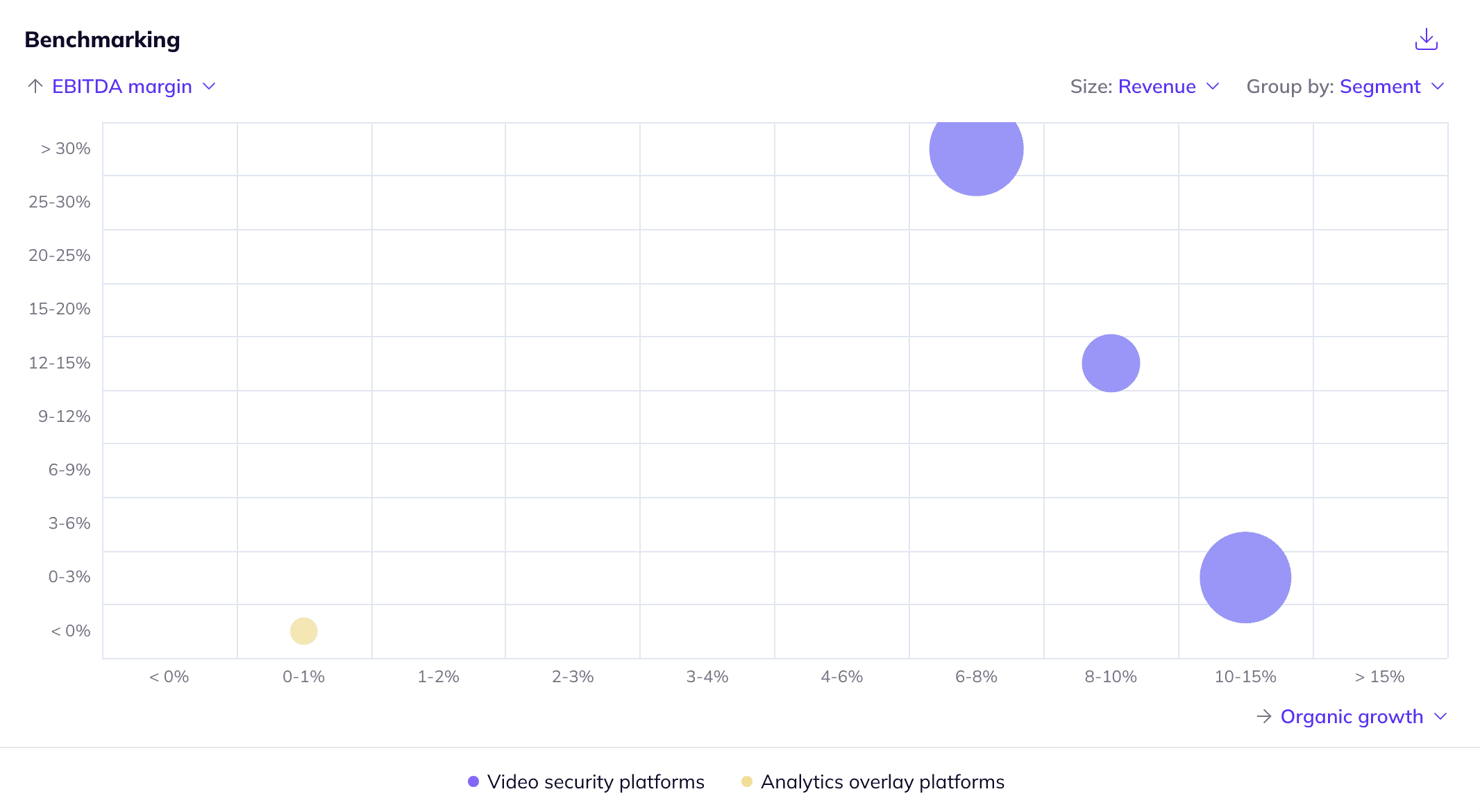
Company benchmarking
Market growth
Technavio (August 2024) estimates that the global video analytics market generated ~$11.9bn in revenue in 2023 and expects it to grow to ~$49.4bn by 2028 (+33.1% CAGR 2023-2028)
According to Statista (December 2025), the global surveillance technology market was valued at ~$130.1bn in 2022 and is anticipated to reach ~$234.7bn by 2027 (+12.5% CAGR 2022-2027)
Positive drivers
Advances in edge AI processors and on-device computer vision models are expected to continue lowering the cost of running video analytics at scale. This is likely to support real-time inference on edge devices such as cameras, gateways and NVRs, reducing latency and bandwidth requirements while enabling broader deployment of analytics across distributed environments, including retail stores, warehouses and transportation networks (asmag, November 2025; SIA, April 2025)
Increasing regulatory and compliance requirements around incident monitoring, safety oversight and evidentiary documentation will continue to expand adoption across regulated environments. As a result, organizations will increasingly use analytics to automate event detection, strengthen audit trails and improve response workflows across workplaces and critical infrastructure (asmag, November 2025; SIA, July 2025)
Persistent labor shortages and workforce replacement needs across guarding and monitoring roles will increase reliance on automated oversight and exception-based supervision across camera-enabled environments. To illustrate, the US Bureau of Labor Statistics (BLS) projects ~162.3k annual openings for security guards and gambling surveillance officers between 2024-2034, which reflects sustained replacement demand across monitoring-intensive roles (BLS, August 2025)
Negative drivers
Expanding government regulation of biometric identification and AI systems elevates compliance obligations and legal exposure for video analytics deployments, particularly where facial recognition capabilities are involved. Emerging AI governance frameworks and biometric data laws across multiple US states will require additional documentation, risk assessment and transparency controls, which can lengthen procurement timelines and slow adoption of advanced analytics functions (Colorado General Assembly, March 2026; Reuters, August 2024; White House, March 2024)
Heterogeneous camera fleets and legacy video management systems increase integration complexity for video analytics deployments, which continue to raise implementation costs and extend rollout timelines. As a result, large-scale deployments often depend on broader system modernization across existing surveillance estates (Genetec, December 2025)
Geopolitical trade restrictions and semiconductor supply concentration increase procurement risk and hardware costs for video cameras, edge processors and other compute components used in analytics deployments. Higher equipment costs and longer lead times can slow camera refresh cycles and delay edge hardware upgrades that enable new analytics capabilities (The White House, January 2026; Reuters, January 2026)
Fill out the form to request your copy of the Video analytics industry report
With the full report, you’ll gain access to:
Detailed assessments of the market outlook
Insights from c-suite industry executives
A clear overview of all active investors in the industry
An in-depth look into 65 private companies, incl. financials, ownership details and more.
A view on all 271 deals in the industry
ESG assessments with highlighted ESG outperformers
Discover hundreds of niche industry reports on Gain
Deep dive into additional industries to understand their market outlook, positive and negative drivers, and more!