

Industry research
Shared mobility
Scope
US
Companies
51
Table of contents
Report collaborator:

Nicholas Farhi and Mark Jannaway, Partners at OC&C Strategy Consultants, provided expert insights for this report. Read the full interview here
Key takeaways
What is the scope of this industry report?
The US shared mobility market comprises businesses that provide on-demand ride-hailing services and vehicle rental services. Herein, players develop a platform that connects passengers with drivers for ride-hailing and car-sharing services, passengers with rental companies for vehicle rentals and users with micromobility options (e.g. e-scooters) for last-mile connectivity. While ride-hailing vehicles arrive at the client's desired location, vehicle rental & sharing and micromobility options are either free-floating (i.e. scattered throughout urban areas for easy access) or available at designated pick-up locations (e.g. airport). We segmented the US market into: (i) vehicle rental & sharing, (ii) B2C ride-hailing, (iii) micromobility and (iv) B2B ride-hailing.
What does the shared mobility market landscape look like in the US?
The US shared mobility market is highly consolidated and dominated by cars, with other types of vehicles playing a smaller role (expert interview by Gain.pro, January 2025). Specifically, the ride-hailing segment is dominated by Uber and Lyft, with Uber holding ~76% of the 2024 US B2C ride-hailing market share in terms of value. Similarly, the US car rental market remains highly concentrated, with the top 3 players, Enterprise Mobility, Hertz and Avis Budget Group, controlling ~90% of the total US car rental market. When zooming in on the micromobility segment, Lime and Third Lane Mobility (through Bird) hold a combined ~60% market share in the US. These large players continue to expand their presence through strategic partnerships (e.g. vehicle OEMs) and by investing in emerging technologies (e.g. electric autonomous vehicles). At the same time, the long tail typically focuses on a particular niche or geographical location (e.g. Outdoorsy caters to the RV rental services niche) to differentiate itself.
What is the level of investor activity in the US's shared mobility industry?
Investor-led interest has been significant, with ~51% of identified assets being backed by financial sponsors (as of February 2026). Investors are primarily attracted by the market's favorable long-term outlook driven by (i) convenience and cost-effectiveness, (ii) the emergence of advanced technologies such as AI and autonomous vehicles and (iii) the increasing shift from vehicle ownership to ride-hailing and pooled rides. On the other hand, deterring factors include (i) the ride-hailing and car-sharing driver shortage, (ii) long-term profitability concerns for ride-hailing and micromobility companies due to high operational costs and investments in technology, (iii) strict regulations that vary across different states in the US and (iv) low switching costs for consumers, which can reduce brand loyalty and lead to price-driven decisions.
What are the key ESG considerations in the US's shared mobility industry?
ESG considerations primarily relate to environmental and social challenges and, to a lesser extent, to governance aspects. Environmental topics relate to CO₂ emissions and challenges in battery disposal. While CO₂ emissions are lower compared to private vehicle ownership, players take further action by adopting electric or hybrid vehicles and address battery disposal challenges by upcycling used e-scooter and e-bike batteries. Social aspects revolve around improving working conditions for drivers, addressing low wage concerns and providing accessible services to all demographics (i.e. including individuals with disabilities). Lastly, governance aspects focus on safety procedures for the well-being of riders and drivers and conducting thorough background checks to verify drivers' backgrounds and potential involvement in crime.
Company benchmarking
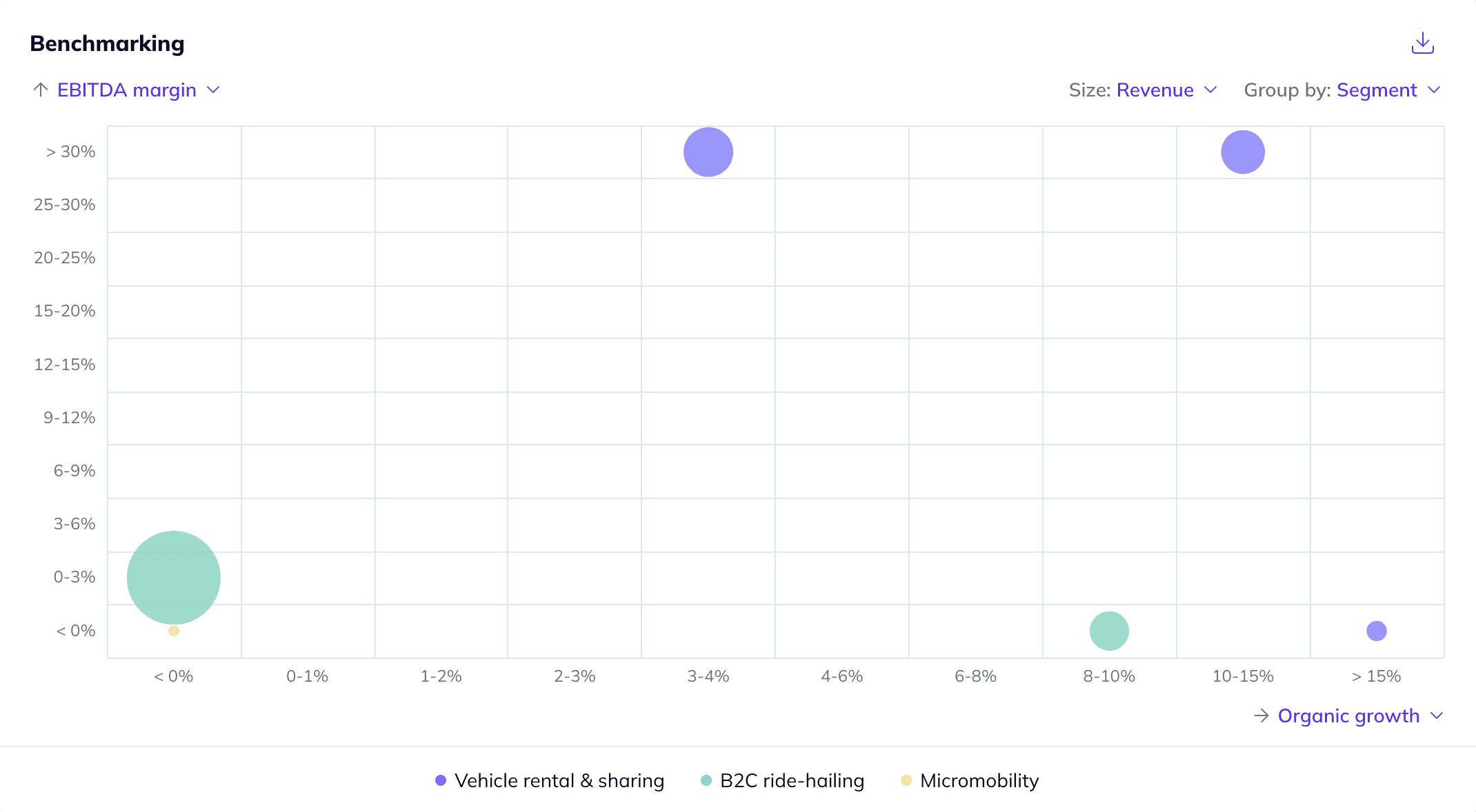
Market growth
The global vehicle sharing market was valued at ~$13.1bn in 2024 and is forecast to reach ~$35.5bn by 2029 (+22.1% CAGR, 2024–2029; Technavio, January 2025)
Statista (June 2025) projects the US shared mobility market size to increase from ~$314.3bn in 2024 to ~$345.9bn by 2029 (+1.9% CAGR 2024-2029)
Positive drivers
Consumers are increasingly turning to shared mobility for its convenience and cost-effectiveness, with Shared Autonomous Electric Vehicles (SAEVs) projected to be $0.2-0.5 cheaper per mile than private car ownership by 2030. Additionally, >40% of US adults are considering giving up personal vehicles, with Gen-Z and millennials showing the highest interest in going car-free (Victoria Transport Policy, November 2025; McKinsey & Company, January 2025; Deloitte, January 2025; expert interview by Gain, January 2025)
The emergence of advanced technologies such as IoT, AI and autonomous driving (e.g. robo-taxis) allows shared mobility firms to enhance operational efficiency and improve the overall user experience. To illustrate, spending on automation is expected to account for >30% of shared mobility companies' CAPEX between 2024-2029 (vs. ~22% between 2019-2024; PVcase, September 2024; McKinsey & Company, February 2024)
The shift from individual vehicle use to pooled rides is gaining traction as cities impose stricter regulations on private car usage. At the same time, the US government aims to make shared mobility more accessible. For instance, the US government's ~$550bn infrastructure plan (2021-2026) includes funding for safe street infrastructure, EV charging, public transit and shared micromobility (US Department of Energy, February 2026; NBER, June 2025; expert interview by Gain, January 2025)
Negative drivers
Shortage of drivers exacerbated by factors such as an aging population, inadequate training and low pay poses a long-term structural challenge for ride-hailing organizations. To illustrate, older drivers (>55 years) significantly outnumber younger drivers (>25 years). By 2030, it is expected that there will be a deficit of drivers, while ~25% of all the professional drivers (i.e. including shared mobility drivers) in the US will be 65 years or older (NHTSA, February 2026; National Library of Medicine, April 2025; DPV Transportation, November 2023)
Long-term profitability concerns continue to mount in the shared micromobility sector. Herein, players' profit margins continue to remain negative due to substantial operational and maintenance expenses, with limited signs of near-term profitability improvement (expert interview by Gain, February 2026)
The regulatory landscape in the US is highly fragmented, with varying rules across states and municipalities. This inconsistency complicates compliance for shared mobility providers and hampers investment and expansion efforts. To illustrate, New York City has implemented caps on the number of ride-hailing vehicles (except electric vehicles) that are allowed to operate in certain neighborhoods to mitigate congestion (NYC Taxi & Limousine Commission, February 2025; expert interview by Gain, January 2025; Smart Cities Dive, May 2024)
Fill out the form to request your copy of the Shared mobility industry report
With the full report, you’ll gain access to:
Detailed assessments of the market outlook
Insights from c-suite industry executives
A clear overview of all active investors in the industry
An in-depth look into 51 private companies, incl. financials, ownership details and more.
A view on all 278 deals in the industry
ESG assessments with highlighted ESG outperformers
Discover hundreds of niche industry reports on Gain
Deep dive into additional industries to understand their market outlook, positive and negative drivers, and more!