

Industry research
Equipment rental & leasing
Scope
Europe
Companies
200
Key takeaways
What is the scope of this industry report?
The equipment rental and leasing industry consists of businesses that provide equipment to customers for a specified period in exchange for fees. Although the terms rental and leasing are often used interchangeably, leasing agreements generally have longer durations and may include predefined renewal options or conditions for ownership transfer at the end of the contract. We segmented the industry by equipment type into: (i) industrial equipment, (ii) automotive, (iii) electronics and (iv) media & entertainment.
What does the equipment rental & leasing market landscape look like in Europe?
The European equipment rental and leasing markets exhibit varying levels of fragmentation. The short-term car rental sector is highly consolidated, with the 5 largest players (e.g. Europcar, SIXT Group and Hertz) holding ~87% of the market in 2024, driven by standardised services, economies of scale and mass consumer demand. On the contrary, the industrial equipment segment remains highly fragmented due to specialised client needs, high transport costs and local projects that favour smaller, regional providers. However, M&A activity in the industrial equipment market accelerated in 2024, as strategic buyers consolidated regional leaders and niche segments, while large platforms expanded into adjacent categories to evolve into full-service providers. Financial buyers have also increased their presence, with their share of transactions rising from ~21% in 2023 to ~32% in 2024. Valuation multiples have recovered, with average EV/EBITDA increasing from ~6x in 2024 to ~6.4x in 2025 (Investec, June 2025).
What is the level of investor activity in Europe's equipment rental & leasing industry?
Sponsor-led interest has been moderate, with ~35% of identified assets being backed by financial sponsors (December 2025). Herein, investor interest is largely driven by rising rental demand as businesses shift from ownership to reduce costs and their carbon footprint. The accelerating adoption of electrified equipment also creates additional rental opportunities, while growing consumer demand for rentals and refurbished products further fuels market interest. Conversely, the disintermediation risk as OEMs integrate rental offerings directly, along with a stagnant European construction sector limiting equipment demand and declining EV residual values putting pressure on rental margins, are key deterrents for investors.nts key deterrents for investors.
What are the key ESG considerations in Europe's equipment rental & leasing industry?
ESG topics in the European equipment rental and leasing market primarily relate to environmental impact, as renting equipment helps reduce emissions by ~30-50% through increased utilisation, extended product lifespans and reduced manufacturing demand. Rental companies also enable industrial and automotive electrification by distributing high upfront costs across multiple users, while supporting the used EV market transition. In electronics, rental businesses mitigate e-waste growth by extending device lifecycles through shared use and refurbishment.
Company benchmarking
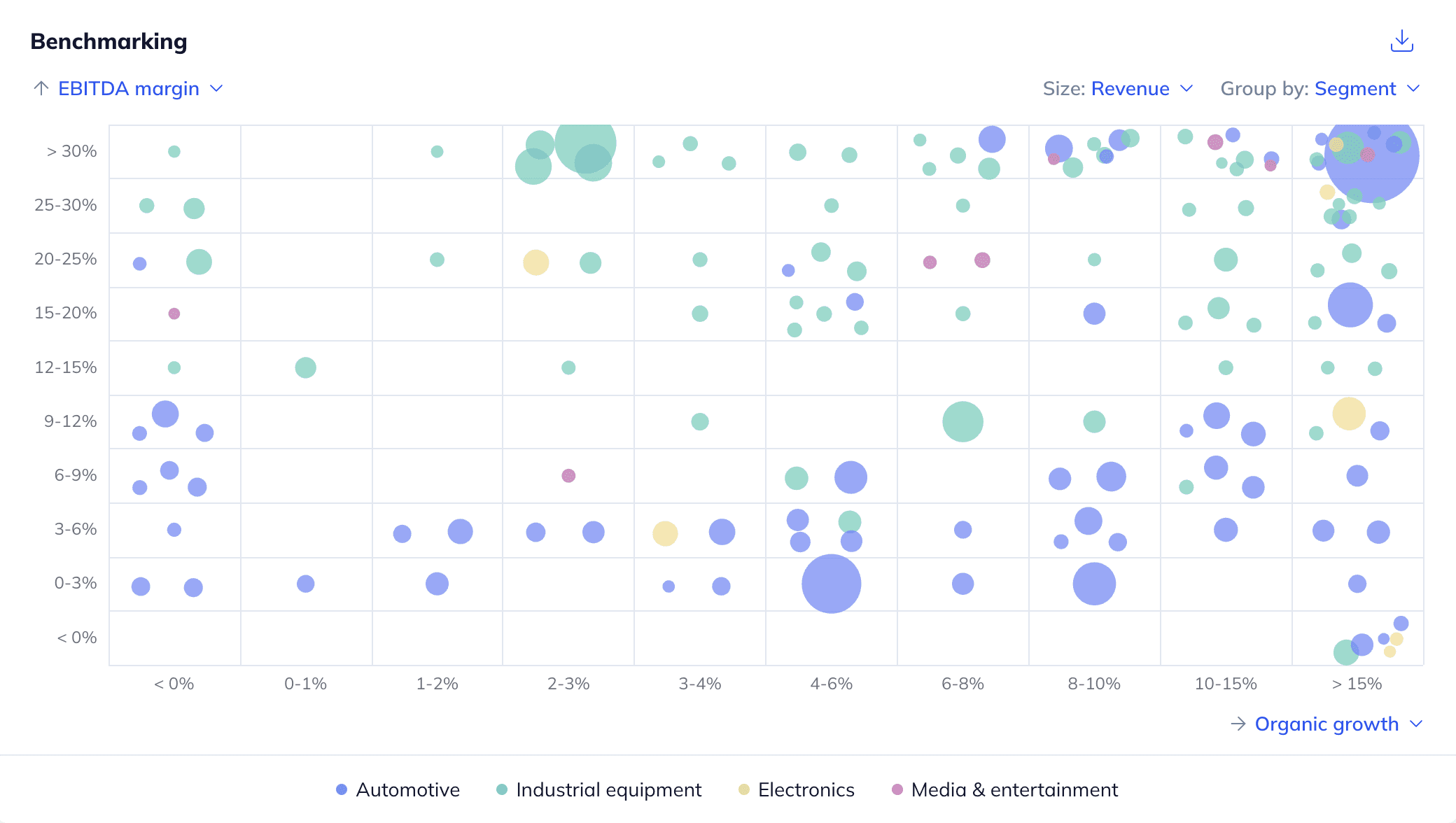
Market growth
Technavio (January 2025) valued the European vehicle leasing market at ~€43.6bn in 2024, forecasting it to reach ~€52.2bn by 2029 (+3.7% CAGR 2024-2029)
The European equipment rental market is set to grow to ~€33.9bn (+1% YoY), with the UK, Germany and France accounting for ~60% (International Rental News, October 2025)
Positive drivers
Businesses are shifting from asset ownership to rental models, aligning with the broader CAPEX-to-OPEX trend. This trend is reinforced by the rising use of costly, complex-to-maintain electrified equipment (e.g. compact machines), driving demand for equipment rental, especially from providers with well-targeted electrified portfolios (interview by Gain.pro; Equipment Finance News, June 2025; Bloomberg, March 2025; European Rental Association, October 2024)
Technological advancements (e.g. telematics, IoT systems) allow rental companies to prevent theft, track and monitor equipment and perform remote troubleshooting. Players with updated, tech-enabled fleets can maximise utilisation and improve operational efficiency, thereby driving top-line and margin performance (For Construction Pros, May 2023)
Consumer behaviour is shifting sharply toward pre-owned and access-based models, driven by rising cost-of-living pressures and sustainability values. This change of preference is boosting demand for electronics rentals and refurbished products, driving growth in the consumer electronics rental segment (Nano Interactive, October 2023)
Negative drivers
Disintermediation threats from suppliers loom as OEMs and dealers gradually integrate rental and leasing options as part of their offering. As such, identified leasing players will face limited growth opportunities and capped profitability (Loopit, November 2024; Appstle, August 2023; TM Capital, February 2023)
A stagnant European construction market with limited project pipelines and low near-term confidence pressures the top-line for rental players. To illustrate, the European equipment rental market is heavily reliant on the construction sector, which generates ~65% of its revenue across residential, commercial and infrastructure projects (ING, August 2025; European Rental Association, June 2025)
Used EVs continue to experience a declining residual value trend due to oversupply, lower new EV prices and reduced consumer willingness to pay. To illustrate, 2024 saw EVs depreciate by ~17% on average compared to ~6% for all used cars across European markets. This sharper-than-expected depreciation leads to lower resale prices, which in turn compresses bottom-line margins for rental players (Fleet Europe, April 2025; McKinsey & Company, December 2024)
Fill out the form to request your copy of the Equipment rental & leasing industry report
With the full report, you’ll gain access to:
Detailed assessments of the market outlook
Insights from c-suite industry executives
A clear overview of all active investors in the industry
An in-depth look into 200 private companies, incl. financials, ownership details and more.
A view on all 842 deals in the industry
ESG assessments with highlighted ESG outperformers
Discover hundreds of niche industry reports on Gain
Deep dive into additional industries to understand their market outlook, positive and negative drivers, and more!