
Industry research
Crop Protection
Scope
Europe
Companies
53
Key takeaways
What is the scope of this industry report?
The European crop protection market consists of businesses active in the development, production and distribution of chemicals to protect agricultural output. These crop protection products are used to limit the negative impact of unwanted plants (i.e. herbicides), pests (i.e. pesticides) and pathogenic fungi (i.e. fungicides) to maximise the output of cultivated land. The market for crop protection is bifurcated into chemical-based and biological products. The former group contains oil-based chemicals such as glyphosate and glufosinate, while biological products are derived from naturally-occurring plant, bacterial, viral and fungal sources (AG FMC, October 2023; Idemitsu, February 2026). Accordingly, market participants tend to follow either a generalist model, combining chemical and biological crop protection with adjacent offerings, or a specialist strategy targeting a specific segment. For example, Bayer Group operates a diversified model spanning pharmaceuticals, agriculture (with a focus on chemical and biological crop protection products) and consumer health (Bayer Group, February 2026). By contrast, Group De Ceuster represents a niche specialist, focusing on the development of organic fertilisers and soil improvers (Group De Ceuster, February 2026). As such, we segmented the market based on players’ offerings into: (i) generalist and (ii) specialist.
What does the crop protection market landscape look like in Europe?
EU crop protection companies face significant regulatory exposure. Notably, the Sustainable Use of Pesticides Directive, introduced as part of the European Green Deal, proposed a ~50% reduction in pesticide and fertiliser use by 2030. However, following pushback from farming industry groups, this proposal was withdrawn (Pasture.io, February 2024). In response to increasing regulatory pressure, crop protection companies are shifting development towards sustainable alternatives, including biologicals, biostimulants and precision or integrated pest management substances, at the expense of conventional chemical products (IBMA, April 2024). Accordingly, there has been a rise in specialist players focused on developing sustainable crop protection products. An illustrative example is Biobest, a specialist in biological pest and disease control. Backed by Tikehau Capital, M&G Investments and Unigrains as financial sponsors, the Company’s top-line has grown revenues by ~4x since 2019 to ~€500m in 2024 (Global AgInvesting, February 2026). Moreover, industry leaders are pursuing strategic M&A to gain exposure to the high-growth sustainable crop protection segment, as illustrated by BASF Group’s acquisition of AgBiTech Group, a specialist in biological insect control with strong exposure to soybeans, corn, cotton and speciality crops (Revista Cultivar, January 2026).
What is the level of investor activity in Europe's crop protection industry?
Investor-led interest has been substantial, with ~53% of identified assets being backed by financial sponsors (February 2026). This interest is primarily driven by long-term growth prospects in global food demand linked to population expansion, alongside the accelerating adoption of biopesticides and biocontrol substances, which are expected to capture increasing market share as sustainable farming practices scale. Conversely, key investment deterrents relate to increasing public awareness of the adverse health impacts associated with chemical pesticides, stringent EU regulatory frameworks that lengthen the time-to-market for new products, as well as intensifying competition from lower-cost crop protection alternatives originating in the APAC region.
What are the key ESG considerations in Europe's crop protection industry?
ESG issues primarily relate to environmental and social topics. Environmentally, the sector faces material challenges related to the fossil fuel-based nature of many chemical pesticides, which contributes to CO₂ emissions, alongside their well-documented negative effects on biodiversity. Market participants are mitigating environmental risks by decoupling production from fossil fuels through green technology investments and implementing biodiversity-focused frameworks that protect critical ecosystems without compromising agricultural yields. From a social perspective, issues concern reducing the risks of chronic diseases (e.g. cancer, neurological) associated with the widespread usage of pesticides in agriculture, as well as minimising exports of banned pesticides in Europe to other regions.
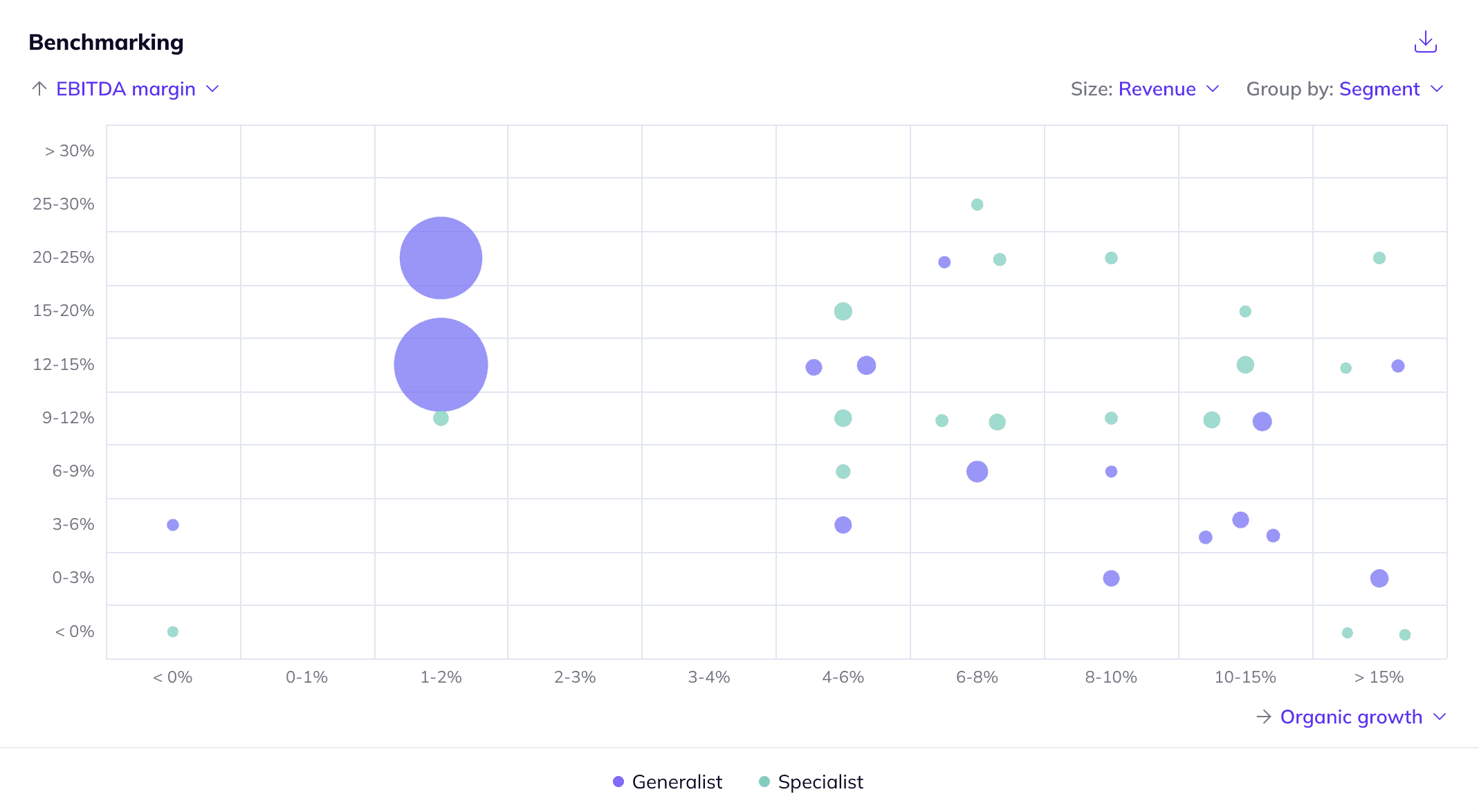
Company benchmarking
Market growth
The global chemicals market for crop protection was valued at ~$136bn in 2023 and is projected to reach ~$159bn in 2028, registering a +3.2% CAGR over the period (Technavio, June 2024)
The European biocontrol market generated ~€1.6bn in sales in 2023. Accounting for ~10% of the entire European crop protection market, IBMA (April 2024) estimates that the biocontrol segment is growing at a +10% CAGR, whereas the conventional crop protection segment records a +2-4% growth rate
Positive drivers
Increasing demand for food, on the back of a growing global population that will increase by ~1.8bn (from ~8.1bn in 2026 to ~10bn by 2050), will drive demand for better and more efficient crop protection products to improve farming and harvesting productivity (FAO, December 2025)
The rising adoption of biopesticides and biocontrol products, as negative public scrutiny and increasingly stringent regulation constrain the use of conventional chemical crop protection products. Given that biopesticides currently account for a relatively small share of the overall crop protection market, specialist players focused on these alternatives are well-positioned to benefit from significant revenue upside as market penetration increases (CropLife, October 2025; SCI, February 2024)
The intensification of climate change is expected to increase extreme weather events and rising temperatures, leading to higher pest pressure and reduced crop resilience. As a result, farmers are likely to increase their use of crop protection products, supporting demand across all market segments (Pesticide Action Network, November 2024)
Negative drivers
Increasing awareness relating to the potential health hazards derived from crop protection and pesticide products, exemplified by Bayer Group facing >100k lawsuits relating to potential cancer causes from its herbicide products. As such, industry players bear the risk of having to pay several billions of euros in settlement fees, which could severely harm profit margins (TNL, September 2025)
Europe’s stringent regulatory framework creates significant bureaucratic barriers that constrain revenue growth for crop protection players. For example, new biocontrol products can take ~10 years to obtain approval for farmer use in the EU, compared with ~2–3 years in regions such as the US and Brazil, thereby placing European players at a competitive disadvantage (IBMA, April 2024)
Intensified competition from low-cost crop protection and pesticide manufacturers in the APAC region, particularly China, represents a structural headwind for European players. Supported by state-driven R&D policies, Chinese manufacturers are rapidly closing technology gaps while maintaining significant cost advantages. This dynamic is likely to drive market share losses and, over time, reduce Europe’s strategic relevance in the global crop protection market (AgriBusiness Global, January 2026)
Fill out the form to request your copy of the Crop Protection industry report
With the full report, you’ll gain access to:
Detailed assessments of the market outlook
Insights from c-suite industry executives
A clear overview of all active investors in the industry
An in-depth look into 53 private companies, incl. financials, ownership details and more.
A view on all 269 deals in the industry
ESG assessments with highlighted ESG outperformers
Discover hundreds of niche industry reports on Gain
Deep dive into additional industries to understand their market outlook, positive and negative drivers, and more!