
2026
The State of Private Equity Fundraising Report
$445bn
Raised by PE funds in 2026 YTD, up 5% vs. the same period in 2025
46%
Share of 2026 PE fundraising that came from funds over $5bn
$104bn
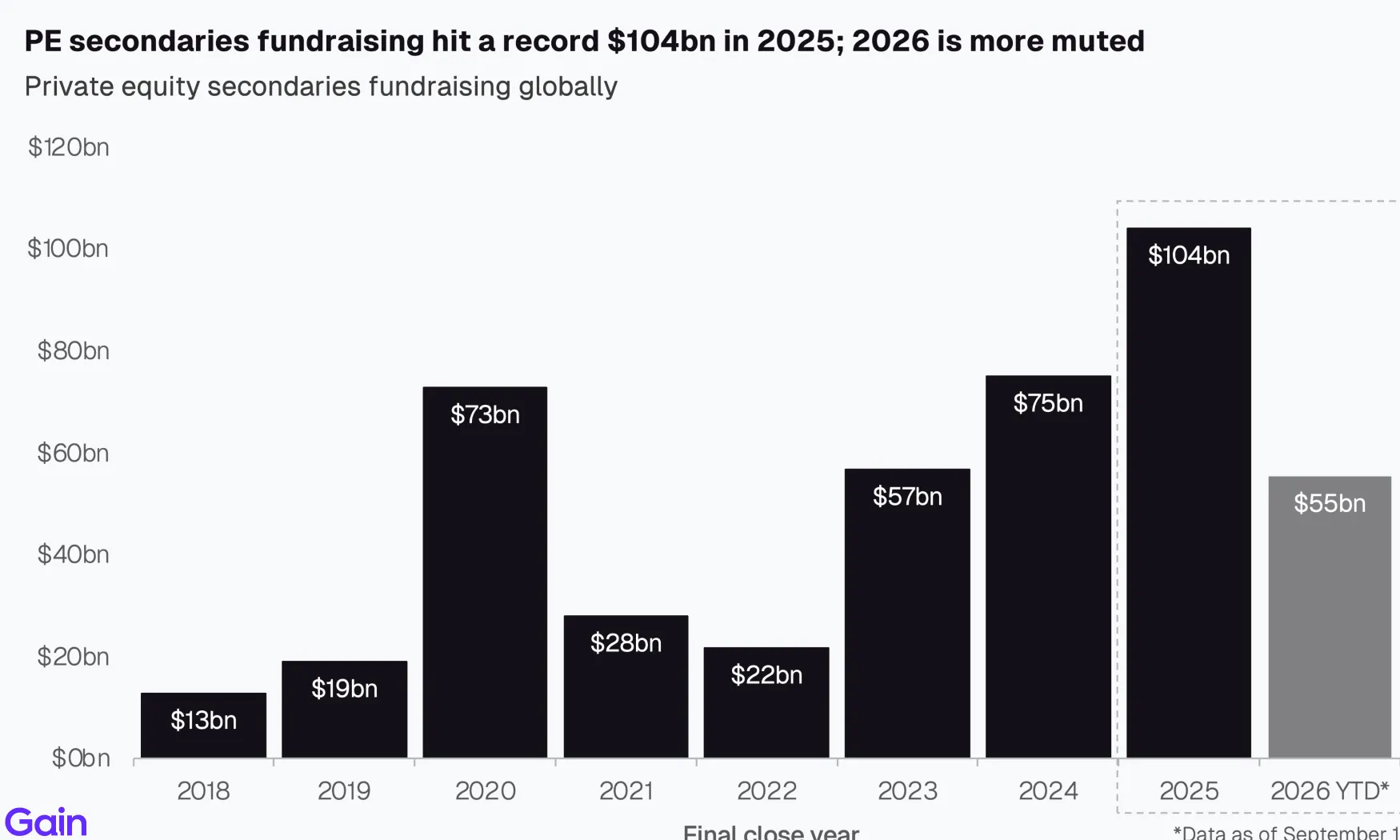
Raised by PE secondaries funds in 2025
16 months
Average time for a PE fund to close in 2026, down from 21 months in 2024

Executive Summary
In this report, we go deep into the state of global PE fundraising. We share insights on fundraising volumes, secondaries, fundraising timelines, fund sizes, performance metrics and much more. Here is a summary of our key findings:
PE fundraising is on pace to rebound in 2026. Capital raised reached $445bn YTD, up 5% vs. the same period last year. Buyout, although strong this year, fell to a five-year low in 2025.
Secondaries have been the key growth driver of PE fundraising over the last few years. The strategy raised a record $104bn in 2025 and is now the second-largest PE strategy, ahead of growth. With exits subdued, LPs and GPs increasingly turn to the market for liquidity, while CV fundraising also hit a record $64bn in 2025.
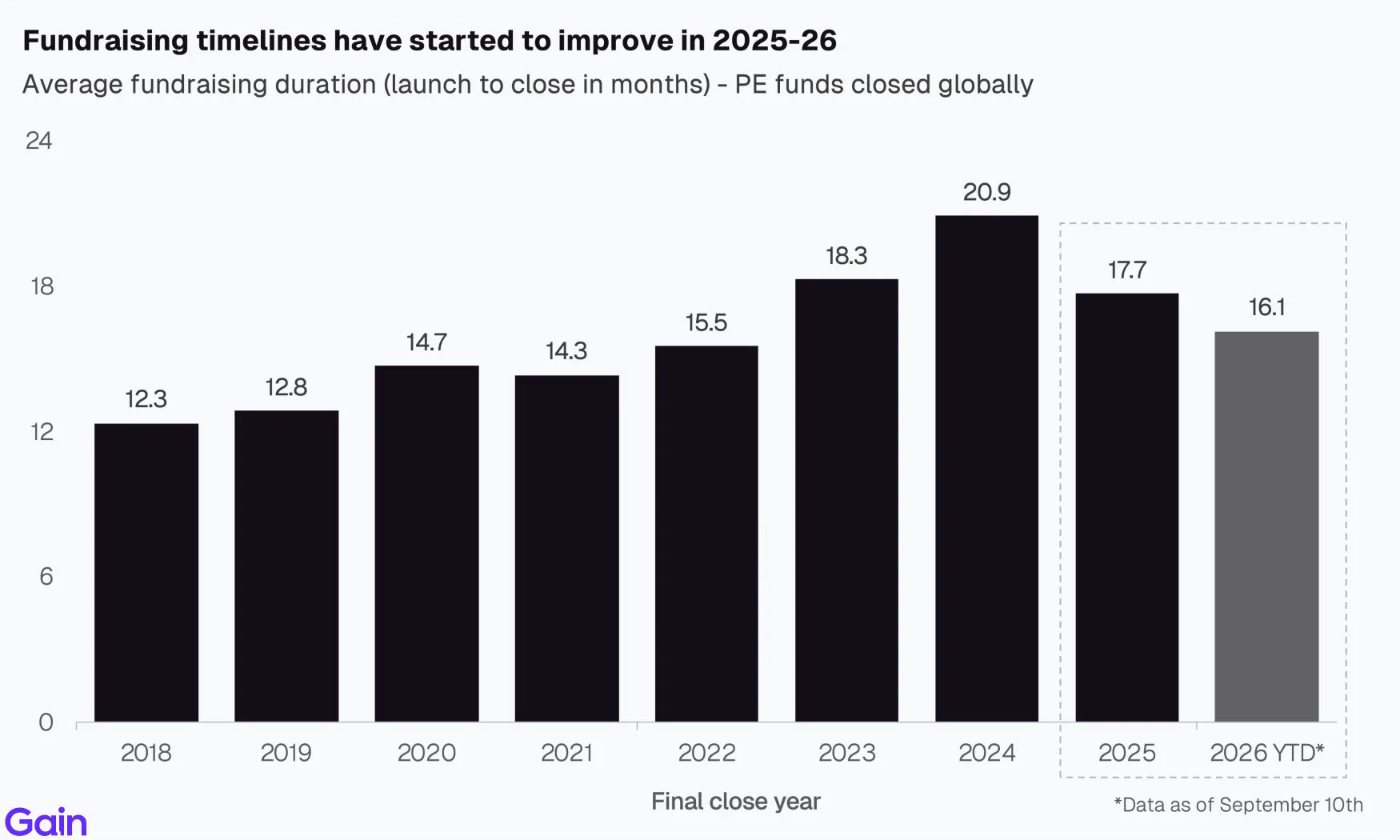
Fundraising timelines have started to improve. Average duration eased from a peak of ~21 months in 2024 to ~16 in 2026 YTD, though GPs are also waiting longer before returning to market, with the gap between funds near record highs (47 months).
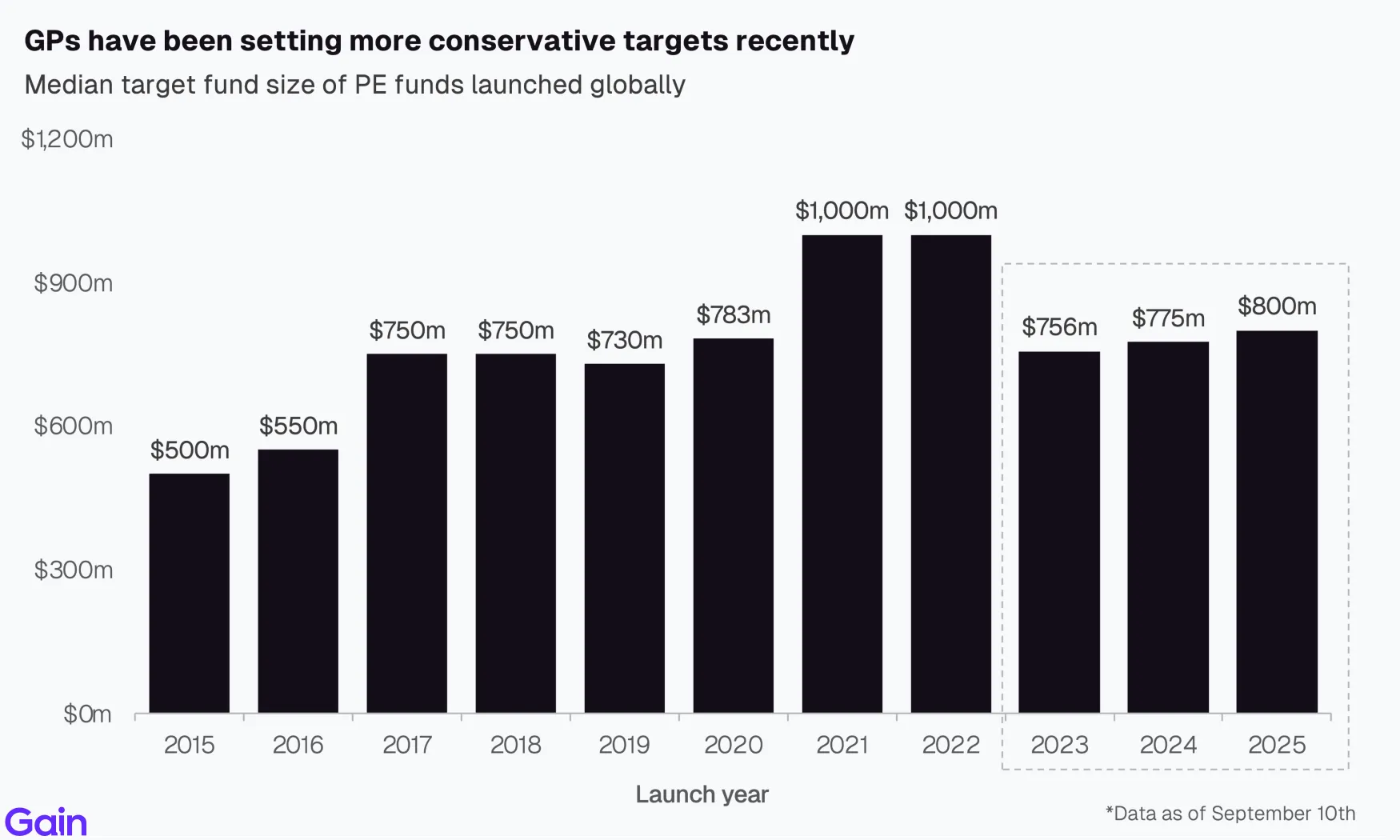
Median PE fund size has plateaued at around $600m since 2023. GPs are also setting more conservative targets, with their median falling from $1bn in 2021 to $800m in 2025, as managers take a more focused approach and right-size ambitions with capital being scarcer.
GPs are raising successor funds at the smallest step-up in years. The median has slid from 1.57x in 2022 to 1.43x in 2026 YTD, largely a base effect after the outsized fundraises of the prior cycle.
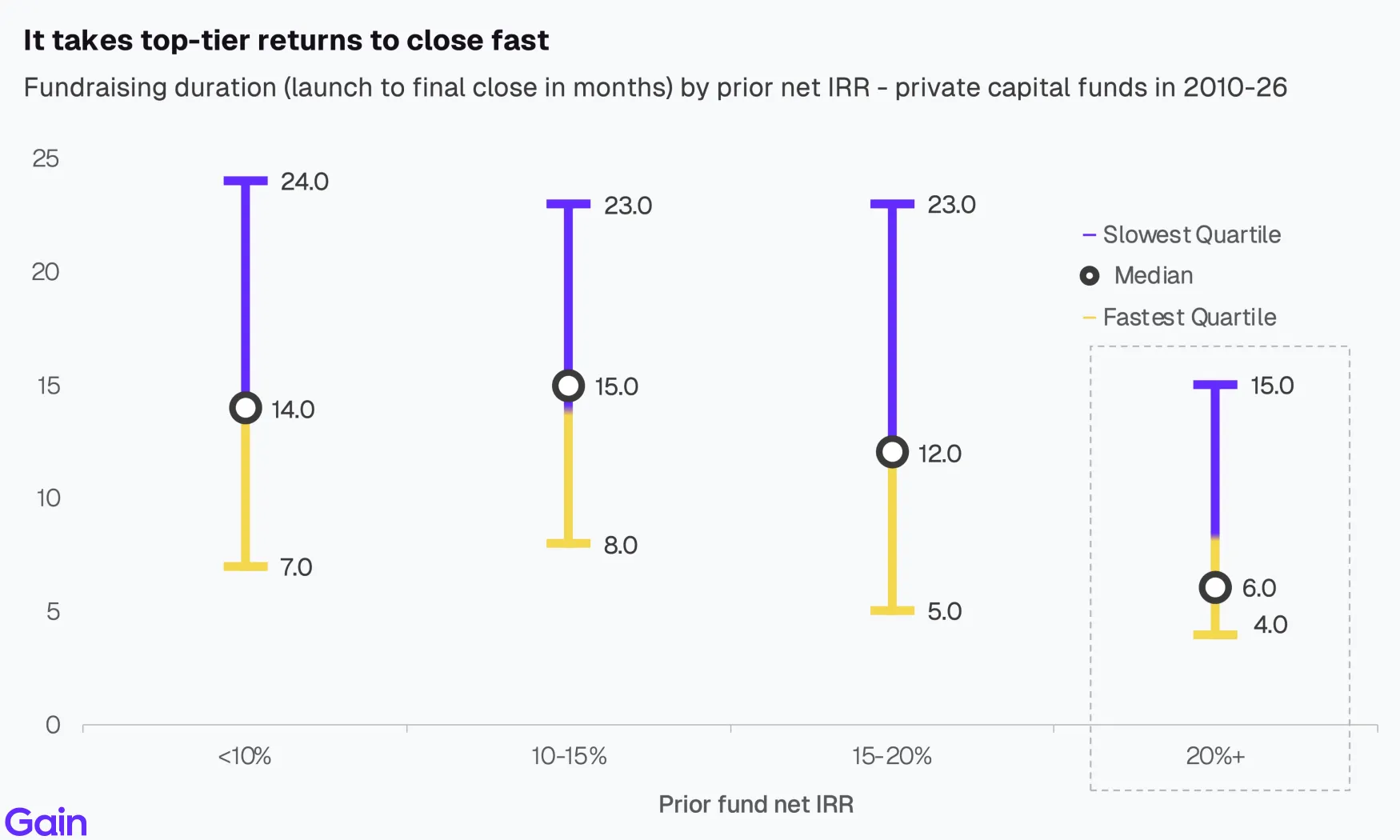
Past performance remains key in fundraising. Compared with managers whose prior fund returned below 10% net IRR, those above 20% close their next fund faster (6 vs 14 months), achieve larger step-ups (1.59x vs 1.35x) and rarely miss their target (4% of funds vs 23%).
If you have any questions about the data or the report, do not hesitate to reach out to insights@gain.pro.



Chapter 01: Fundraising Trends
Overall
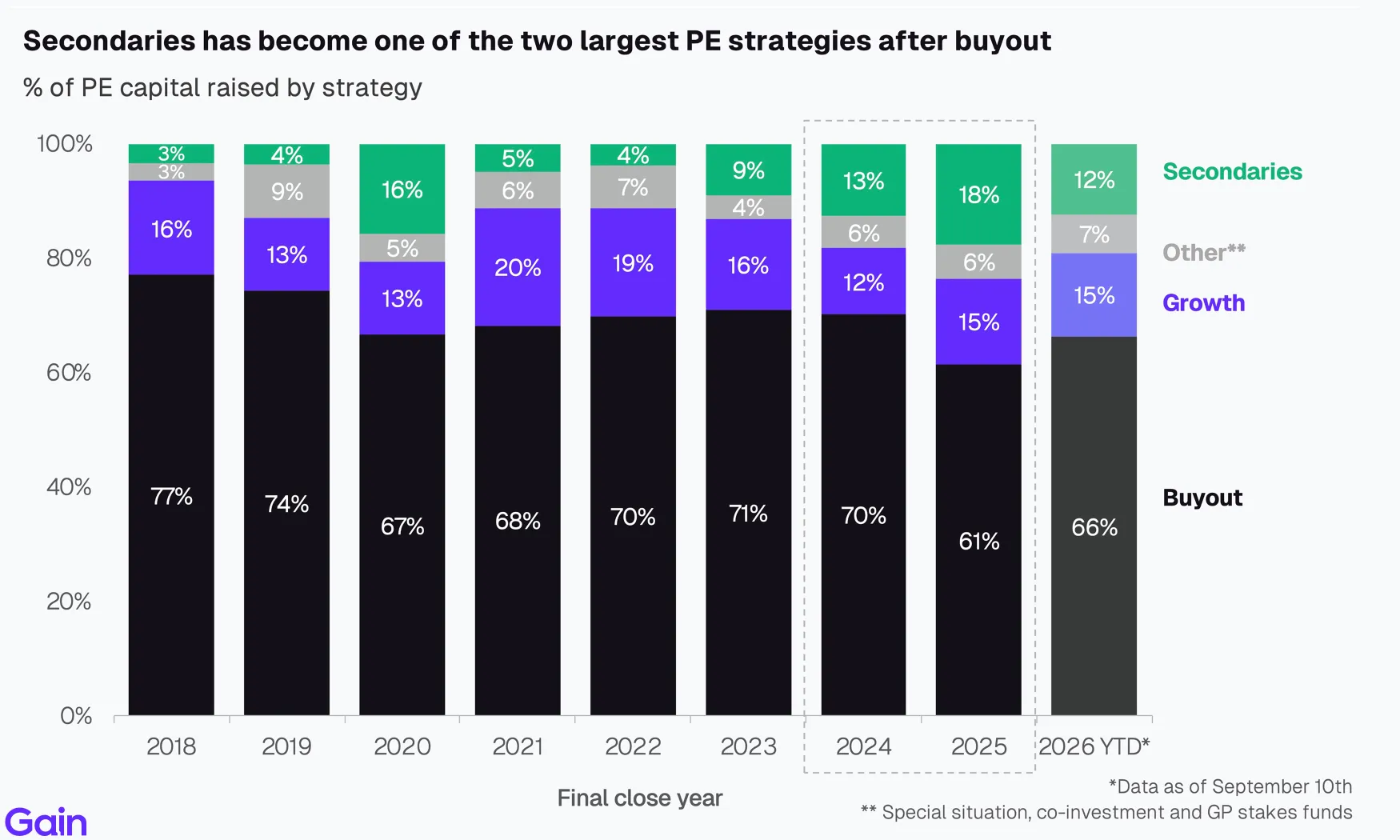
Private equity fundraising is on pace to rebound in 2026. Fundraising hit $445bn YTD and is up 5% vs. the same period last year. Strategy-wise, buyout fundraising fell to a five-year low in 2025. Secondaries have been the main growth driver in the last few years, as LPs lean on the market for liquidity while exit activity stays subdued.

In 2025, secondaries was the 2nd largest PE strategy by capital raised (18%), ahead of growth (15%). This is driven by LPs seeking more liquidity. Buyout, though down from 70% to 66% in 2024-26, remains the core of the asset class, commanding the majority of capital raised.
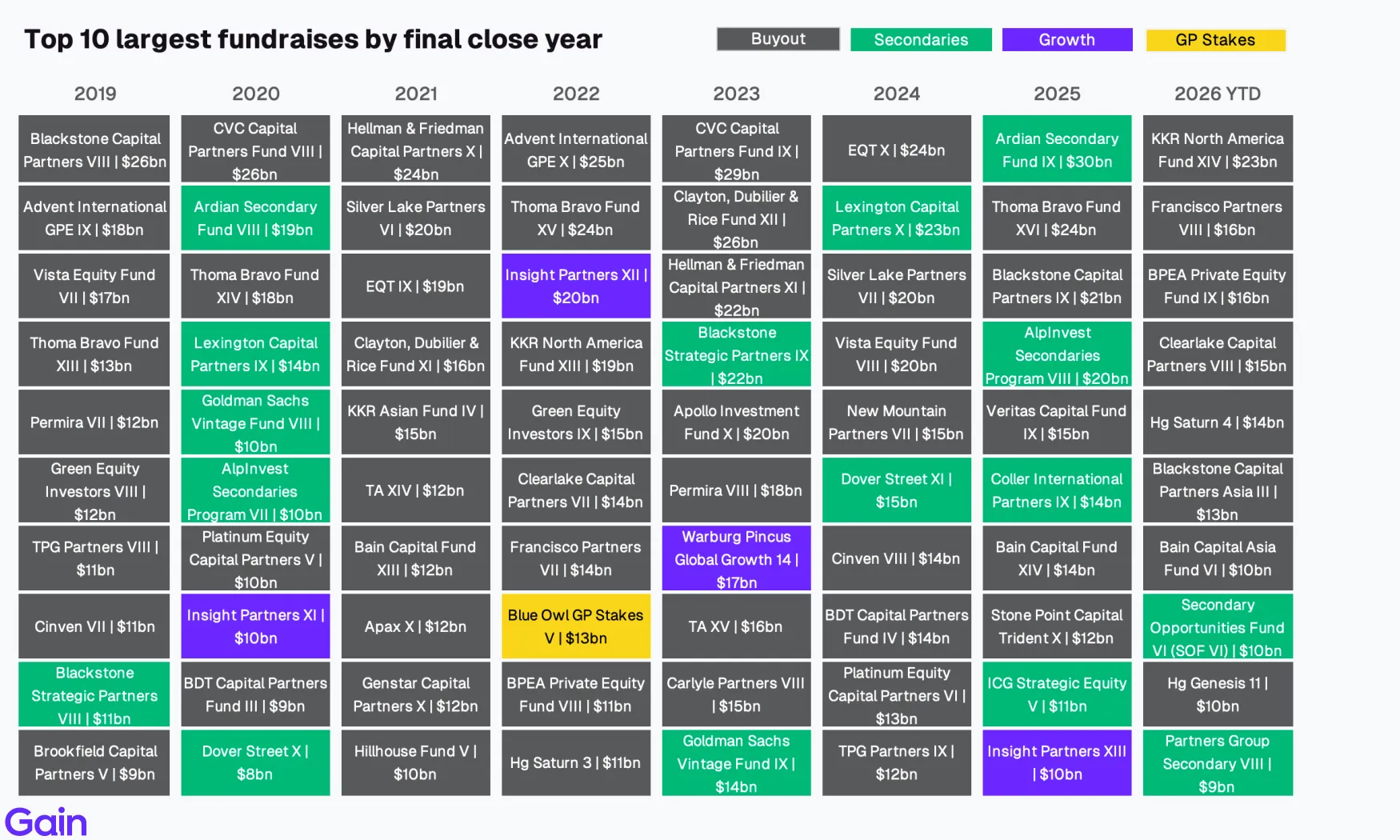
KKR’s North America Fund XIV, Francisco Partners VIII and EQT’s BPEA IX are the largest funds raised this year. Of the top 10, 8 are buyout funds while 2 are secondaries funds. 4 of the 10 funds raised have single-region focus: 3 for Asia and 1 for North America.
Chapter 02: Fund Sizes
Overall Trend
Median PE fund size has plateaued at around $600m since 2023. After rising in 2016-2020, the median has held in a narrow band since. GPs in the last few years have missed targets and are also setting more conservative ones.

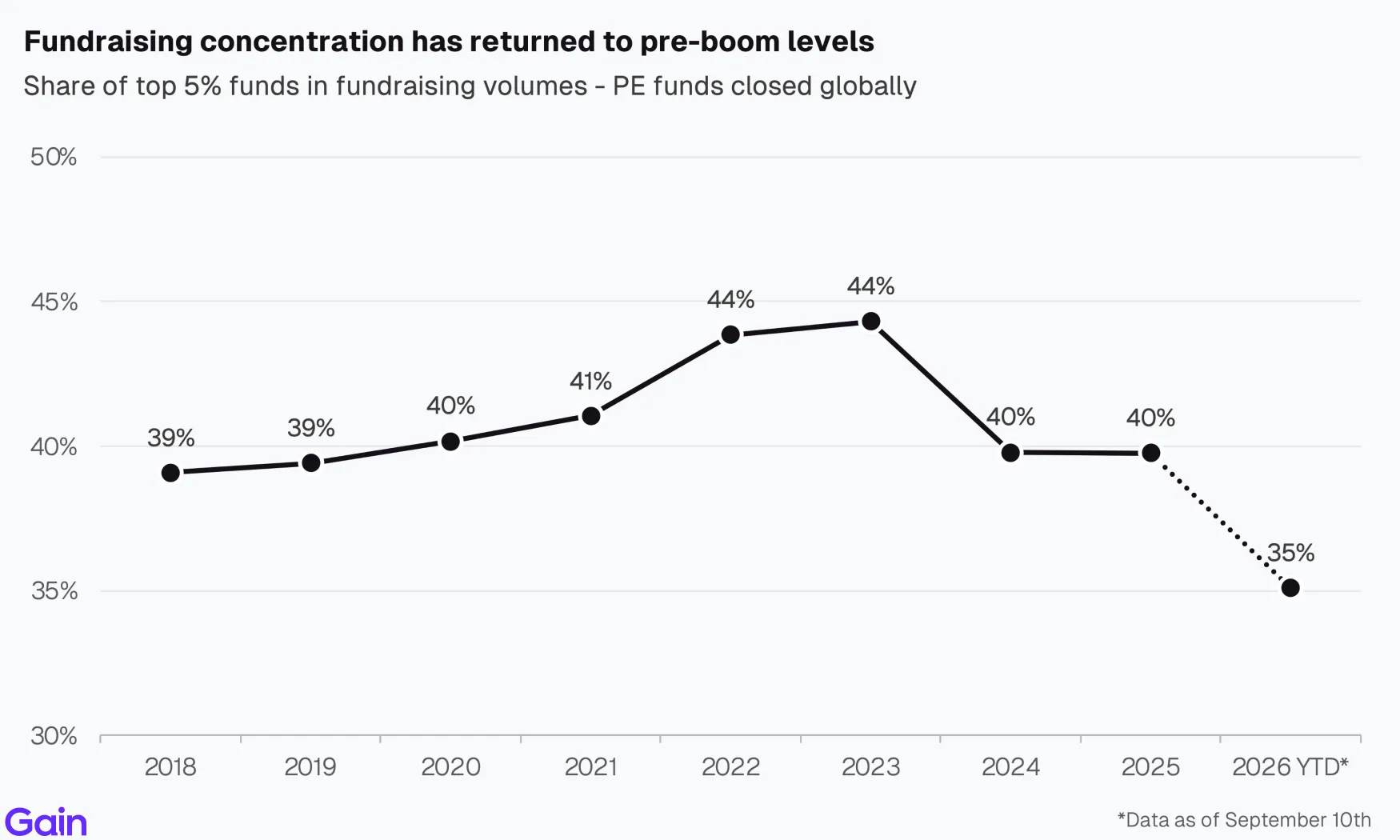
Fundraising concentration has declined from the highs of 2022-23. The share of capital raised by the largest 5% of funds has come down from 44% in 2023 to 40% in 2025. During COVID, LPs consolidated behind the largest brands as smaller managers struggled to raise; that's since eased, with high-quality smaller managers back in the market.
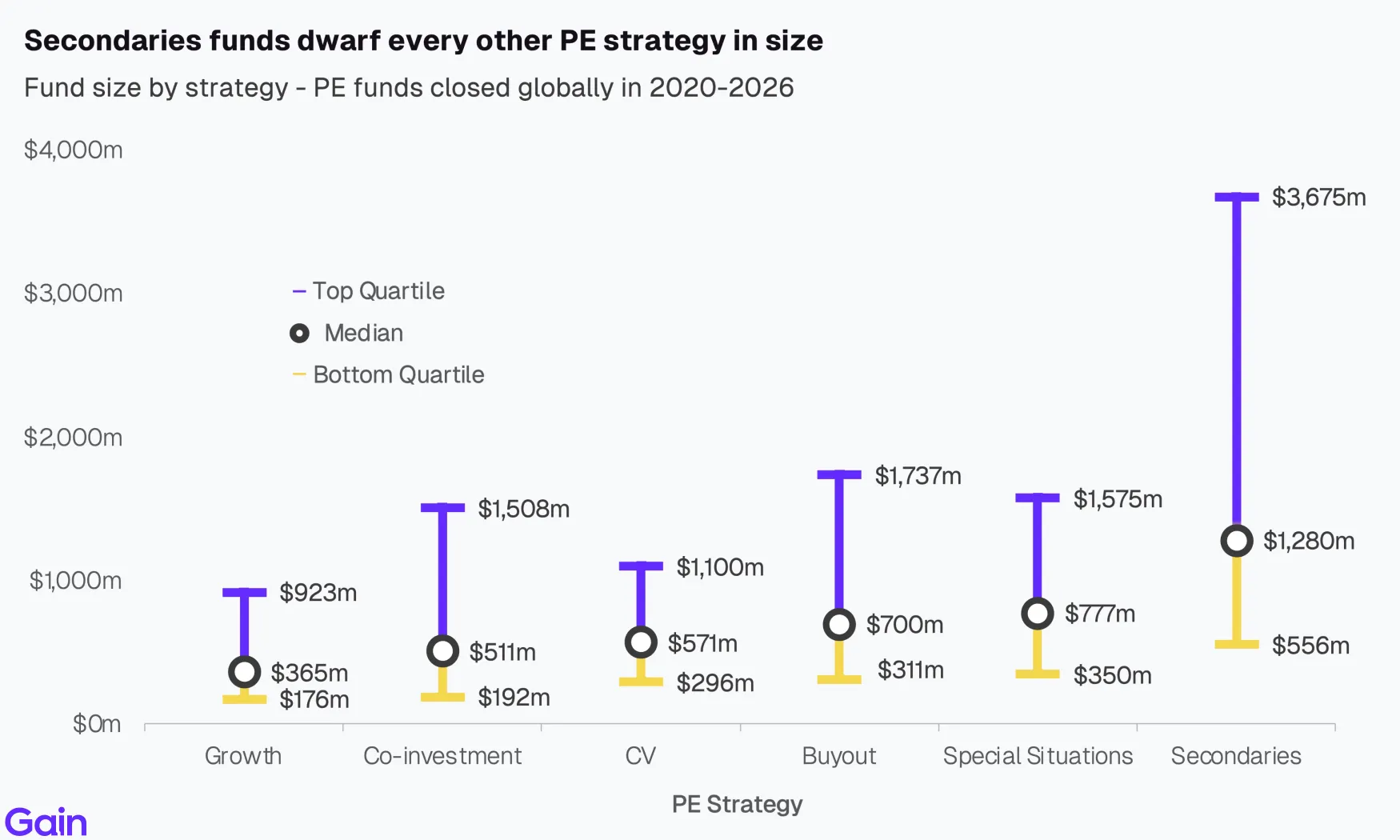
Secondaries funds dwarf every other PE strategy in size. The median secondaries fund raised $1.3bn over 2020-26, nearly double buyout's $700m. Scale is structural to the strategy. LP portfolio deals come as large bundles, and anchoring a GP-led deal requires a large cheque. LPs are also more comfortable committing more capital, as the underlying assets are usually known and have been held in the GP's portfolio for some time, rather than backing a blind pool.
Chapter 03: Target Size & Step-up Multiple
Target Size
GPs have been setting more conservative fundraising targets recently. The median target has fallen from $1bn in 2021 to $800m in 2025, back near 2017-2020 levels. Managers are right-sizing ambitions to a market where capital is scarcer.
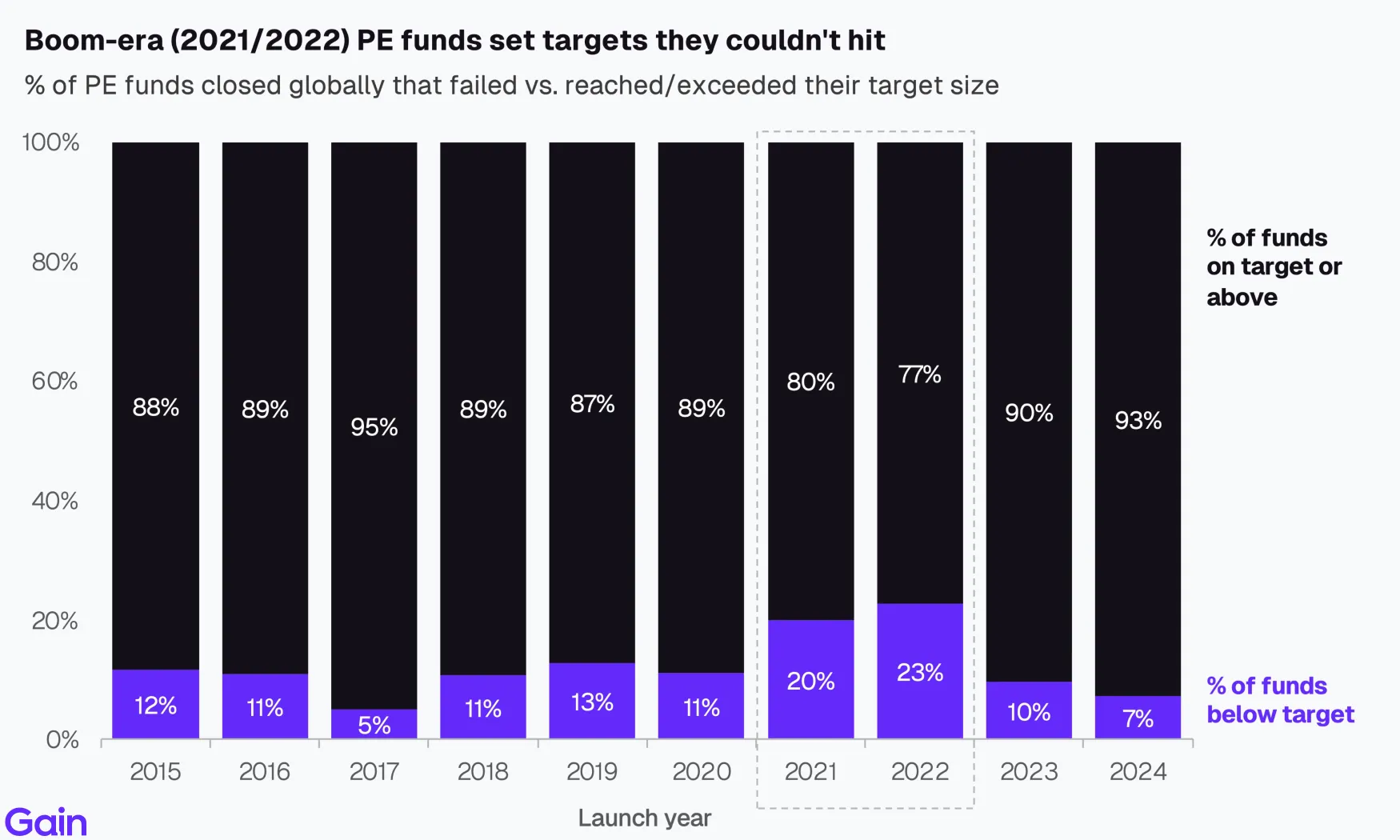
Boom-era (2021/22) PE funds set targets they couldn't hit. Funds launched in 2021-22 missed targets at roughly twice the historical rate, with 20% and 23% falling short against a ~10% standard. Recent vintages look better, but many funds are still in market and the shortfalls have yet to surface in the data.
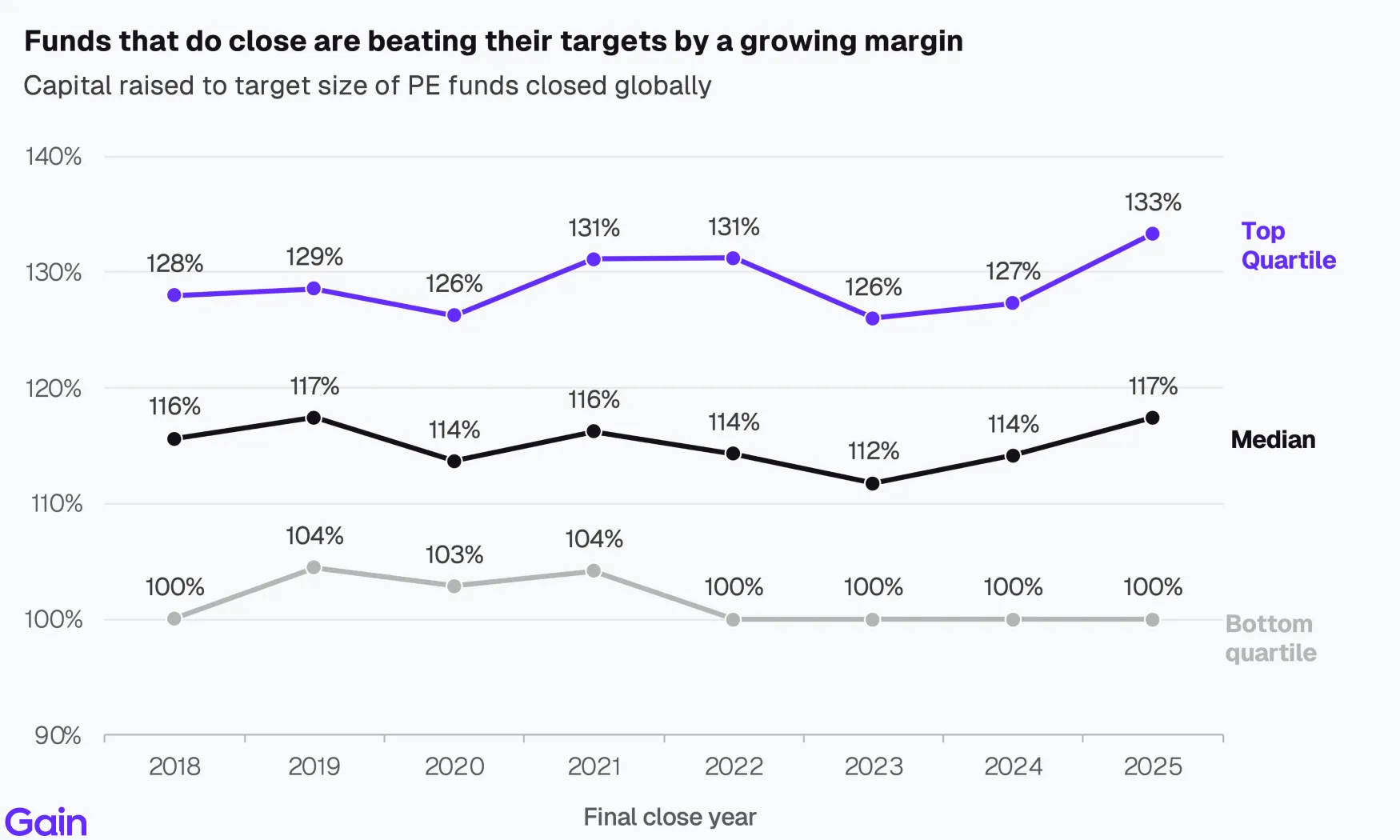
Funds that do close are beating their targets by a higher margin. The median fund reached 117% of target in 2025, while top-quartile funds hit a record 133%. As discussed above, this is partly due to more conservative target setting.
Chapter 04: Timelines
Launch to close
Fundraising timelines have started to improve in 2025-26. Average duration has eased from a peak of ~21 months in 2024 to ~18 in 2025 and ~16 YTD. The longer timelines of 2023-24 reflected ambitious fundraising targets set against a more difficult environment.
More than 50% of PE capital raised in 2026 took >18 months to close, down from a peak of 72% in 2024. That is still well above the average ~20% share across 2018-22, when quick closes were the norm.

It takes top-tier returns to close fast. Those with an IRR of >20% for their previous fund close the next fund in just 6 months. Compared to that, those with performance <15% typically take 14-15 months.
Chapter 05: Secondaries & CVs
Secondaries Insights
PE secondaries fundraising hit a record $104bn in 2025. 2026 is slower, as many large funds have already closed in 2025, leaving a thinner pipeline behind. Over the years, Secondaries as a strategy has grown in popularity, with LPs and GPs alike using it to generate liquidity and rebalance their portfolios.
Secondaries fund sizes keep breaking records, with each manager's latest fund its largest yet. Ardian's $30bn Fund IX is the largest secondaries fund ever raised, while Blackstone and Lexington both crossed $20bn mark. Lexington, Blackstone, and HarbourVest all also have successor funds in the market targeting further step-ups.

CV Insights
PE CV fundraising reached a record high of $64bn in 2025 as well. However, 2026 fundraising hit $30bn YTD and is down 26% vs. the same period last year. Private equity firms are increasingly holding onto their highest-conviction assets longer instead of exiting early. These vehicles serve multiple purposes: they (i) allow sponsors to extend ownership of high-performing assets, (ii) provide liquidity to existing LPs, and (iii) bring in new investors.

Methodology
The data for this report comes from Gain.
Our analysis focuses on global private equity (PE) strategies: buyout, growth, co-investment, special situations/turnaround, as well as GP Stakes and PE-focused secondaries. Venture capital, infrastructure, real estate, credit and evergreen are excluded.
Fundraising figures are based on the final close date i.e. a fund's entire committed capital is attributed to the year of its final close.
Where a fund's size isn't available, we estimate it using target, first close, or hard-cap numbers. For funds closed without a final close date, we use the vintage year as a proxy.
Fund sizes reported in local currencies are converted to USD using exchange rates at each fund's final close date.
Definitions
Continuation vehicles: vehicles a GP raises to acquire one or more assets from an existing fund, with that fund's LPs choosing to cash out or roll into the new vehicle.
Final close: point at which a fund stops accepting new commitments and its fundraising period formally ends.
First close: point at which a fund receives its initial commitments from investors and can begin deploying capital, typically representing a partial share of its eventual target size.
First-time fund: the first independent fund raised by a given GP under a new fund series (i.e., a Fund I).
Fundraising duration: time between a fund's launch and its final close.
Net IRR: discount rate at which the net present value of a historical series of cash flows equals zero after management fees, carried interest and other fund-level expenses.
Net TVPI: ratio of a fund's total value (cumulative distributions plus remaining net asset value) to the capital paid in by LPs, after management fees, carried interest and other fund-level expenses.
Step-up multiple: the ratio of a fund's size to that of the previous.
Target size: the amount of capital a GP sets out to raise for a fund at launch.
Time between funds: time between the final close of a fund and the final close of the previous fund within the same fund series.
Related Research
Discover our proprietary reports on investors, assets and PE deals.