

Industry research
Optical healthcare
Scope
Europe
Companies
51
Key takeaways
What is the scope of this industry report?
The European optical healthcare market comprises businesses that offer eye care treatments and manufacture equipment used to detect, remediate and treat various ophthalmological conditions. The most common treatments are cataract surgery, which replaces a cloudy natural lens with an artificial intraocular lens (IOL), as well as glaucoma treatments (e.g. ALT, SLT, LPI) that reduce intraocular pressure. In addition to essential eye surgeries, laser-based procedures (e.g. LASIK, PRK, LASEK) are growing in popularity but are generally not considered medically necessary, meaning patients typically pay for them out-of-pocket. These treatments aim to reshape the cornea with precise laser energy to correct vision problems such as myopia, hyperopia and astigmatism (Eye Laser, July 2024). The equipment used in such procedures includes surgical laser systems, imaging and measuring devices (e.g. topographers, biometers, perimeters), intraocular lenses (IOL), as well as other consumables. We segmented the market into: (i) eye clinics and (ii) ophthalmology instruments.
What does the optical healthcare market landscape look like in Europe?
The European eye clinics landscape remains highly fragmented, with ~70% of ophthalmology treatments performed by independent providers. However, there has been a wave of consolidation, which led to the emergence of several pan-European and regional platforms, including Veonet Group (>250 clinics across 5 countries) and Sanoptis Group (>460 locations in 6 countries; Lincoln International, July 2024). This consolidation is fuelled by growing PE-led interest, supported by strong sector fundamentals that favour robust profit margins. These include high reimbursement rates, a balanced mix of insurance and cash-pay revenue, as well as a shift from inpatient to outpatient care, increasing procedure volumes and lowering operating costs (PGP, January 2026; Healthcare Digital, December 2025). These favourable economics are combined with increasing pressures on small practices, including admin burden, cost inflation, workforce shortages and ageing physician demographics driving exits (Lincoln International, July 2024). For example, PE-backed Artemis Group completed ~45 add-on acquisitions from 2015 to 2026 (Montagu, January 2026). Meanwhile, Optical Express acquired ~70 clinics across the UK from Sk:n, ABC Medical and Harley Medical Group, using these locations to expand its eye care services while also diversifying into cosmetic and skin-care treatments (AOP, August 2024). Looking ahead, further consolidation is expected to take place, particularly in France and Germany, where there is a high need to invest in expensive femtosecond laser technology (Healthcare Digital, December 2025).
What is the level of investor activity in Europe's optical healthcare industry?
Investor-led interest has been robust, with ~41% of identified European assets being backed by a financial sponsor (as of January 2026). Investors are primarily attracted by (i) structural volume growth driven by ageing populations and the rising incidence of myopia, (ii) AI- and technology-enabled advances that enhance both clinical operations and instrument innovation opportunities, as well as (iii) the near-universal shift of cataract surgery into high-throughput day-case settings across Europe, which supports the build-out of larger clinic chains. On the other hand, (i) high patient out-of-pocket costs for elective laser procedures due to limited insurance coverage, (ii) chronic shortages of ophthalmology professionals that constrain organic growth, as well as (iii) increasing regulatory and compliance requirements that raise costs without providing additional pricing power act as key deterrents for investors.
What are the key ESG considerations in Europe's optical healthcare industry?
ESG topics primarily focus on environmental and social issues. On the environmental side, the sector has a sizeable carbon footprint due to high-volume, single-use-intensive eye surgeries, prompting identified clinics and manufacturers to adopt recycling and reusable instrument initiatives. Socially, persistent global gaps in access to basic eye care drive industry players to invest in training programmes to expand cataract treatments, as well as enable tele-ophthalmology services for remote diagnosis in underserved regions.
Company benchmarking
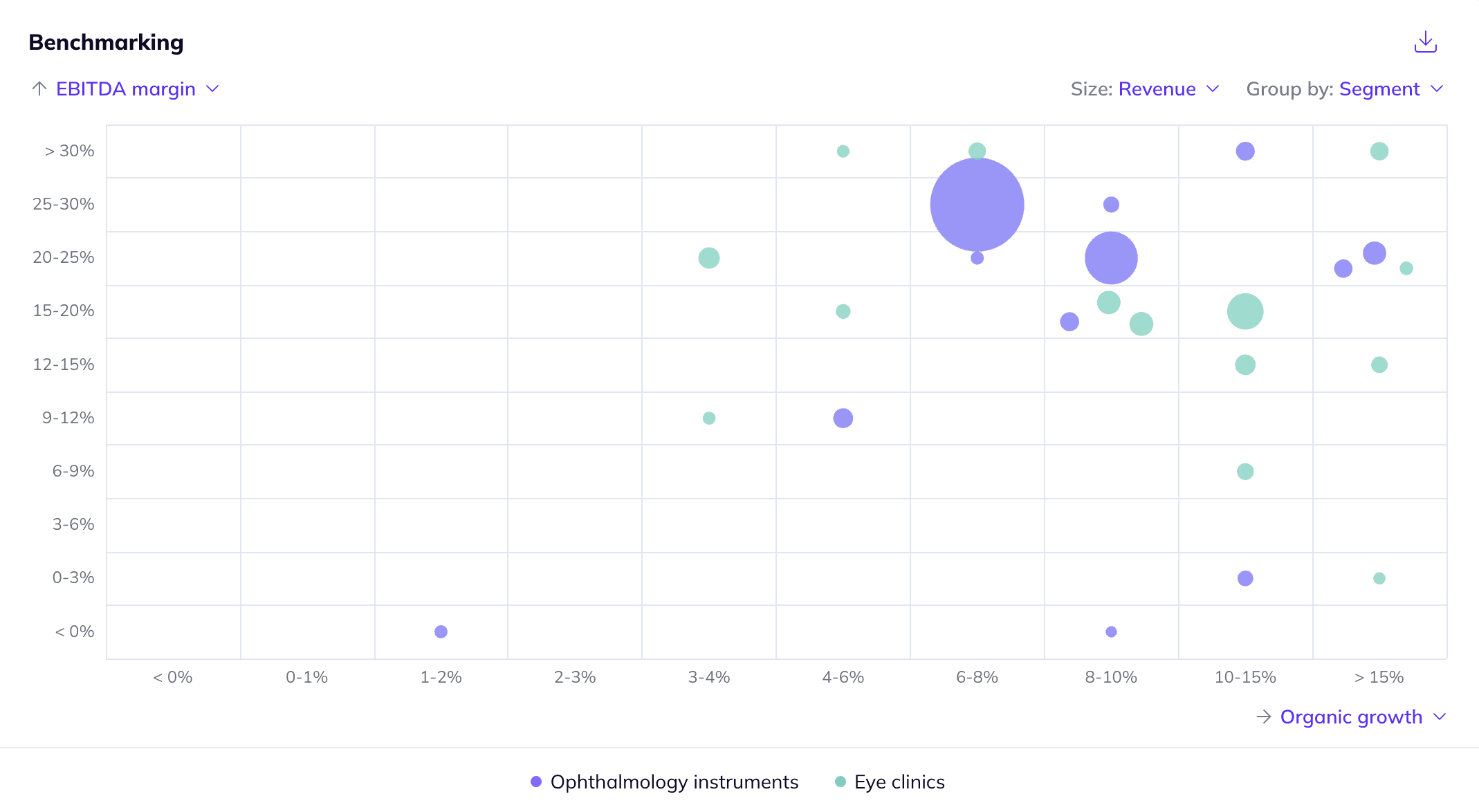
Market growth
Statista (June 2025) projects the European ophthalmic devices market to grow from ~€11.7bn in 2026 to ~$13.4bn in 2030, registering a +3.4% CAGR during the period
According to Technavio (December 2025), the global cataract surgery devices market was valued at ~$7.2bn in 2025 and is projected to reach ~$9.8bn by 2030 (+6.5% CAGR 2025-2030)
Positive drivers
Europe’s ageing demographic is a primary catalyst for market expansion, as the incidence of age-related eye diseases climbs. Notably, glaucoma affecting two-thirds of the over-70 demographic continues to drive sustained demand. At the same time, increased screen time is driving a rise in myopia among children, further supporting top-line growth prospects for eye clinics and manufacturers of ophthalmology instruments (National Library of Medicine, March 2025; The Holland Times, November 2024)
AI-driven technological advancements are transforming ophthalmic diagnostics accuracy and treatment efficiency. Innovations (e.g. robotic surgical tools, AI-based imaging systems) drive improvements in clinical operations while creating new growth opportunities for instrument manufacturers (Ophthalmology Times, December 2025; National Library of Medicine, March 2024)
Same-day surgery represents ≥90% of cataract procedures in most OECD countries, enabling high-volume operations and lower operating costs through outpatient delivery. Simultaneously, rising cost pressures and an ageing physician base are squeezing independent ophthalmology practices and pushing many owners towards an exit. Together, these factors offer significant scale-up and consolidation opportunities for specialised eye-clinic chains across Europe (OECD, November 2025; Lincoln International, July 2024)
Negative drivers
Elective laser eye surgeries are generally excluded from standard medical insurance coverage across Europe, resulting in high out-of-pocket costs for patients, with prices ranging from ~£1.5k-3k per eye in the UK. This substantial cost burden may lead to patient hesitation and hinder market penetration (Lincoln International, July 2024; Laser Vision Eye Centre, January 2026)
Structural labour shortages, specifically among optometrists and ophthalmologists, remain a primary headwind. Ophthalmology is forecasted to have the second-highest supply-demand imbalance out of 38 medical and surgical specialties, posing a significant bottleneck for future service delivery. Notably, no nation in the UK currently meets the recommended minimum of 3 consultant ophthalmologists per ~100k population, thereby limiting the industry’s capacity to drive organic growth (Forbes, March 2025; The Royal College of Ophthalmologists, May 2024)
Stricter ophthalmology regulations, higher quality and safety standards compel both equipment manufacturers and eye clinics to engage in more thorough inspections and compliance procedures. While being both costly and time-consuming, these activities do not translate into more favourable pricing, thus affecting players’ profitability margins (interview by Gain.pro; Eurotimes, February 2024; Eclevar, January 2026)
Fill out the form to request your copy of the Optical healthcare industry report
With the full report, you’ll gain access to:
Detailed assessments of the market outlook
Insights from c-suite industry executives
A clear overview of all active investors in the industry
An in-depth look into 51 private companies, incl. financials, ownership details and more.
A view on all 173 deals in the industry
ESG assessments with highlighted ESG outperformers
Discover hundreds of niche industry reports on Gain
Deep dive into additional industries to understand their market outlook, positive and negative drivers, and more!