

Industry research
Content marketing technology
Scope
US
Companies
55
Key takeaways
What is the scope of this industry report?
The US content marketing technology market comprises businesses that develop tools to support the end-to-end content lifecycle management, ranging from ideation and asset creation to governance, distribution and performance measurement across digital channels. Herein, content planning and creation tools support ideation, drafting and production workflows, while content management and distribution platforms govern and deliver content assets across channels via a content management system and digital asset management. Content performance and analytics tools track reach and engagement to assess effectiveness and ROI. As such, we segmented the US content marketing technology market into: (i) content planning & creation, (ii) content management & distribution and (iii) content performance & analytics.
What does the content marketing technology market landscape look like in the US?
The competitive landscape remains fragmented across the content planning & creation and content management & distribution segments, with specific players leading different niches (e.g. Notion in collaborative content workspace software) rather than dominant firms across the entire market. These pure-play firms compete with large, diversified software firms such as Adobe (US), HubSpot (US) and Canva (AU). Additionally, CMS platforms in the content marketing technology market are typically marketing-oriented rather than website builders, such as Automattic (US; WordPress), Shopify (CA), Wix (IL) and Squarespace (US). Contrarily, the US content performance & analytics market is dominated by large technology giants such as Alphabet (US), Salesforce (US), SAP Group (DE) and Microsoft (US). These large players have attained and reinforced their dominant positions through deep integration with enterprise software ecosystems. At the same time, their established market leadership positions them as low-risk, trusted choices for enterprises. To compete, the long tail focuses on narrow use cases, industry-specific workflows or differentiated analytics capabilities. For example, Archive focuses on influencer marketing analytics, combining social listening with creator discovery and rights management.
What is the level of investor activity in the US's content marketing technology industry?
Investor-led interest has been significant, with ~82% of identified assets being backed by financial sponsors (as of January 2026). Investors are primarily attracted by the market's favorable long-term outlook on the back off (i) rising AI adoption in marketing which expands personalization and automation use cases, (ii) a shift in B2B marketing toward digital, content-led engagement across owned and third-party channels and (iii) higher complexity of digital customer journeys, increasing demand for centralized platforms to coordinate content planning, execution and measurement across channels. On the other hand, deterring factors include (i) budget pressure from higher spend on generative AI, diverting funds from content marketing, (ii) technology stack fragmentation and higher integration complexity, which raises modernization costs and pushes vendor rationalization and (iii) macroeconomic uncertainty, leading organizations to treat content marketing technology as discretionary spend and delay new subscriptions.
What are the key ESG considerations in the US's content marketing technology industry?
ESG considerations in the US content marketing technology market primarily relate to environmental and governance challenges. Environmental topics relate to the energy intensity of cloud infrastructure for content storage and distribution, as well as the higher computational demands from AI-enabled tools, which increase exposure to data center electricity use. To address these concerns, incumbents align infrastructure strategies with hyperscale cloud operators that emphasize renewable power sources. Governance aspects revolve around data privacy, cybersecurity and the handling of personally identifiable information, as breaches or misuse can trigger financial, reputational and regulatory harm. To mitigate this, incumbents apply multi-layer security and compliance controls, including stronger access management and assurance standards.
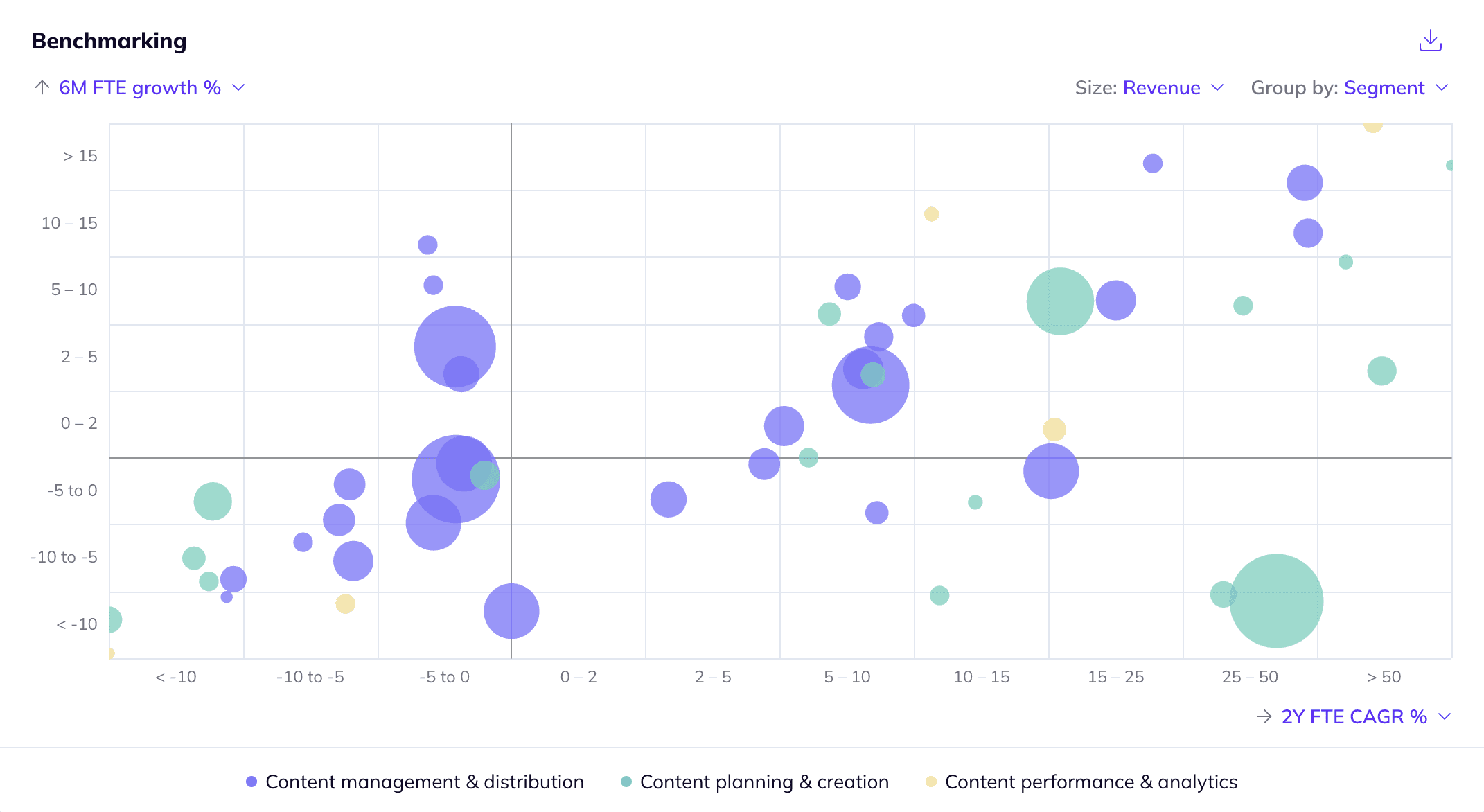
Company benchmarking
Market growth
The global marketing technology market was valued at ~$131.0bn in 2023 and is projected to reach ~$215.0bn by 2027 (+13.3% CAGR 2023-2027; McKinsey & Company, October 2025)
Technavio (December 2024) estimates that the global content management software market generated ~$21.3bn in revenue in 2024 and expects it to reach ~$28.4bn by 2029 (+5.9% CAGR 2024-2029)
Positive drivers
Advancements in AI and machine learning allow content marketing technology platforms to extend use cases across data analysis, personalization and process automation within existing cost structures. To illustrate, the integration of AI into marketing operations is projected to reach ~44.2% by 2028, up from ~17.2% in 2025, which lowers unit content costs and raises output volumes (Averi, November 2025; Forbes, March 2024; McKinsey & Company, December 2023)
Increased digital consumption is expected to shift B2B buying behavior toward content-led engagement across digital channels, which raises the strategic importance of content marketing technology platforms. To exemplify, Gartner projects that ~80% of B2B sales interactions occurred through digital channels in 2025 (SuperAGI, June 2025; Gartner, May 2023)
The rising complexity of digital customer journeys extends reliance on integrated content marketing technology platforms to coordinate planning, execution and measurement across channels. As customer interactions increasingly span multiple digital touchpoints and become more fragmented and non-linear, enterprises will leverage centralized content marketing platforms (FutureCIO, July 2023; McKinsey & Company, February 2022)
Negative drivers
The increasing generative AI technology and advanced data analytics spend eats into content marketing budgets. To illustrate, ~59% of global CMOs cite budget pressure as the primary obstacle for new MarTech deployments, which slows development and restricts scaling of MarTech platforms across organizations (CMSWire, June 2025; Gartner, May 2025; Mi3, May 2024)
Technology stack fragmentation and rising integration complexity are expected to increase operational friction and accelerate consolidation across content marketing technology platforms. Herein, fragmented marketing technology stacks require ~2.7x higher investment to achieve necessary modernization, which drives enterprises to rationalize vendors and limit platform sprawl (McKinsey & Company, October 2025; CMSWire, June 2025; Brixon Group, May 2025)
In periods of macroeconomic uncertainty, content marketing technology is categorized as a discretionary marketing expense rather than a core revenue enabler, prompting organizations to postpone new subscriptions or limit upgrades to higher-tier platforms (Robotic Marketer, September 2024; MarTech, May 2024)
Fill out the form to request your copy of the Content marketing technology industry report
With the full report, you’ll gain access to:
Detailed assessments of the market outlook
Insights from c-suite industry executives
A clear overview of all active investors in the industry
An in-depth look into 55 private companies, incl. financials, ownership details and more.
A view on all 254 deals in the industry
ESG assessments with highlighted ESG outperformers
Discover hundreds of niche industry reports on Gain
Deep dive into additional industries to understand their market outlook, positive and negative drivers, and more!