
Industry research
Animal feed
Scope
US
Companies
54
Key takeaways
What is the scope of this industry report?
The US animal feed industry comprises companies that formulate, manufacture and supply nutrition products used in the production of meat, dairy, eggs and other animal-derived products across commercial livestock and aquaculture systems. These players develop a broad range of nutritionally formulated feed products and inputs, combining agricultural commodities with proteins, fats, minerals, vitamins and functional additives to support animal growth, health and productivity across different species and production stages. Accordingly, we have segmented the market into: (i) compound feed and (ii) ingredients and additives.
What does the animal feed market landscape look like in the US?
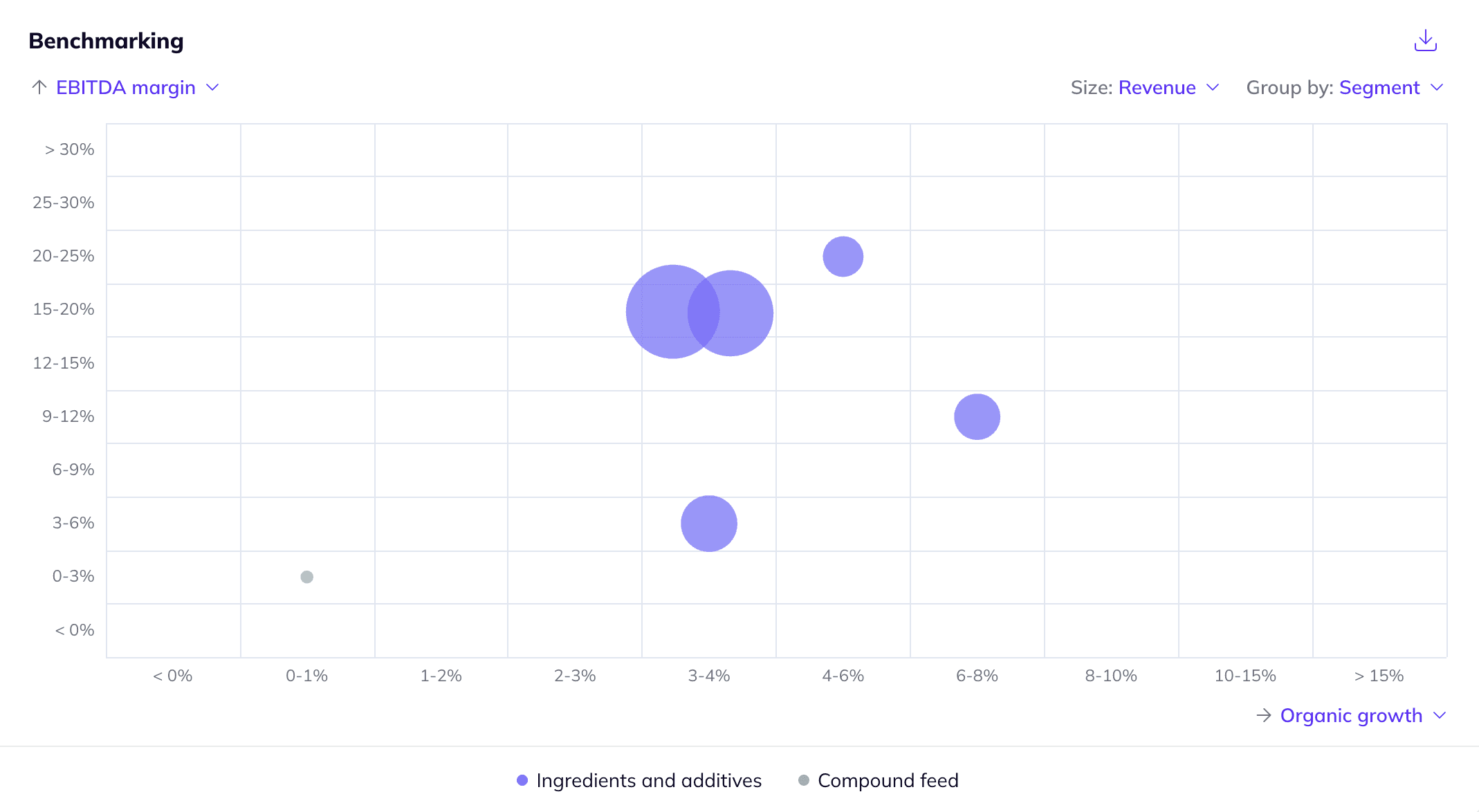
The US animal feed landscape remains structurally fragmented across both segments, with a long tail of regional operators alongside a limited number of scaled platforms (e.g. Land O’Lakes). Herein, large platforms in compound feed differentiate primarily through vertically integrated supply chains and multi-site manufacturing networks, while smaller producers compete through localized production and formulation flexibility. By contrast, the ingredients and additives segment combines scaled ingredient platforms (e.g. Darling Ingredients) with numerous category-specific additive specialists operating across a wide range of product classes (e.g. enzymes and trace minerals). Within the ingredients niche, competition is shaped by standardized nutritional inputs, where pricing is closely linked to commodity alternatives and scale supports the absorption of fixed costs and market coverage. Meanwhile, the additives category remains more fragmented due to product diversification and narrowly defined functional applications. As a result, competitive positioning in additives is driven less by scale and more by formulation intensity and validation capabilities, within a regulatory framework that constrains claims, labeling and use conditions.
What is the level of investor activity in the US's animal feed industry?
Sponsor-led interest remains limited, with ~11% of identified assets being investor-backed (January 2026). Herein, investors are primarily attracted to (i) structural growth in animal protein production that expands baseline feed demand and supports multi-year volume visibility, (ii) persistent disease risk that shifts nutrition programs toward proactive health support and lifts demand for functional additives, as well as (iii) ongoing digitalization of feed manufacturing that improves cost discipline, margin resilience and customer confidence through tighter formulation control. On the other hand, the main detractors relate to (i) sustained volatility across feed commodities and micro-ingredients that elevates operational risk and compresses margins, (ii) expanding regulatory oversight under preventive controls and cGMP requirements that raise compliance costs and execution risk, as well as (iii) commoditized formulations and dense local competition that constrain pricing power and cap base product margin expansion.
What are the key ESG considerations in the US's animal feed industry?
ESG considerations span all pillars, with environmental risks primarily driven by emissions intensity and resource inefficiencies across feed manufacturing and ingredient sourcing, including limited circularity in agricultural input systems. Identified players address these risks through formulation optimization, increased use of co-products and targeted investments in energy-efficient production assets. Social topics arise from concerns about antibiotic stewardship in animal nutrition and safety-related risks for workers across manufacturing operations. In response, players expand non-antibiotic nutrition programs and reinforce Environmental, Health and Safety (EHS) systems, training and incident prevention protocols. Governance risks pertain to the disciplines of product labeling and performance claims, as well as oversight of food safety and regulatory compliance under the Food Safety Modernization Act (FSMA). Players mitigate these risks by strengthening food safety management systems, supplier verification, recall readiness, as well as formal claim substantiation and review processes.
Company benchmarking
Market growth
Technavio (February 2025) estimates that the global animal feed market generated ~$542.4bn in revenue in 2024 and forecasts it to reach ~$688.3bn by 2029 (+4.9% CAGR 2024–2029)
The North American animal feed additives market was expected to generate ~$9.5bn in revenue in 2024 and reach ~$12.5bn by 2029 (+5.6% CAGR 2024-2029; Statista, June 2025)
Positive drivers
Structural growth in animal protein production is expected to expand baseline feed demand and provide multi-year volume visibility. To illustrate, long-term projections of the US Department of Agriculture (USDA) indicate US pork production and broiler consumption per capita to increase by ~10% between 2026–2034, supporting sustained feed throughput across major species (USDA, February 2025)
Persistent disease risk and performance volatility are expected to drive nutrition programs toward proactive health support, which raises demand for functional additives that stabilize outcomes. For instance, highly pathogenic avian influenza (HPAI, H5N1) continues to affect domestic birds and dairy cattle across the US, which reinforces interest in probiotics, prebiotics and postbiotics positioned to support gut health and immunity (Feed Strategy, December 2025; USDA, December 2025)
Digitalization of feed manufacturing is expected to strengthen margin resilience and customer trust, as tighter nutrient control and data-driven formulation improve cost discipline and consistency of animal performance. To illustrate, increased adoption of real-time near-infrared (NIR) ingredient analysis, combined with AI-enabled formulation tools, allows producers to dynamically adjust rations in response to variability in grain quality, thereby reducing over-formulation risk and raw-material waste while protecting feed margins (Feed Strategy, January 2025; Feed Strategy, January 2024)
Negative drivers
Persistent feed input volatility across commodities and micro-ingredients creates operational risk and margin pressure due to lagged price pass-through and supply chain dependencies. With ~99% of key vitamins and amino acids sourced from China and swine feed costs swinging ~$0.43 per cwt for every $0.10 move in corn, identified players are exposed to both international trade tensions and domestic market volatility (KSJD, January 2026; The Mid-West Farm Report, December 2025; USDA, July 2025; Purdue University, June 2025)
Expanding regulatory oversight under preventive controls and current Good Manufacturing Practices (cGMP) requirements is expected to raise compliance costs and heighten execution risk across feed manufacturing. To illustrate, FDA warning letters issued to animal food manufacturers in 2025 following 2024 inspections – cited deficiencies in required hazard analyses and written food safety plans, which increased remediation burden and interruption risk (FDA, June 2025; FDA, April 2025; FDA, December 2024)
Commoditized market dynamics drive feed producers into intense price competition as standardized formulations and dense local competition continue to limit pricing power. With few defensible brands or experiential moats, buyers frequently rebid volumes and prioritize price parity and service reliability, shifting competition toward cost control and operational efficiency rather than price-led growth and sustaining pressure on base product margins (FeedStrategy, December 2025; World Grain, January 2024)
Fill out the form to request your copy of the Animal feed industry report
With the full report, you’ll gain access to:
Detailed assessments of the market outlook
Insights from c-suite industry executives
A clear overview of all active investors in the industry
An in-depth look into 54 private companies, incl. financials, ownership details and more.
A view on all 78 deals in the industry
ESG assessments with highlighted ESG outperformers
Discover hundreds of niche industry reports on Gain
Deep dive into additional industries to understand their market outlook, positive and negative drivers, and more!