

Industry research
PropTech EU
Scope
Europe
Companies
78
Table of contents
Report collaborator:

James Cavanagh and Anthony Crutchett, partners at CIL Strategy Consultants, provided expert insights for this report. Read the full interview here.
Key takeaways
What is the scope of this industry report?
The European PropTech market comprises businesses developing digital tools and software for homebuyers, sellers and real estate professionals, designed to streamline transactions and enhance efficiency across the real estate ecosystem. Their offerings cover the broader real estate value chain, from property lettings and sales to transactions and property management.
As such, we segmented the European market into:
Marketplaces,
Hybrid agencies,
Liquidity providers,
Property management platforms.
What does the PropTech landscape look like in Europe?
The European PropTech market exhibits a relatively consolidated landscape, although the degree of consolidation varies by segment. The marketplaces segment is concentrated at the national level, as strong network effects have given rise to clear national leaders (e.g. Idealista Group in Spain, Rightmove in the UK). By contrast, the remaining segments are more fragmented, reflecting the relative immaturity of newer business models that are still scaling and have yet to produce clear pan-European leaders, particularly across hybrid agencies and liquidity providers. These players seek to outcompete traditional agencies through lower prices, faster execution and more digitalised customer journeys. However, adoption remains constrained by consumer reluctance toward fully digital property transactions (CIL expert interview).
What does the PropTech market landscape look like in Europe?
Sponsor-led interest has been significant, with ~91% of identified assets being investor-backed (June 2026).
Investors are primarily attracted to:
Significant runway to digitise the traditional property transactions market,
Rising EU building decarbonisation requirements, which support demand for digital energy performance monitoring and assessment tools,
Expanding revenue opportunities by developing tools that automate time-consuming back-end tasks (e.g. documentation, lead management).
On the other hand,
Regulatory developments across European real estate markets (e.g. rent control measures, higher transaction taxes) lowering property sales and lettings volumes,
Increased macroeconomic uncertainty (e.g. Iran conflict),
Continued resistance to fully digital property transactions, particularly among older demographics, serve as key deterrents for investors.
What are the key ESG considerations in the European PropTech industry?
ESG topics primarily relate to environmental and social issues. Environmentally, players have mostly indirect exposure. Herein, they improve sustainability visibility through EPC ratings, green certifications and energy-cost data. From a social perspective, the main challenges revolve around handling sensitive user and transaction data, while improving transparency and comparability in housing data and supporting broader housing affordability. To address this, players implement stronger data protection, verified listings, affordability tools and pricing insights.
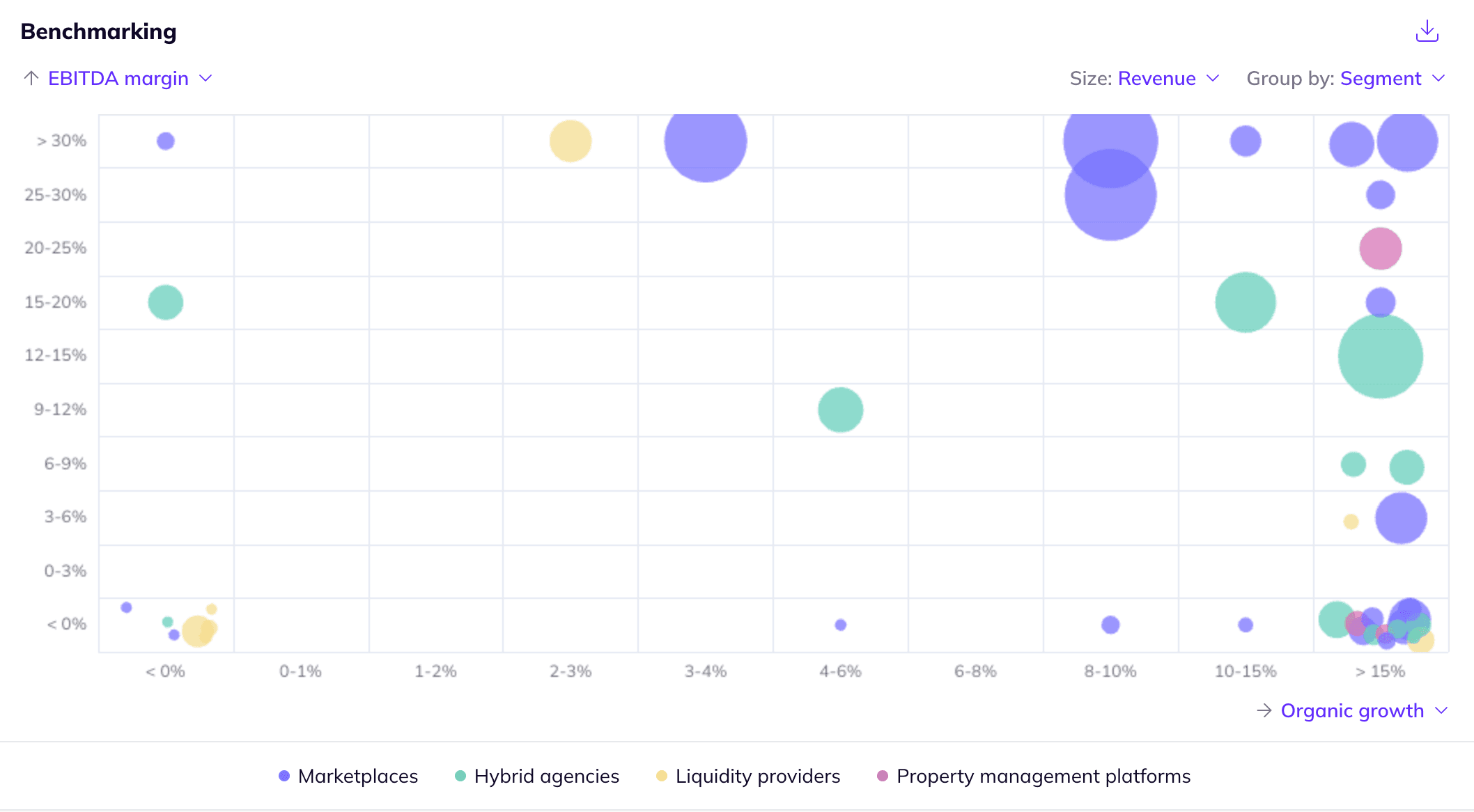
Company benchmarking
Market growth
The global property management market is expected to grow from ~$28.7bn in size in 2025 to ~$43.2bn by 2030 (+8.5% CAGR 2025-2030; Technavio, March 2026)
The European commercial and residential real estate market was valued at ~€146.3tn in 2025 and is projected to grow to ~€165.7tn in 2031, registering a +2.1% CAGR over the period (Statista, April 2026)
Positive drivers
Opportunities to accelerate the digitisation of the traditional real estate market, with AI-enabled features increasingly enhancing the buying, selling and renting experience for sellers, tenants and buyers. When viewed through the technology adoption lifecycle, the sector remains in the early stages of accelerated growth, suggesting substantial headroom for demand across all segments (CIL expert interview)
Rising building decarbonisation requirements are expected to support PropTech demand, as the revised EU Energy Performance of Buildings Directive aims to achieve a fully decarbonised building stock by 2050. This is expected to increase demand for digital tools that help real estate stakeholders monitor energy performance, track emissions, plan retrofits and prioritise sustainability-related CAPEX (European Commission, June 2026; JLL, June 2026; ULI Europe, November 2024)
Growing cost pressures and operational efficiency needs are expected to accelerate PropTech adoption, as real estate agencies seek to reduce manual workloads and improve agent productivity. By leveraging AI and big data analytics to automate time-consuming back-end tasks (e.g. documentation, property listings, lead management), PropTech platforms can help agents focus on higher value-added, relationship-driven activities, while deepening workflow integration and expanding monetisation opportunities (CIL expert interview)
Negative drivers
Stricter rental regulations across Europe are creating headwinds for PropTech providers by weakening landlord incentives, constraining rental supply and reducing transaction volumes that drive revenue generation. For example, in the UK, the recently approved Renters' Rights Bill introduces measures such as ending "no-fault" evictions and restricting rent increases, while the Netherlands' WWS points-based system caps rents according to property characteristics, including size, energy label and facilities (CIL expert interview; Gov.UK, November 2025; The Guardian, May 2024)
Macroeconomic uncertainty, including geopolitical tensions and tariff wars, may lead to higher interest rates across Europe and weigh on real estate transaction volumes. Given the highly cyclical nature of property buying and selling, lower transaction activity reduces monetisation opportunities for PropTech players dependent on transaction-led services (e.g. listings, brokerage software, mortgage intermediation; CIL expert interview; Reuters, May 2026)
Resistance to change among home buyers and sellers, particularly among older, wealthier demographics, may constrain PropTech adoption, as many market participants remain more comfortable with traditional, relationship-led transaction processes. These dynamics can increase customer acquisition costs and limit growth for digital-first real estate platforms (Savills, March 2026; NAR, January 2026)
Fill out the form to request your copy of the PropTech EU industry report
With the full report, you’ll gain access to:
Detailed assessments of the market outlook
Insights from c-suite industry executives
A clear overview of all active investors in the industry
An in-depth look into 78 private companies, incl. financials, ownership details and more.
A view on all 418 deals in the industry
ESG assessments with highlighted ESG outperformers
Discover hundreds of niche industry reports on Gain
Deep dive into additional industries to understand their market outlook, positive and negative drivers, and more!