Executive Summary
In this report, we go deep into the PE landscape in the TMT (Technology, Media, and Telecom) sector. We share insights on the largest TMT investors, their portfolios, subsector trends, entries, add-ons, exits, holding periods, growth rates, and much more. Here is a summary of our key findings:
Thoma Bravo has emerged as the largest TMT private equity investor, managing a total estimated EV of $132.4bn*, followed by Vista Equity ($83.5bn), and KKR ($76.5bn). Other investors in the top 10 include Hg ($69.2bn), EQT ($65.3bn), Blackstone ($57.5bn), Silver Lake ($57.4bn), TPG Capital ($48.1bn), TA Associates ($46.7bn), and Bain Capital ($46.5bn).
US-headquartered investors dominate the TMT 100 ranking, managing 74% of aggregate EV. The top 100 collectively manage an estimated $1.6tn across 2,104 assets, with the top 10 alone accounting for 42% of EV.
By region, the US (30%) and Nordics (29%) have the highest concentration of TMT assets by EV, while concentration is generally lower in Europe. PE investors have aggressively shifted into Software since 2010 (+9pp). TA Associates, Hg, and Insight Partners stand out for having the highest deal activity (including add-ons).
TMT revenue growth has consistently outpaced other sectors by 5-6 percentage points, with margins being 3–5 percentage points higher as well. Private TMT valuations have come down, though they still remain elevated compared to public market comparables.
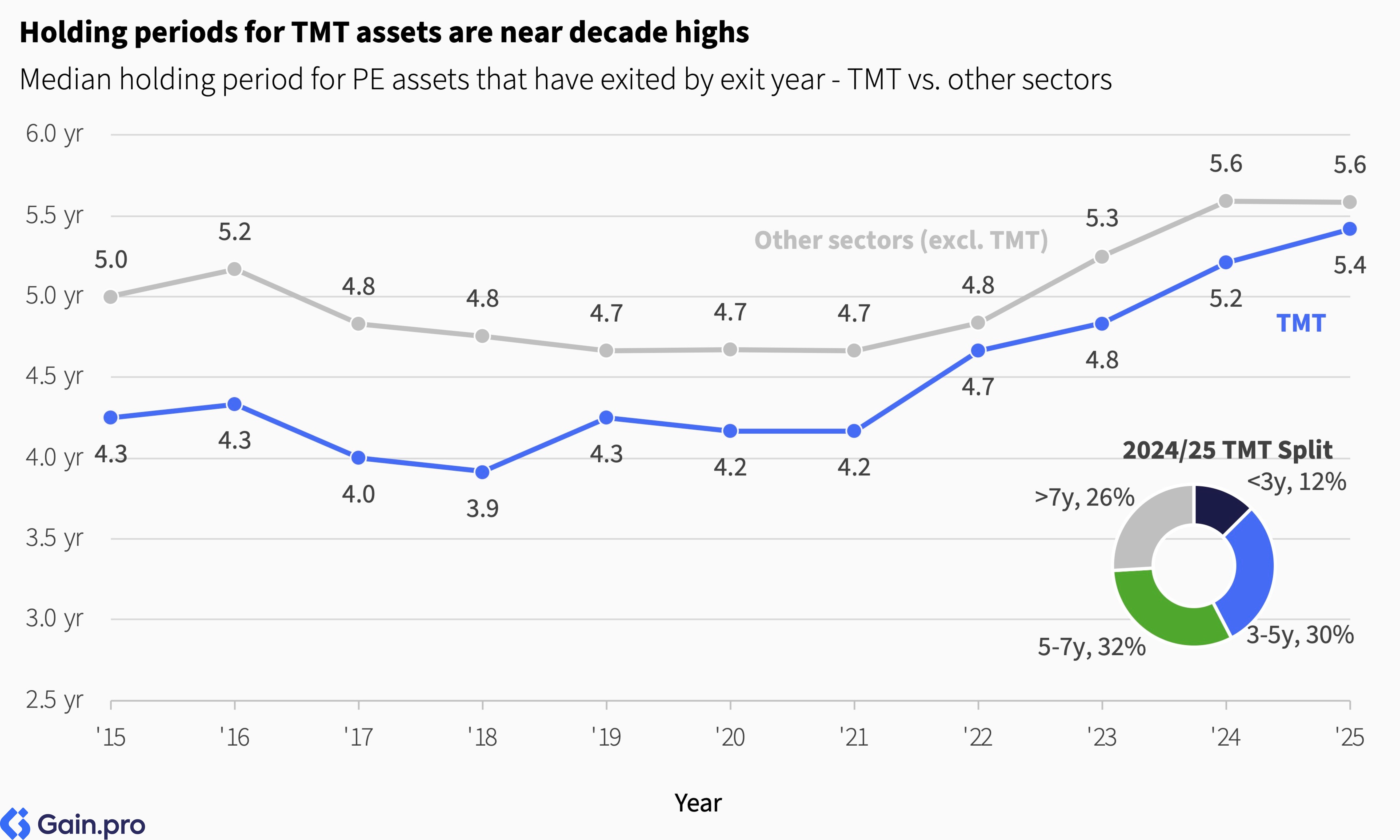
TMT overall sees significantly higher strategic exit activity than other sectors, particularly for smaller deals. Overall, holding periods for TMT assets have risen to a median of 5.4 years, though they remain slightly lower than the broader market at 5.6 years.
There is a lot more data and charts to explore in the full report. Reach out if you have any questions.
*across North American and European markets






Chapter 01: Investor Rankings
The TMT 100 Ranking
Thoma Bravo has emerged as the largest TMT private equity investor, managing a total estimated EV of $132.4bn (across transatlantic markets), followed by Vista Equity Partners ($83.5bn) and KKR ($76.5bn).
Other investors in the top 10 include Hg ($69.2bn), EQT ($65.3bn), Blackstone ($57.5bn), Silver Lake ($57.4bn), TPG Capital ($48.1bn), TA Associates ($46.7bn), and Bain Capital ($46.5bn).
Collectively, the top 100 TMT investors manage an estimated EV of $1.6tn across 2,104 assets. On average, they have a mean portfolio EBITDA of $119m and manage 21 companies each.
Over the last 6 years, TMT 100 investors have invested in 2.1x as many new portfolio companies as they have exited. There have been 2,004 new investments and 914 exits from these sponsors.
The table below lists all the top 100 TMT investors. Use the search bar or the arrows at the top to navigate through the ranking.
Dominant Investor HQs
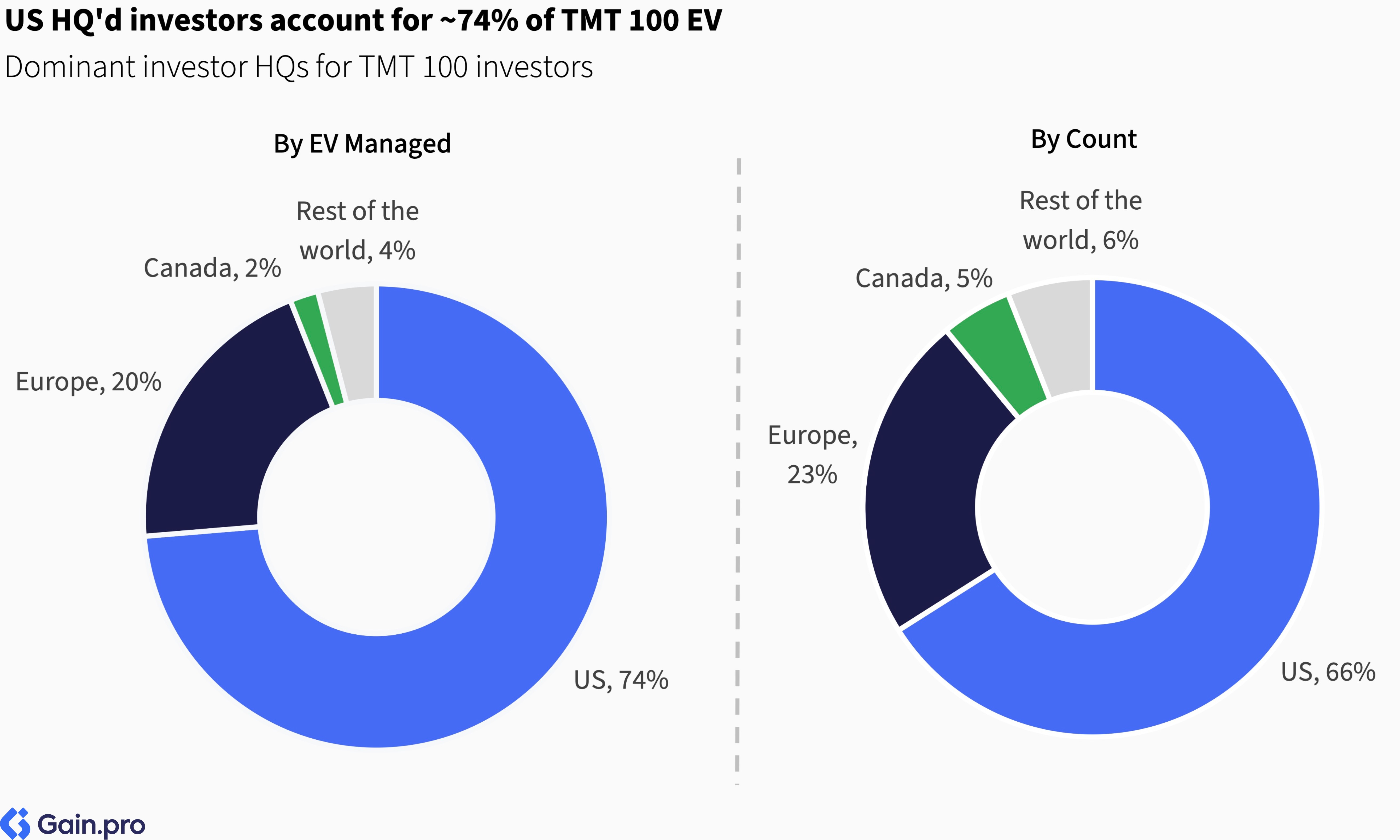
US-headquartered investors dominate the TMT 100 ranking, managing 74% of the aggregate TMT 100 EV. Sponsors headquartered outside the US represent only 26% of total TMT 100 EV — with European sponsors at 20%, Canadian at 2%, and other international investors at 4%. US investor activity spans the entire spectrum of deal sizes, from small and mid-sized assets to mega-large platforms.
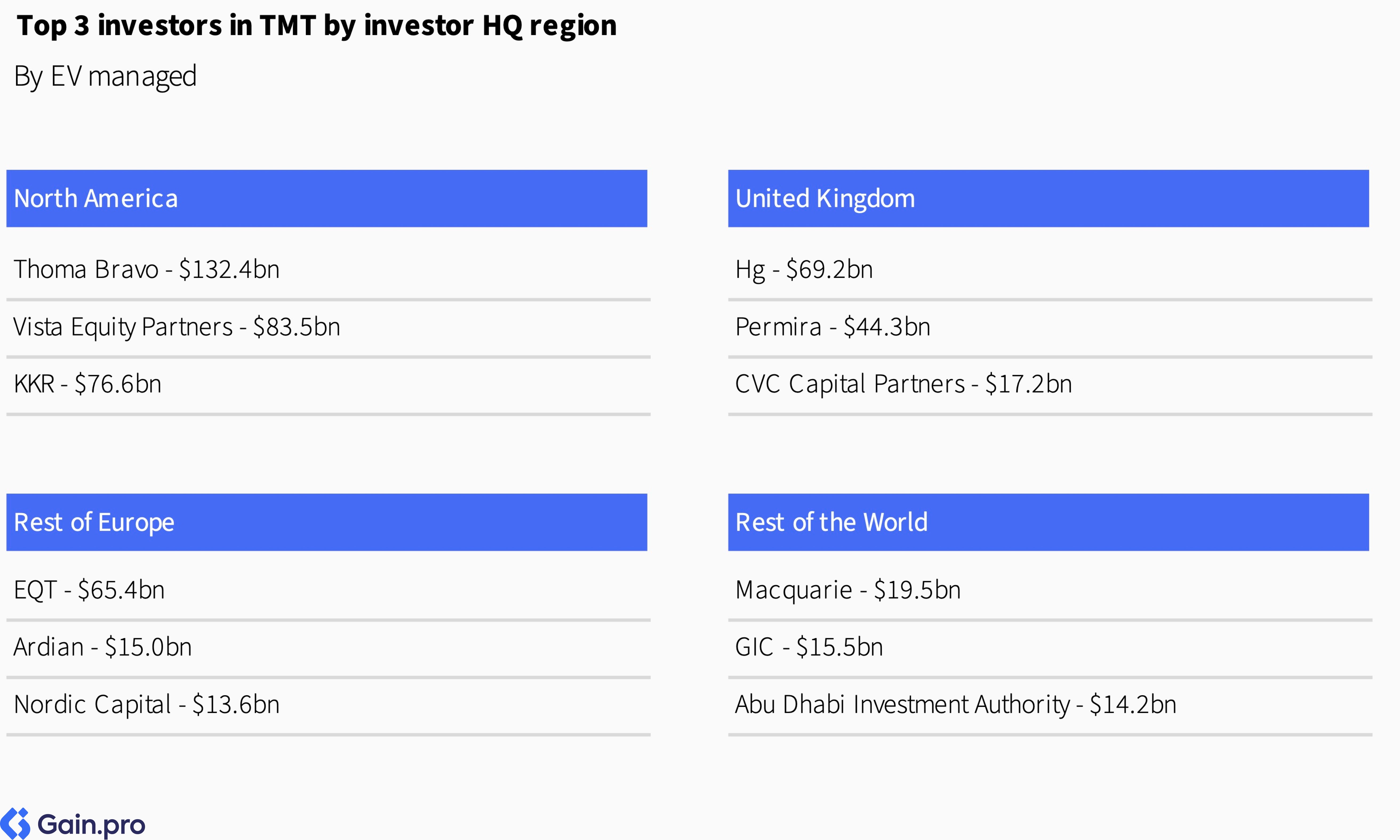
By investor HQ region, leading the rankings are Thoma Bravo (North America, $132bn), Hg (UK, $69bn), EQT (Rest of Europe, $65bn), and Macquarie (Rest of the World, $20bn). Other large investors outside North America include Permira ($44bn), CVC Capital Partners ($17bn), GIC ($16bn), Ardian ($15bn), ADIA ($14bn), and Nordic Capital ($13bn).
Investor Concentration
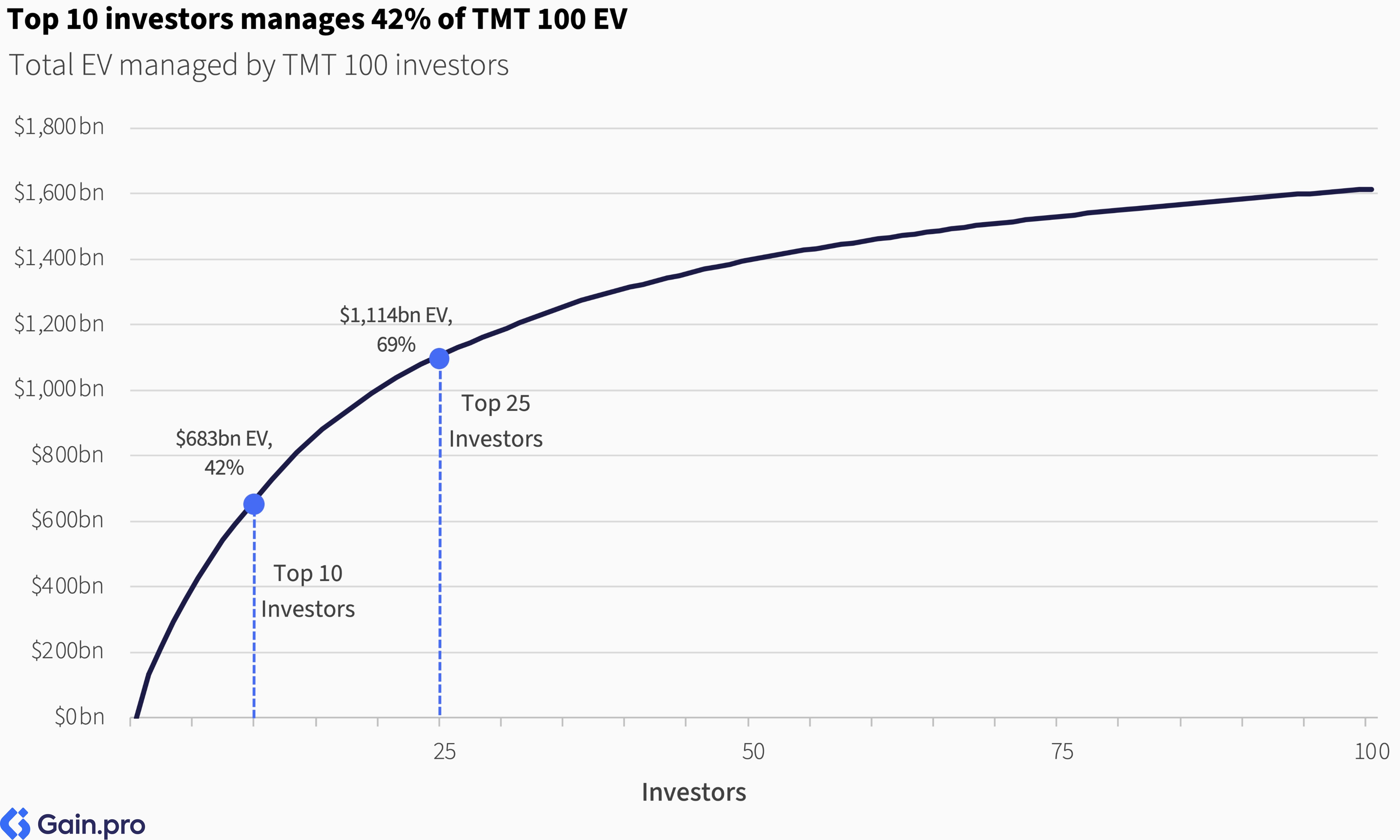
The TMT 100 landscape is fairly concentrated at the upper end, with the top 10 investors managing 42% of the aggregate TMT 100 EV. The top-ranked firms include both dedicated TMT specialists like Thoma Bravo, Vista Equity Partners, Silver Lake, and Hg, as well as generalist mega-funds such as KKR and Blackstone. TMT specialists benefit from scale advantages including deeper sector expertise, better deal flow access, established industry relationships, and strong credibility with founders and management teams. Fundraising trends over the last few years have also favored these specialist investors.
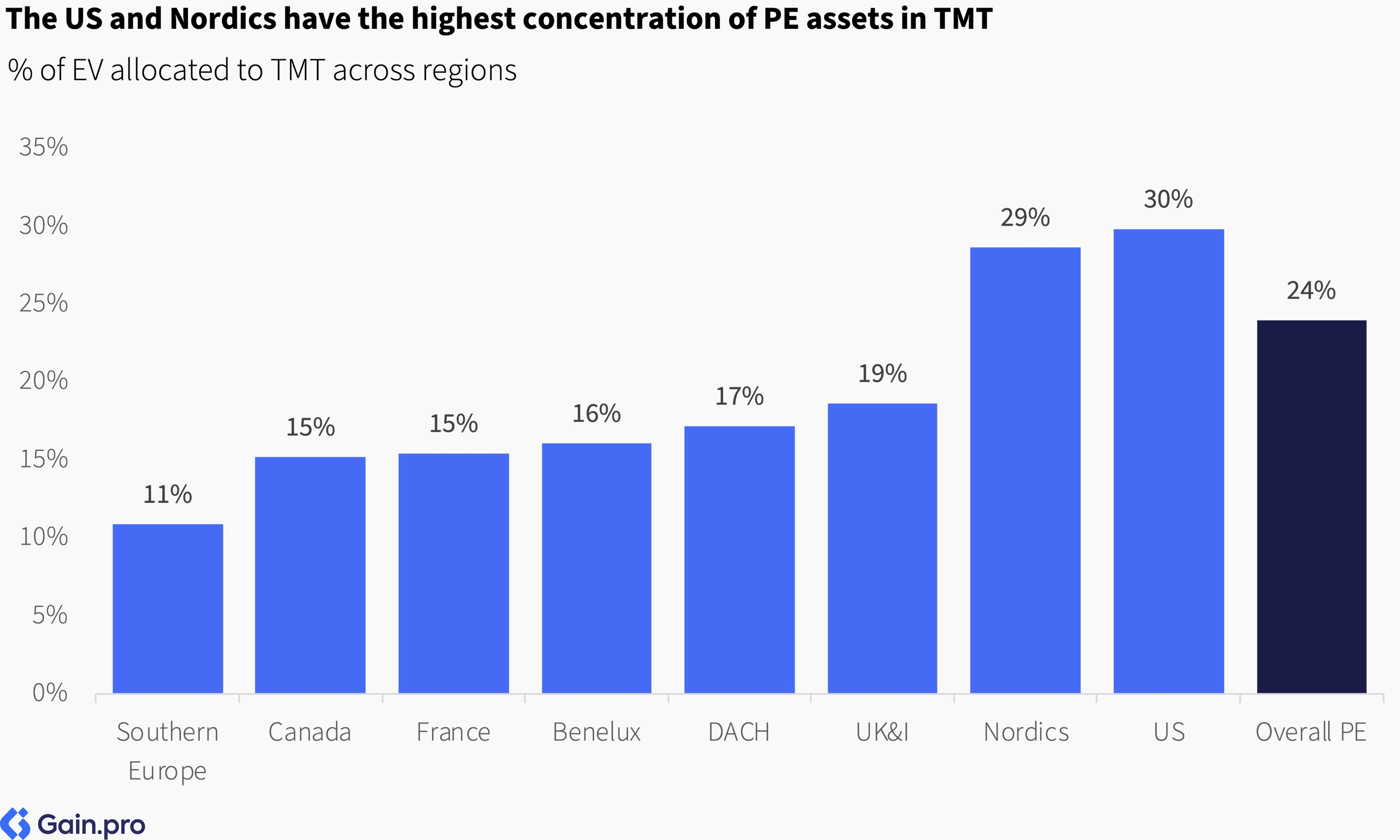
The US (30%) and Nordics (29%) have the highest concentration of PE assets in TMT by EV. The concentration is generally lower in Europe, with Southern Europe (11%) being an outlier at the lower end. Services is still the largest PE sector in Europe at 19% of managed EV.
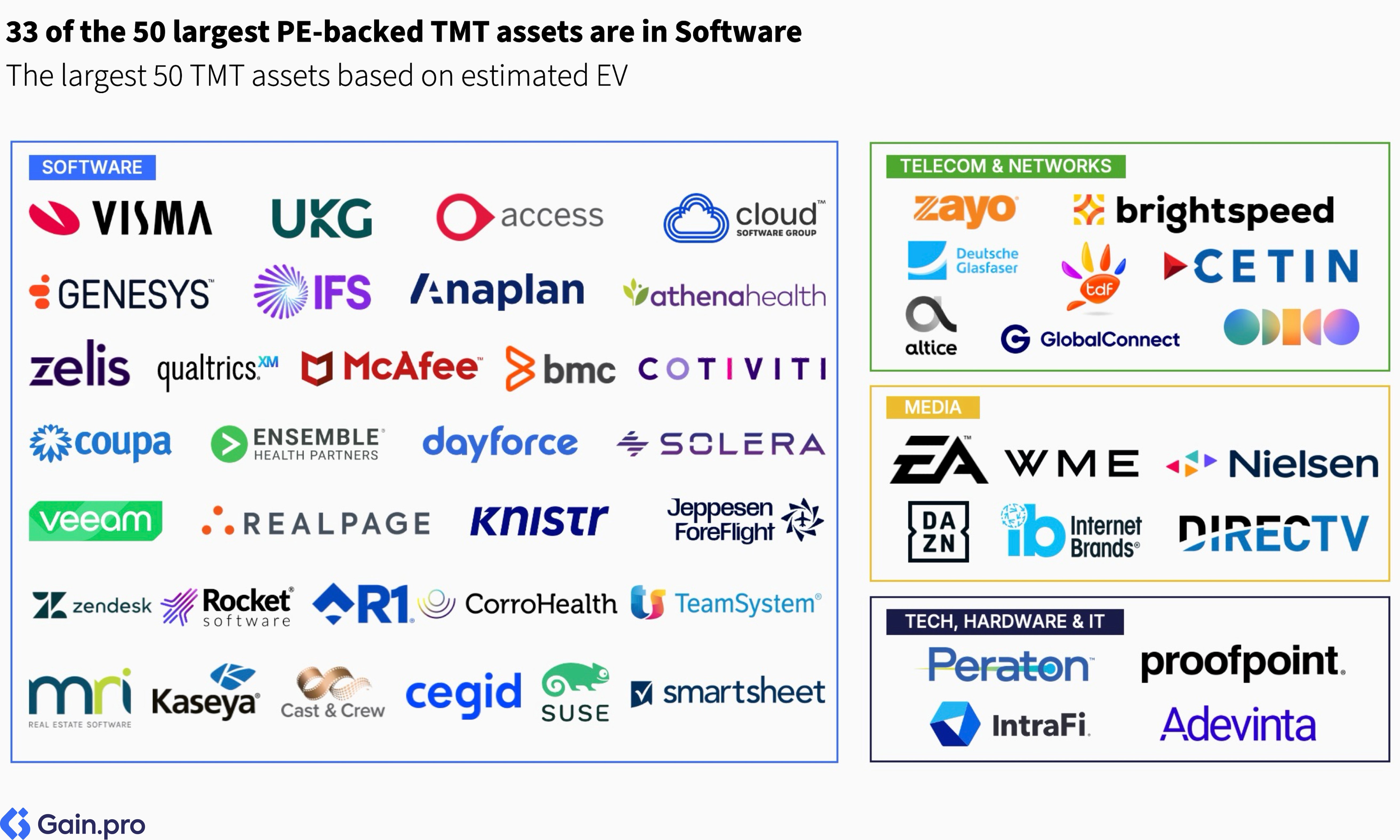
33 of the 50 largest PE-backed TMT assets are in Software, seven in Telecom & Networks, six in Media, and four in Tech, Hardware and IT. Notable assets include Access Group, Anaplan, athenahealth, BMC Software, Cloud Software Group, Cotiviti, Coupa Software, Electronic Arts, Genesys, IFS, Internet Brands, McAfee, Nielsen, Peraton, Qualtrics, UKG, Visma, WME Group, Zayo Group, Zelis, and many more.
Chapter 02: Portfolio Insights
In this chapter, we explore the investment portfolios of the top 30 PE investors in TMT, analyzing key metrics such as EV range, growth rates, buy-and-build activity, holding periods, and sector/regional split of their TMT investments.
Note: We exclude from this analysis investors who have less than 5 data points for a particular metric.
By Deal Activity
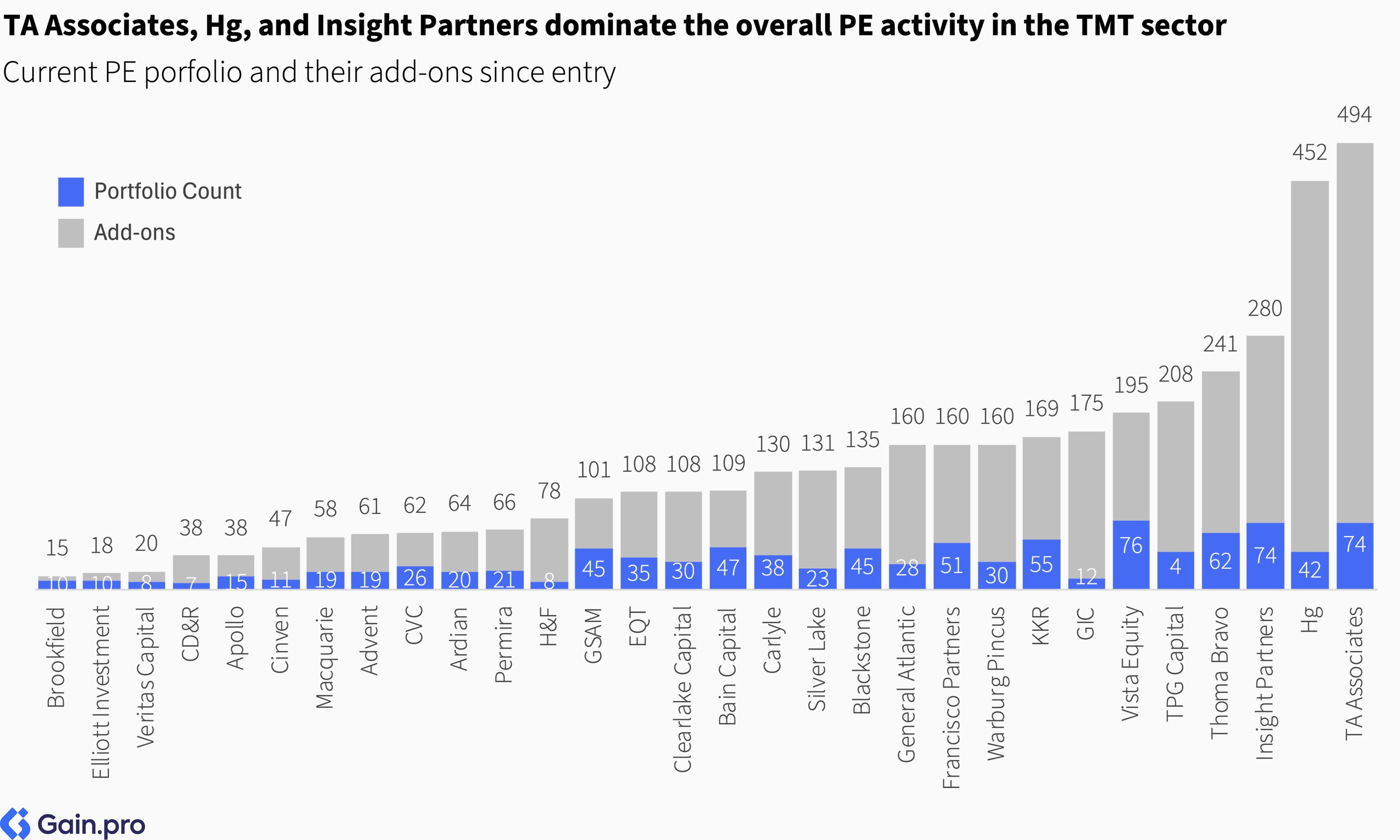
TA Associates, Hg, and Insight Partners have the highest overall PE activity in TMT. In addition to their platform investments, they are also among the most active buy-and-build investors. In contrast, Brookfield, Elliott Investment Management, and Veritas Capital pursue a more concentrated strategy with fewer overall transactions.
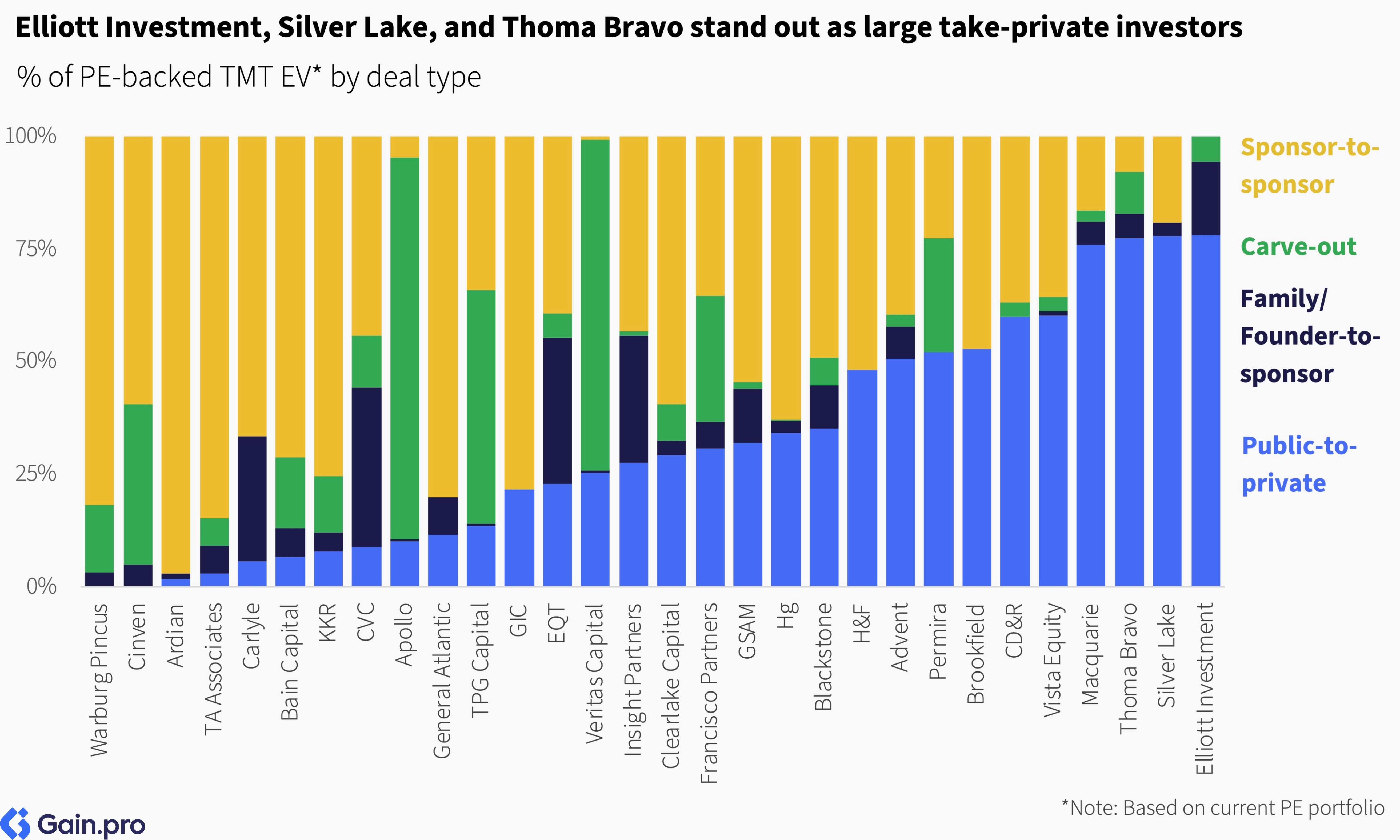
Elliott Investment, Silver Lake, and Thoma Bravo stand out as large take-private investors given their focus on large-scale investments that fit their strategy. Macquarie, Vista Equity, CD&R, Brookfield, Permira, Advent, and Hellman & Friedman are also active in the take-private markets. While public-to-private deals are a key entry route for these large-scale investors, sponsor-to-sponsor transactions remain the most popular entry type across the broader TMT investor landscape.
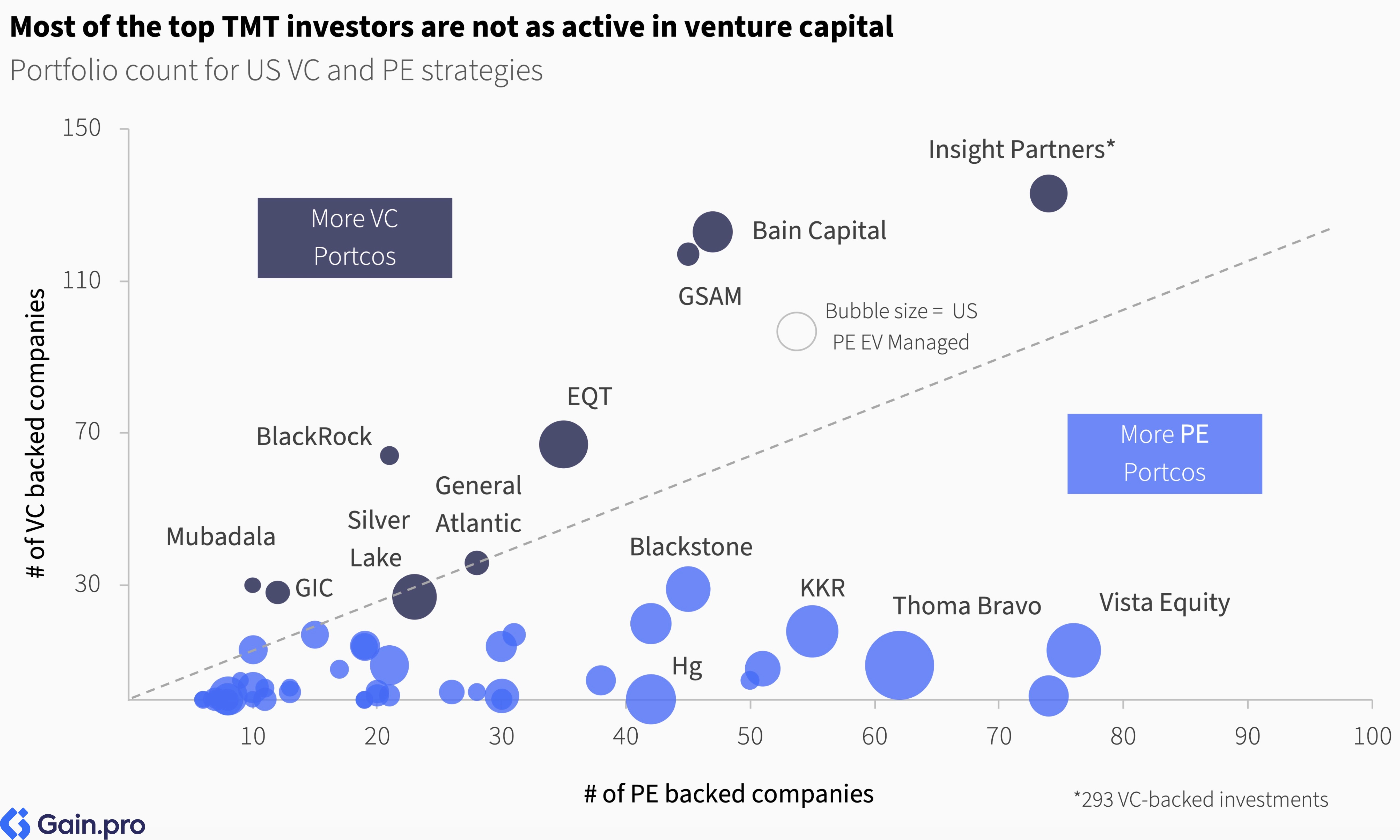
Most of the top TMT investors are not as active in venture capital. Exceptions include Insight Partners, GSAM, Bain Capital, and EQT, who have twice as many (and in some cases more) VC investments as PE investments. In contrast, Vista Equity, Thoma Bravo, KKR, and Hg focus predominantly on buyouts and growth equity with minimal venture capital activity.
By Sector & Region
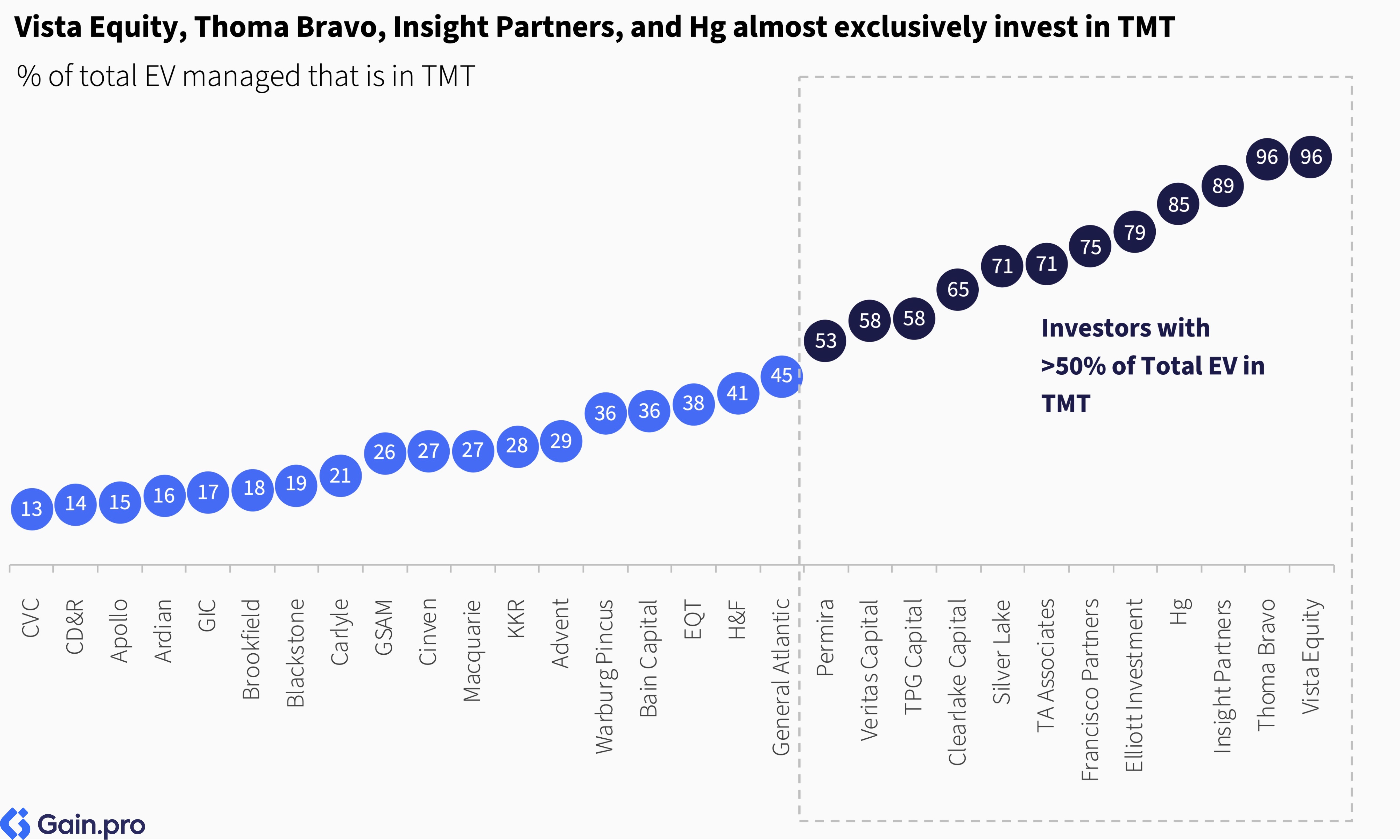
Vista Equity, Thoma Bravo, Insight Partners, and Hg almost exclusively invest in TMT, with over 85% of their portfolios concentrated in the sector. Other TMT-heavy sponsors include Elliott Investment, Francisco Partners, TA Associates, Silver Lake, Clearlake Capital, and TPG with 60-80% of their portfolio in TMT. In contrast, investors like CVC, CD&R, Apollo, and Ardian maintain lower TMT exposure, diversifying their portfolios across multiple sectors.
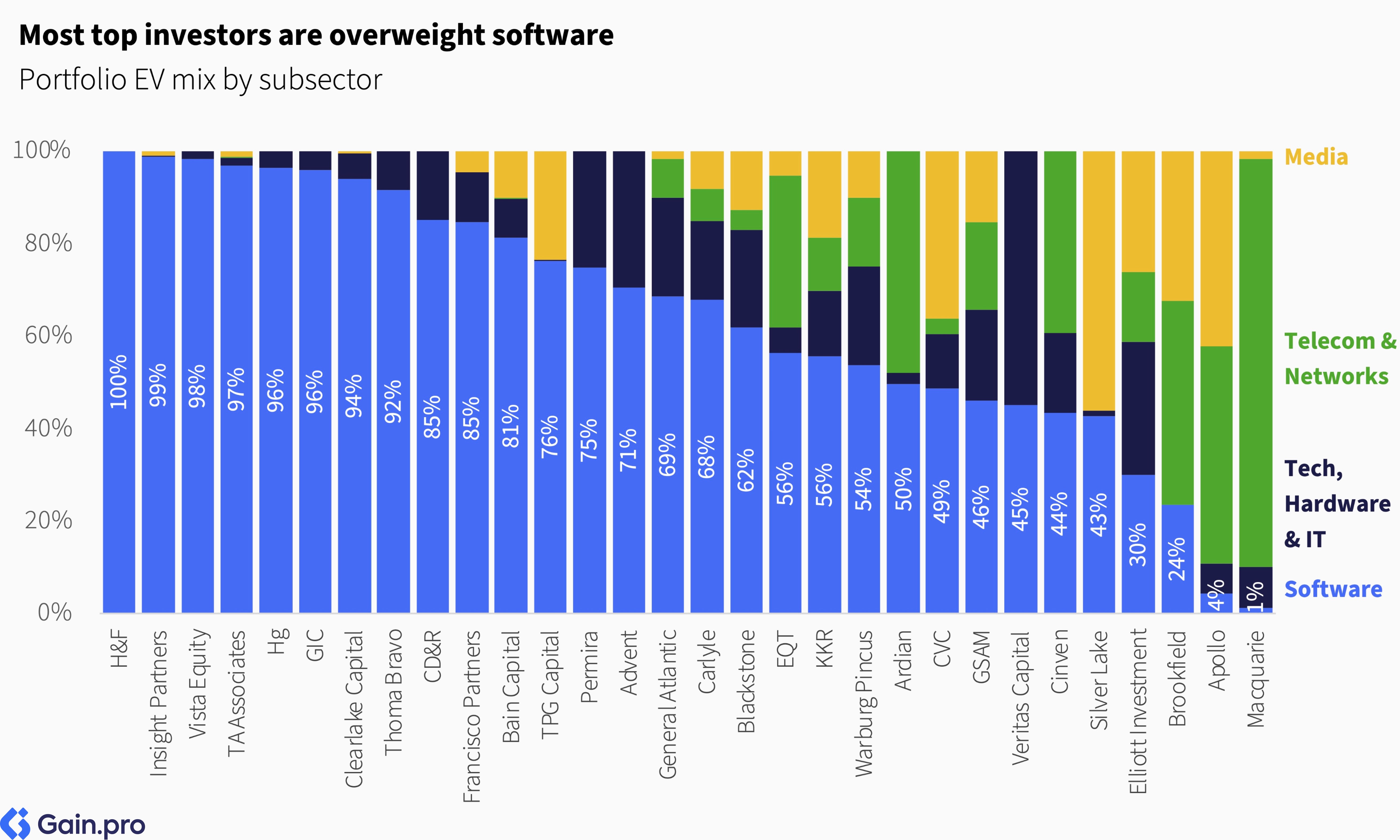
Within TMT, most investors heavily overweight software, reflecting the subsector's superior growth and margin profile. H&F, Insight Partners, Vista Equity, TA Associates, Hg, and GIC all have over 95% of their TMT portfolio in software. In contrast, behemoths like Blackstone, EQT, CVC, and KKR, along with other generalists, maintain more diversified TMT portfolios across subsectors, consistent with their broader multi-sector investment mandates.
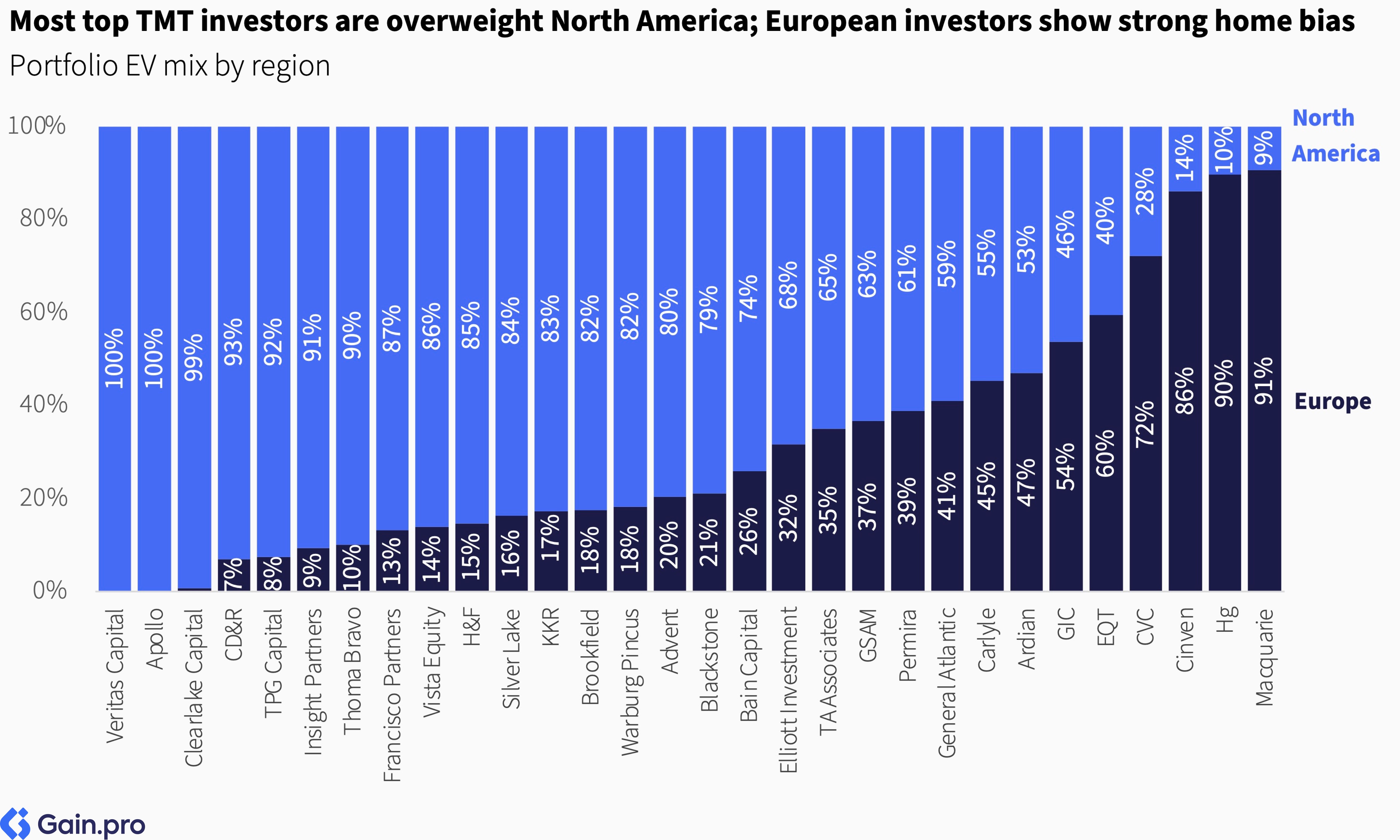
Hg, Cinven, and CVC allocate over 70% of their TMT portfolios to Europe, reflecting strong home-market focus. Most other investors are overweight North America, with US firms like Veritas Capital, Apollo, and Clearlake Capital allocating nearly their entire portfolios there. However, large American players are now expanding into Europe, as evidenced by Thoma Bravo's first European fund-close in 2025 and Vista Equity's acquisition of a majority stake in Swiss software firm Nexthink after a five-year hiatus from European majority acquisitions.
By Size
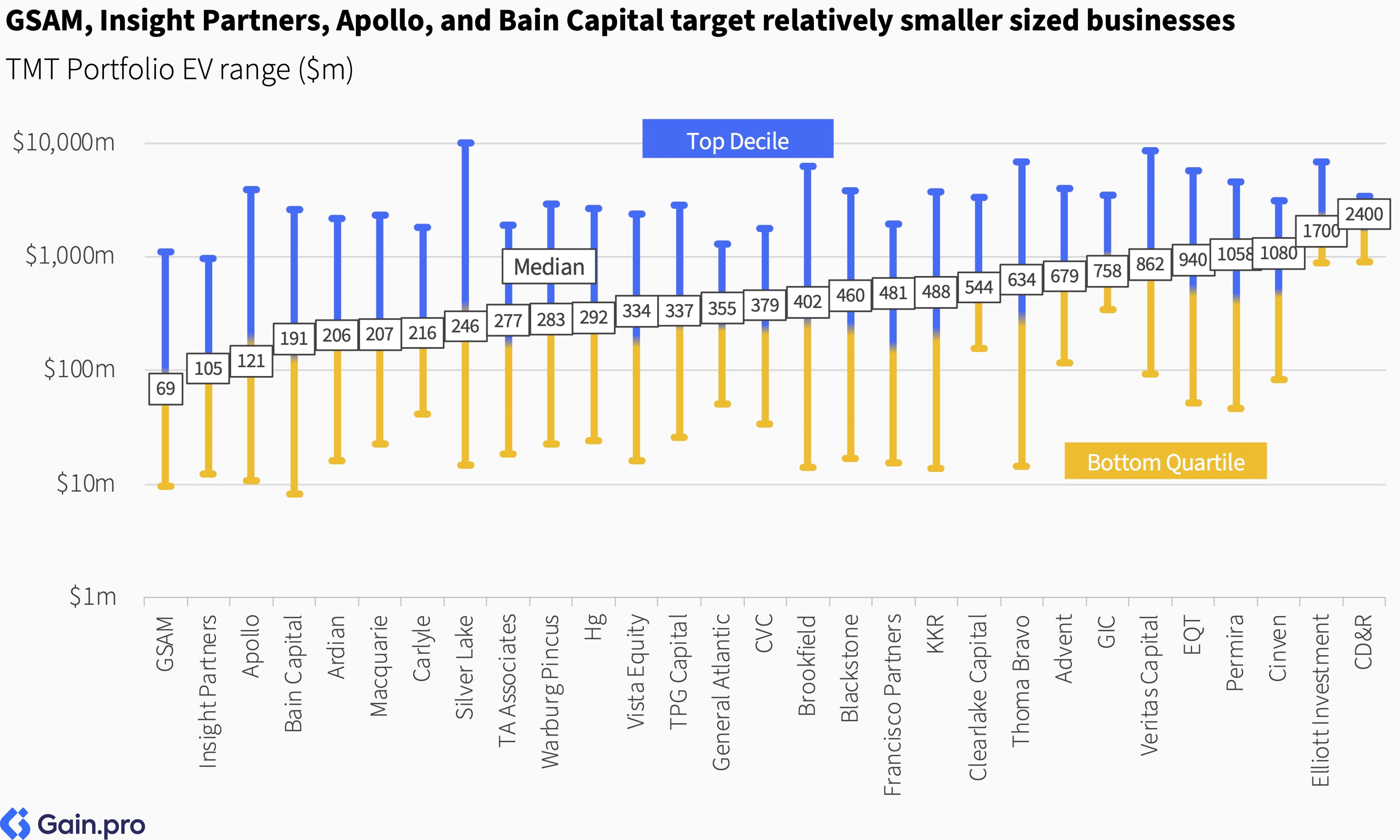
CD&R, Elliott Investment Management, Cinven, Permira, and EQT target larger businesses, deploying substantial capital in fewer, larger positions. In contrast, Goldman Sachs Asset Management (GSAM), Insight Partners, and Bain Capital target relatively smaller-sized businesses.
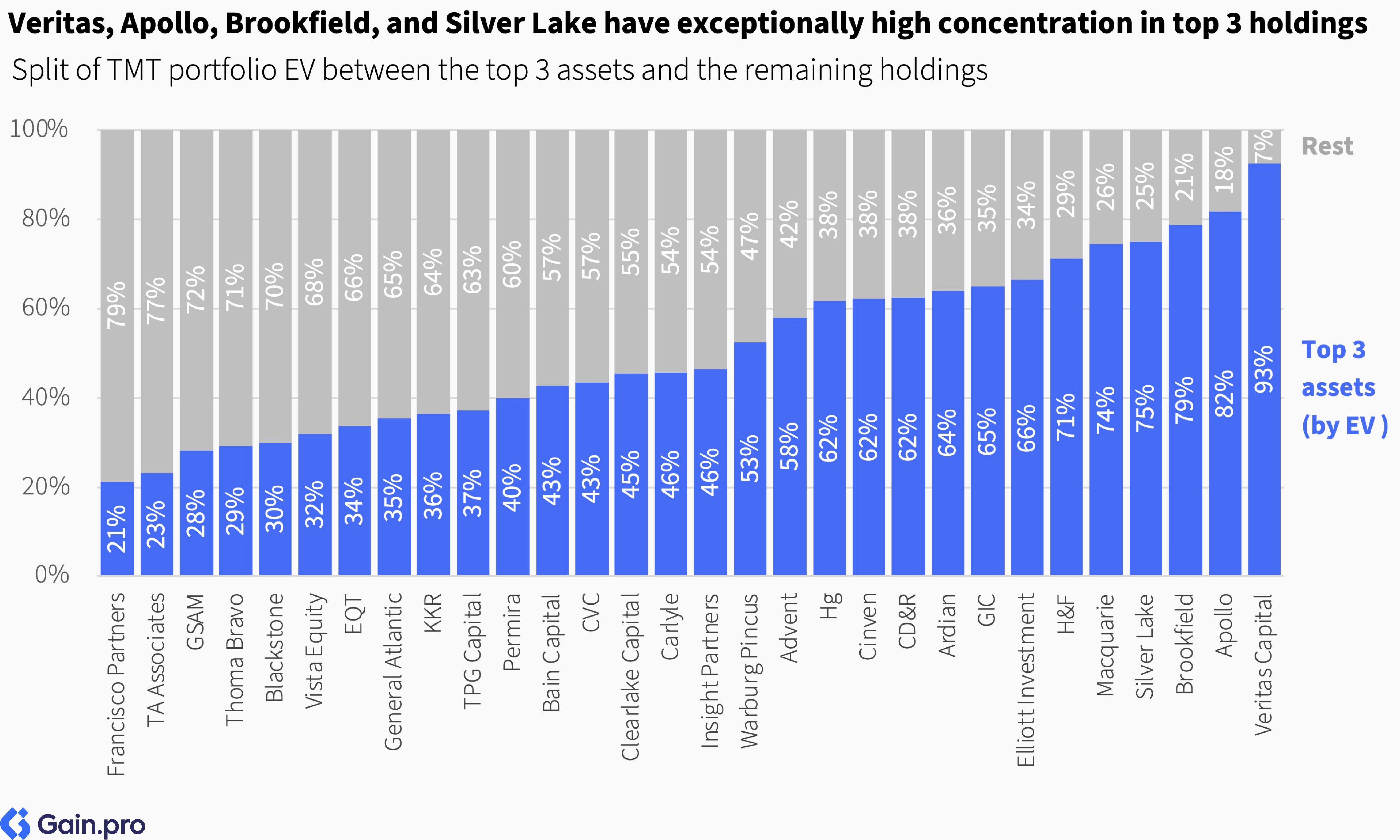
Veritas Capital, Apollo, Brookfield, and Silver Lake have exceptionally high concentration in their top 3 holdings, representing over 80% of their TMT portfolio EV. In contrast, Francisco Partners, TA Associates, and GSAM show more diversified portfolios, with top 3 assets representing just 21-28% of their TMT EV, also reflecting their broader mid-market/growth equity focus.
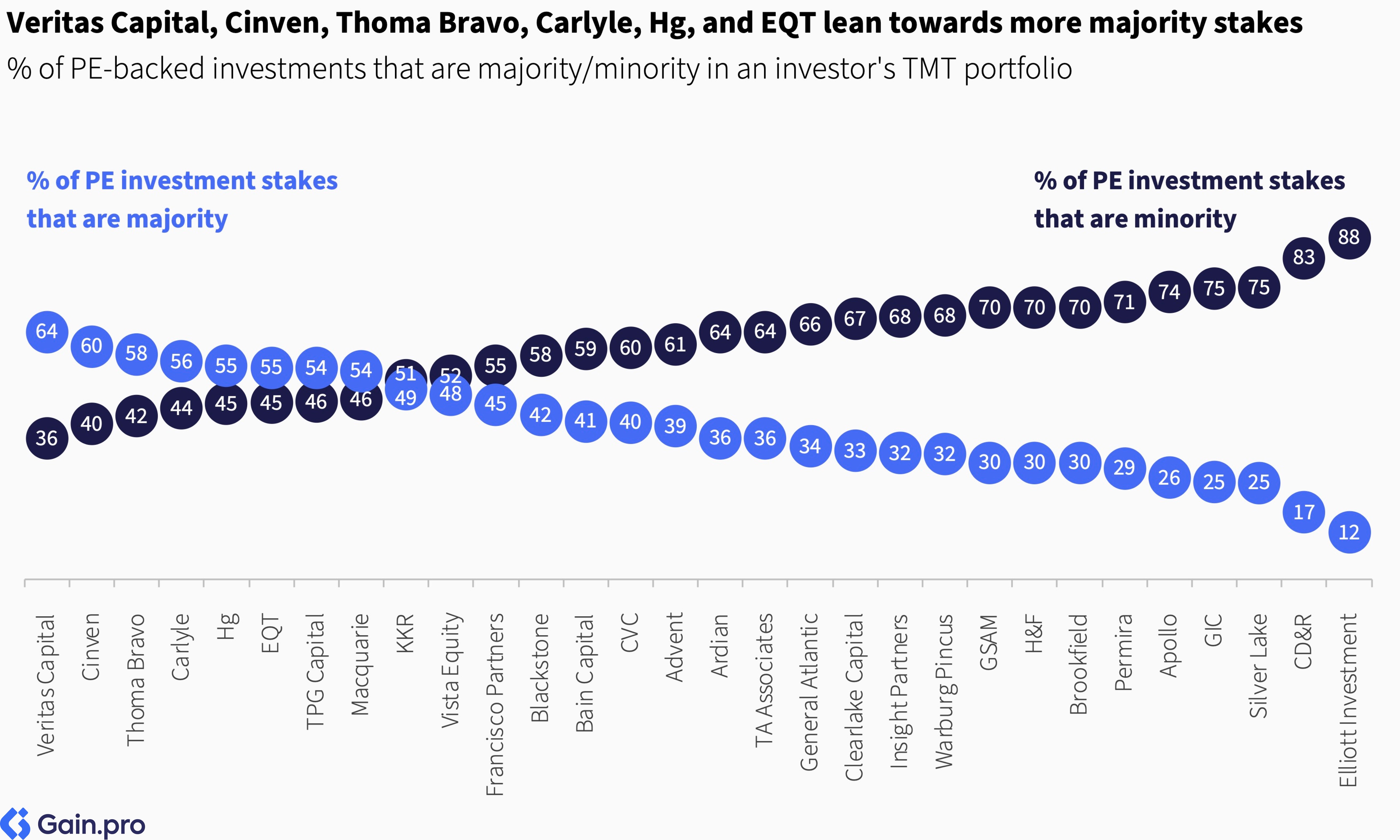
The preference for minority versus majority stakes differs among top TMT investors, with most taking minority stakes. In particular, Elliott Investment Management, CD&R, Silver Lake, GIC and Apollo have a higher share of minority stakes. In contrast, Veritas Capital, Cinven, Thoma Bravo, Carlyle, Hg, and EQT lean towards majority stakes.
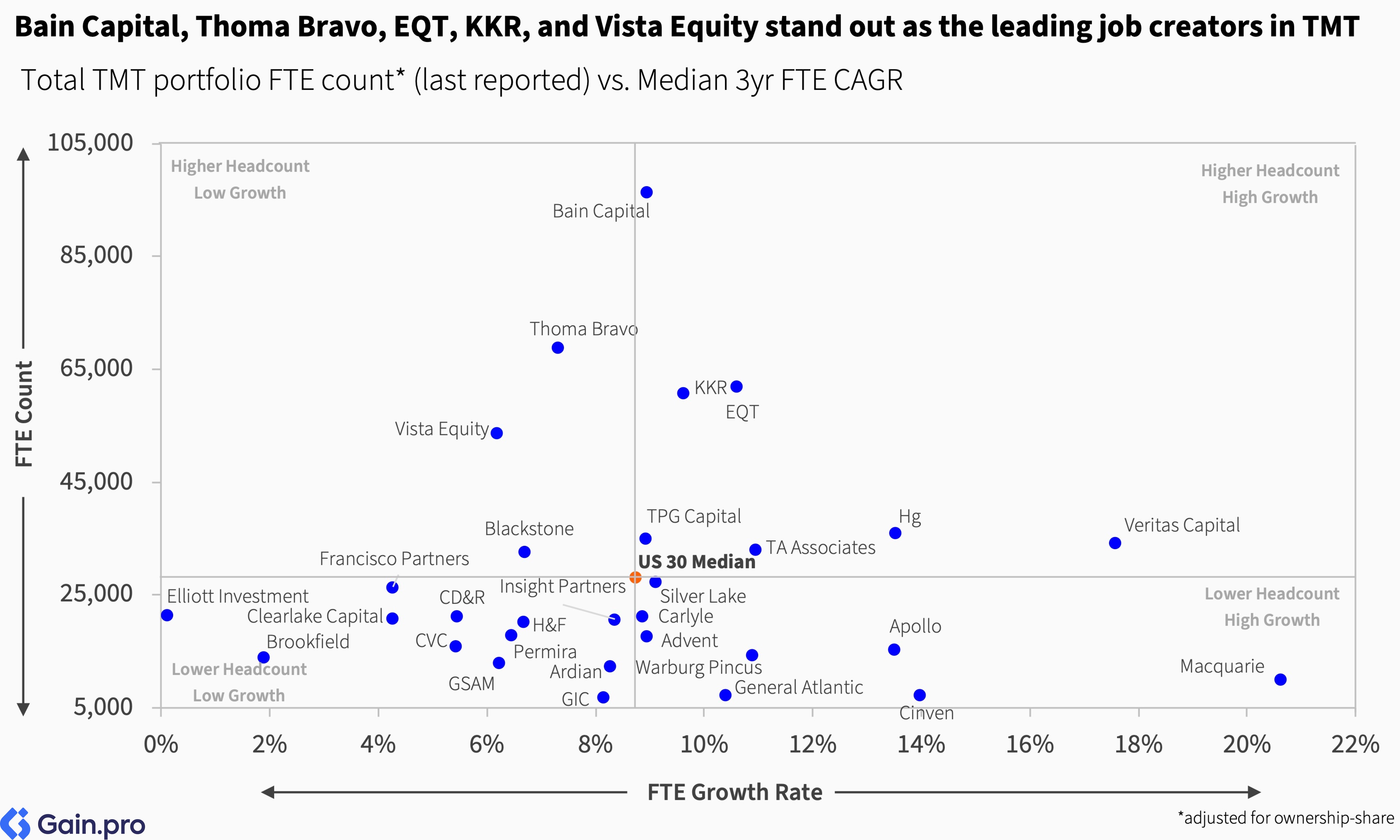
Bain Capital stands out as the leading PE job creator within TMT. It is home to some of the largest TMT businesses by FTE count, including VXI Global Solutions (customer experience management), Kantar (market research), and Engineering Group (IT & software services). Other leading PE job creators in TMT include Thoma Bravo, EQT, KKR, and Vista Equity. Overall, PE-backed TMT assets employ over 2.5 million people, with 63% in Software.
By Holding Period
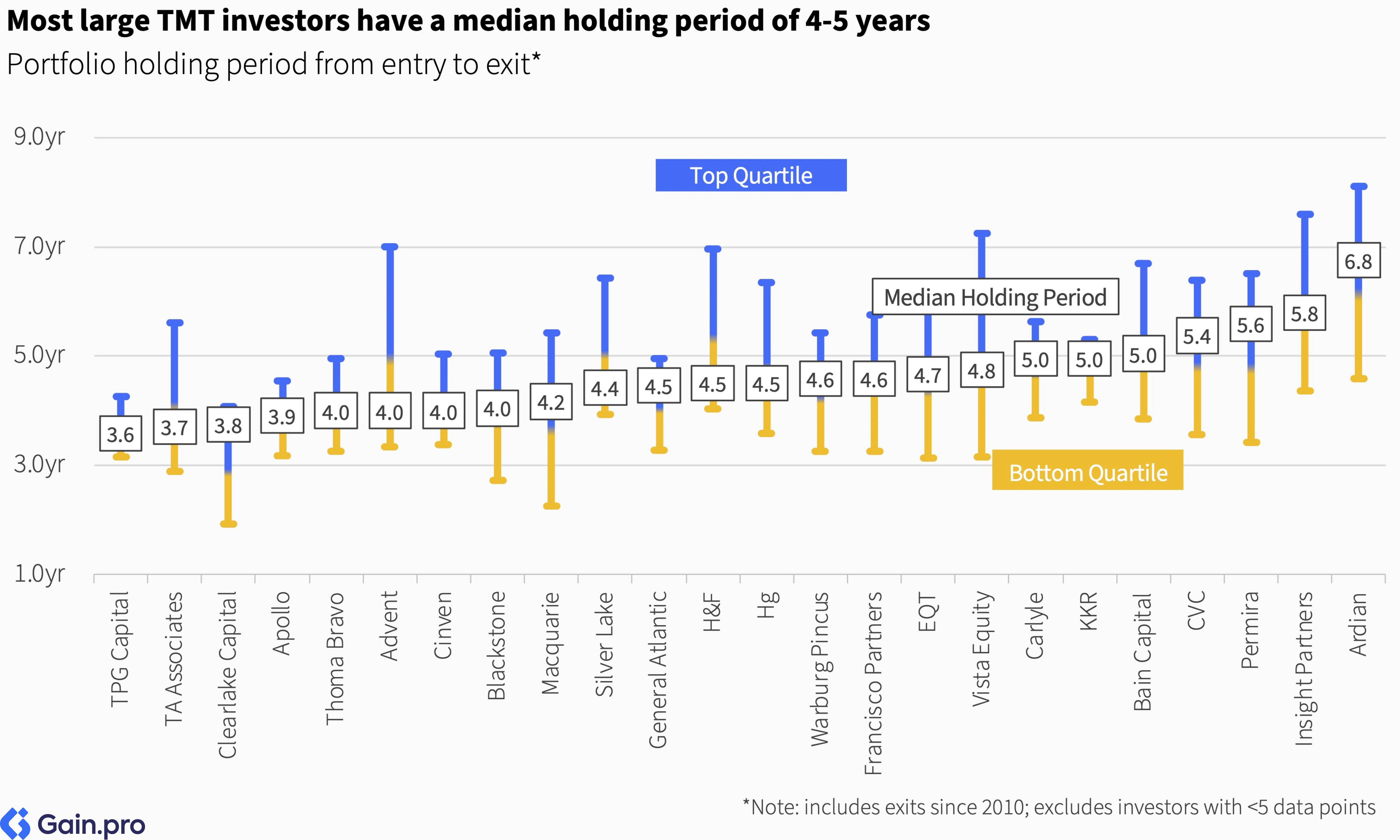
Most large TMT investors have a median holding period of 4-5 years. However, Ardian, Insight Partners, Permira, and CVC hold TMT assets slightly longer, with median holding periods of 5-6 years.
Chapter 03: Subsector Trends
Entries
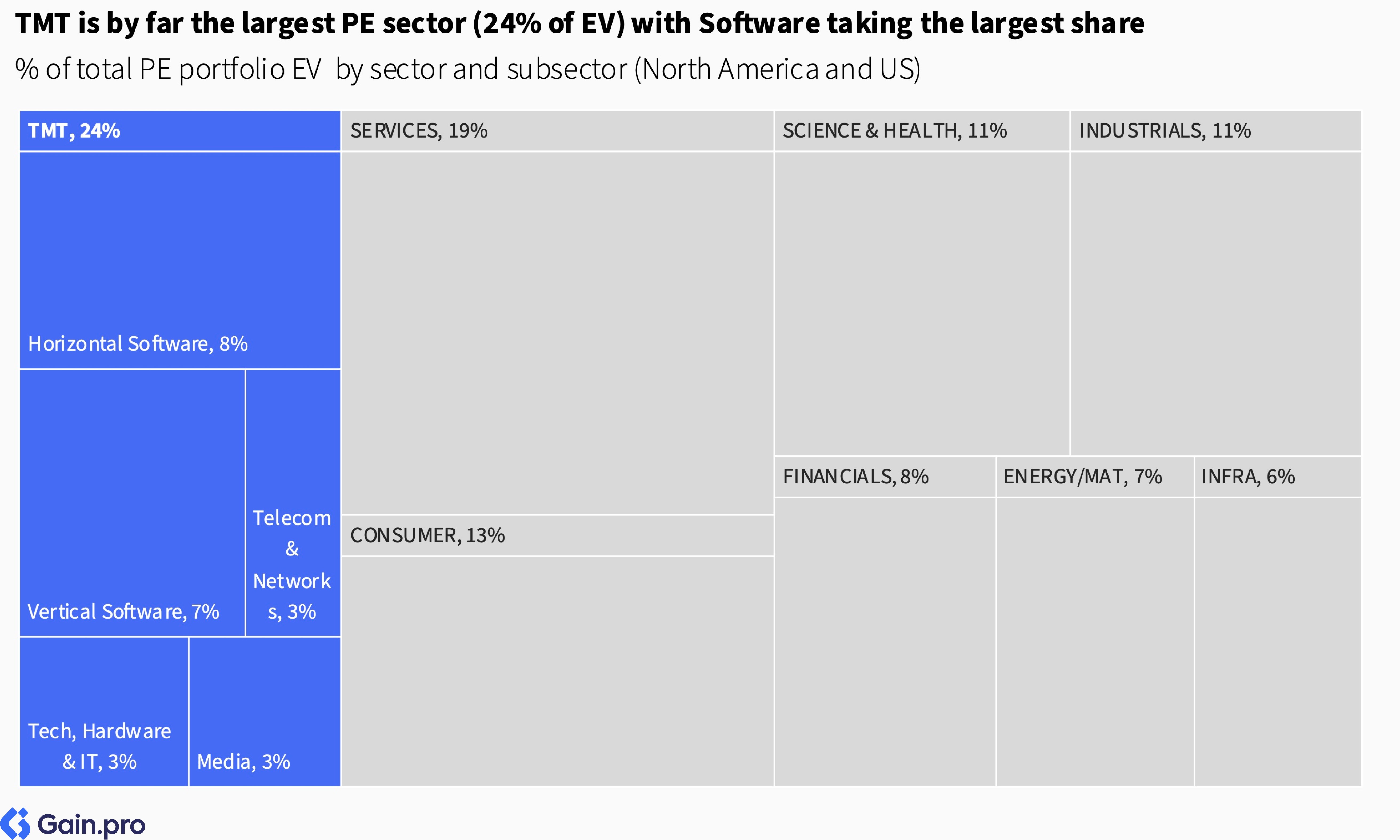
By sector, TMT is by far the largest PE sector in North America and Europe, representing 24% of total PE EV. At the subsector level, Horizontal Software is the largest at 8% of total PE EV, followed by Vertical Software (7%), Telecom & Networks (3%), Tech, Hardware & IT (3%), and Media (3%). Software alone accounts for over 60% of TMT's total EV, reflecting PE's strong preference for high-margin, high-growth businesses.
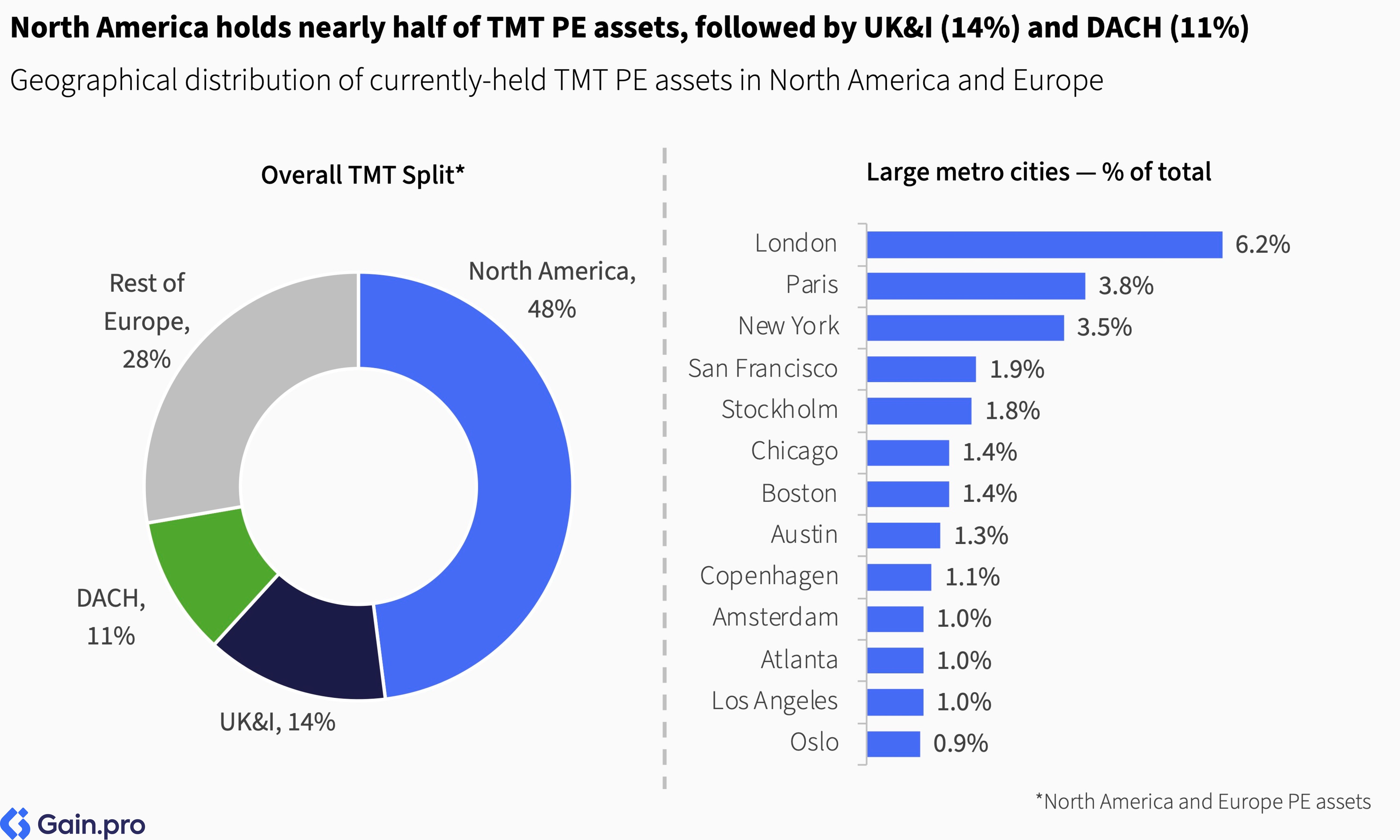
North America holds nearly half of TMT PE-backed assets, followed by the UK & Ireland (14%) and DACH (11%). By city, London leads with 6.2% of all assets based there, followed by Paris (3.8%) and New York (3.5%). The US TMT assets are geographically spread across multiple hubs including San Francisco, Boston, Chicago, and Austin, while European activity is concentrated in major metropolitan centers like London, Paris, Stockholm, and Copenhagen.
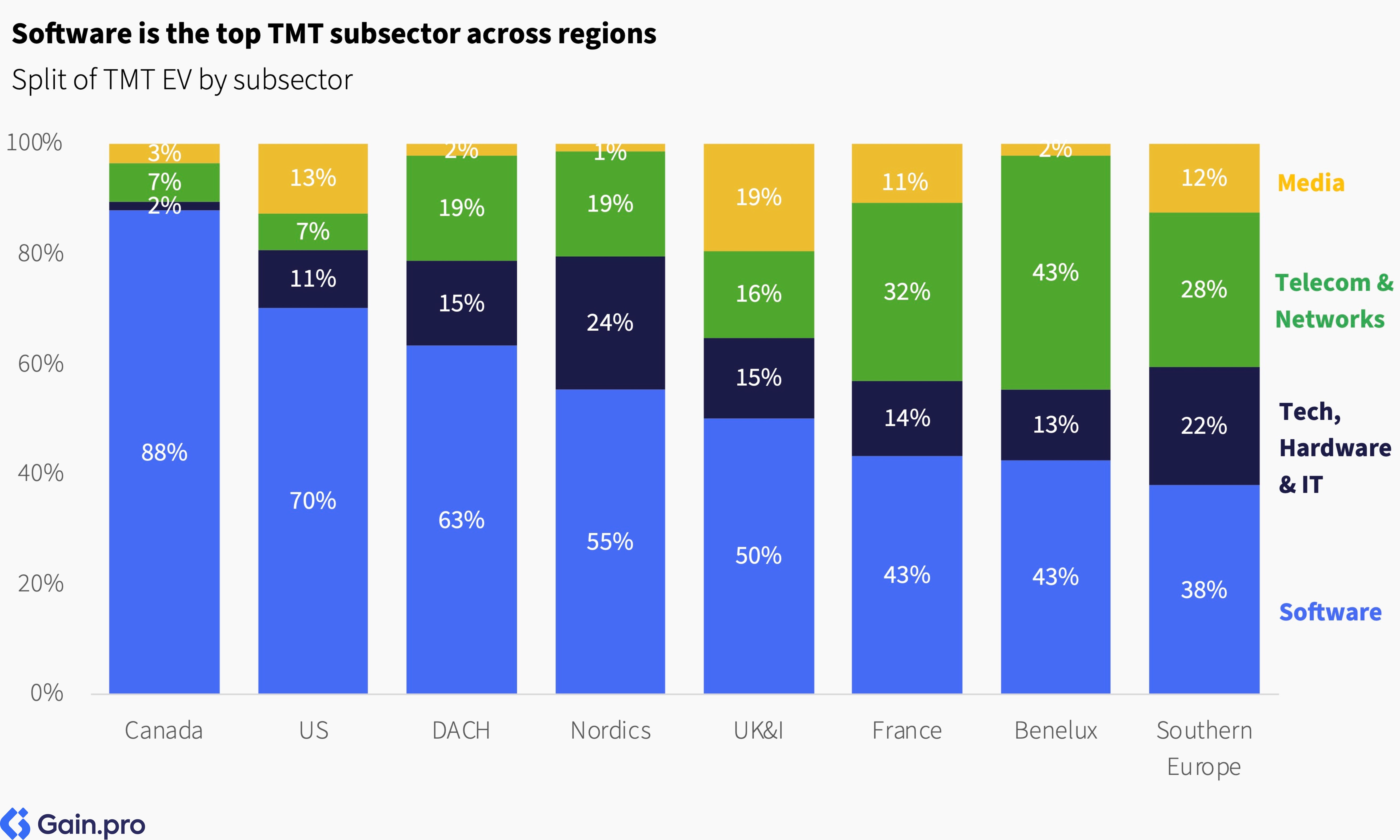
By subsector, Software dominates across regions. Its concentration is highest in Canada (88% of TMT EV), the US (70%), and DACH (63%). Southern Europe, Benelux, and France, in contrast, have more assets in Telecom & Networks (30-40% by EV). Also note the higher share of Media in the UK & Ireland (19%) and the US (13%).
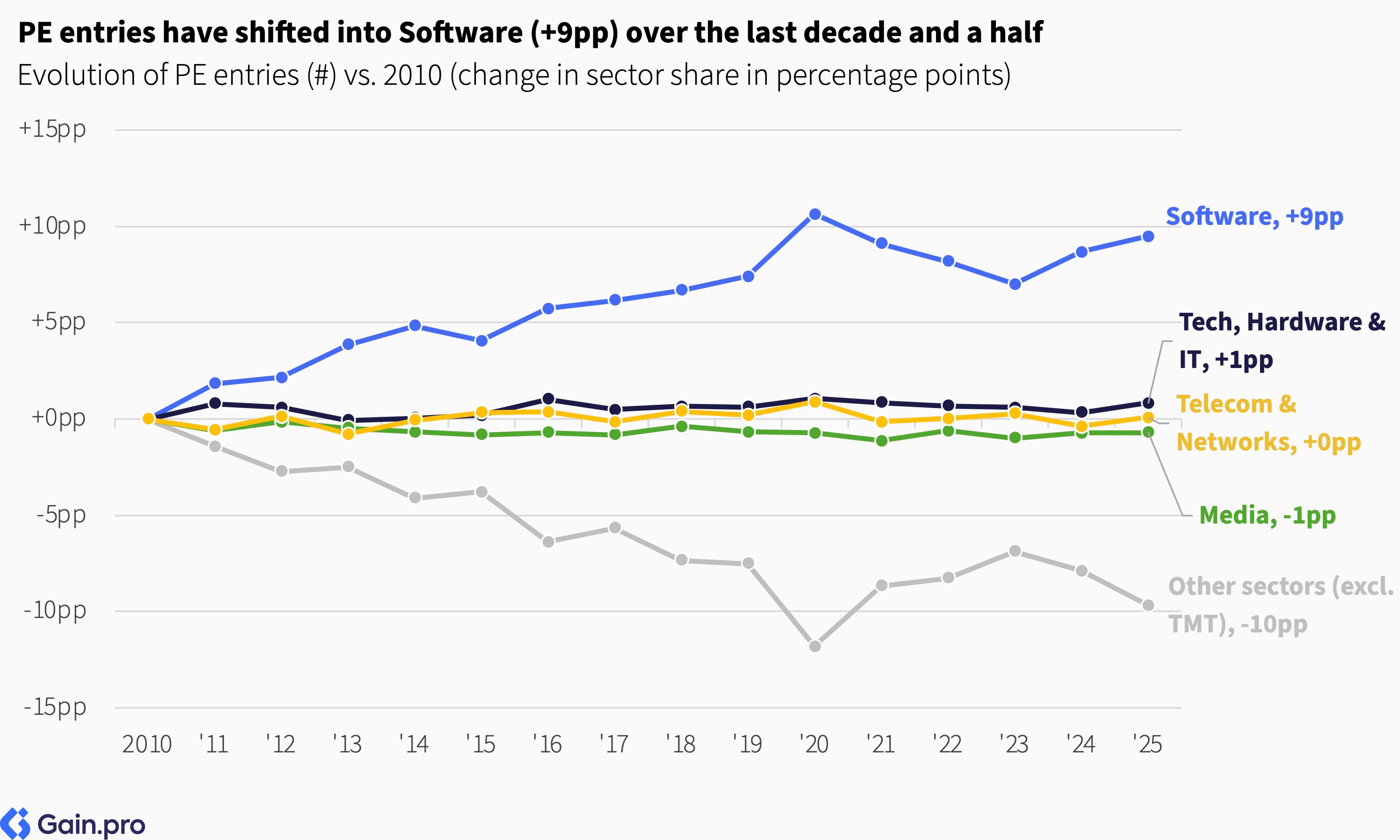
PE investors have aggressively shifted into Software since 2010 (+9pp), while other TMT subsectors remained stagnant. Across the broader market, Industrials and Consumer have lost ground to TMT and Services.
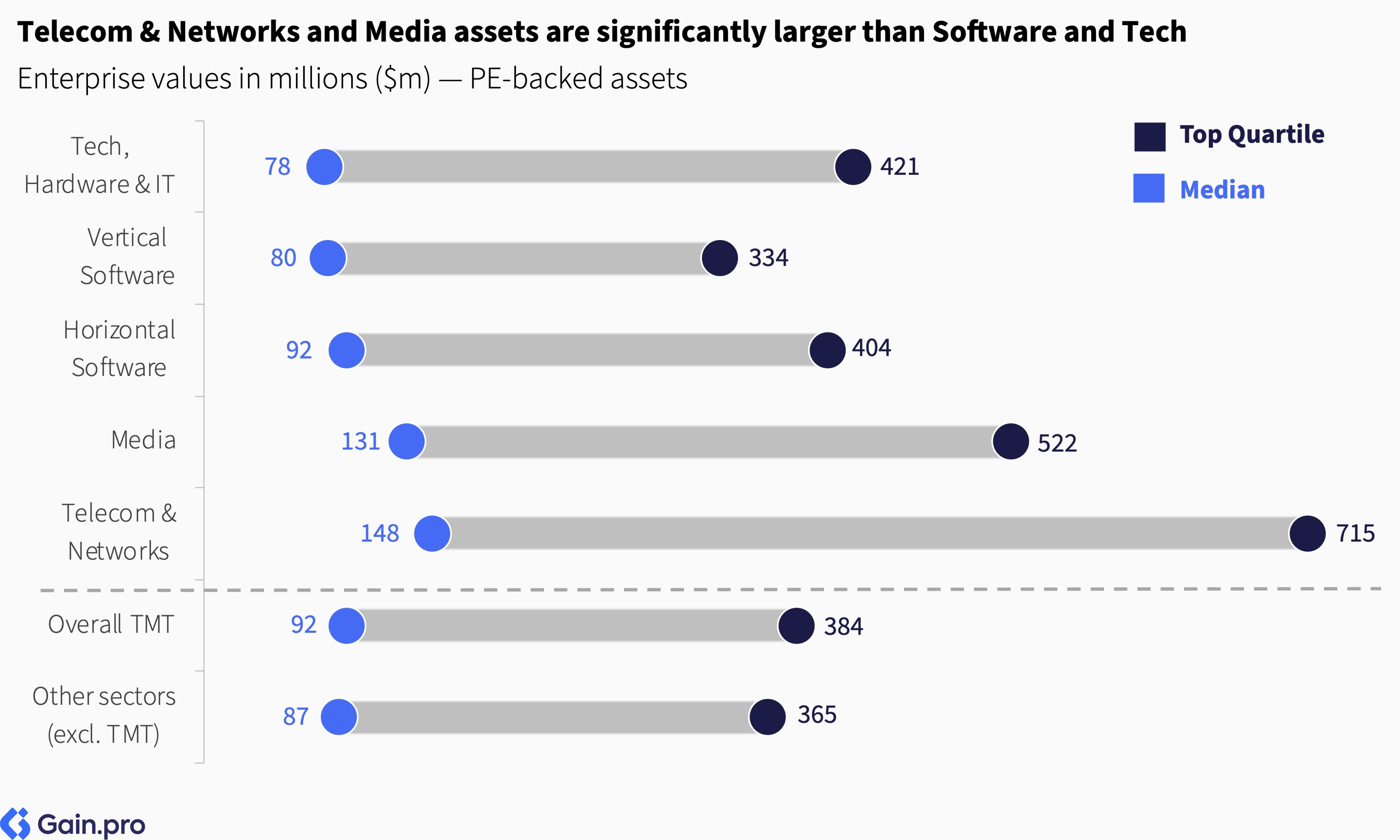
Assets in Telecom & Networks and Media are larger than those in Software and Tech. The barriers to entry differ — Software companies can start small and scale efficiently, while Telecom and Media require significant upfront investment, skewing their portfolios toward larger assets.
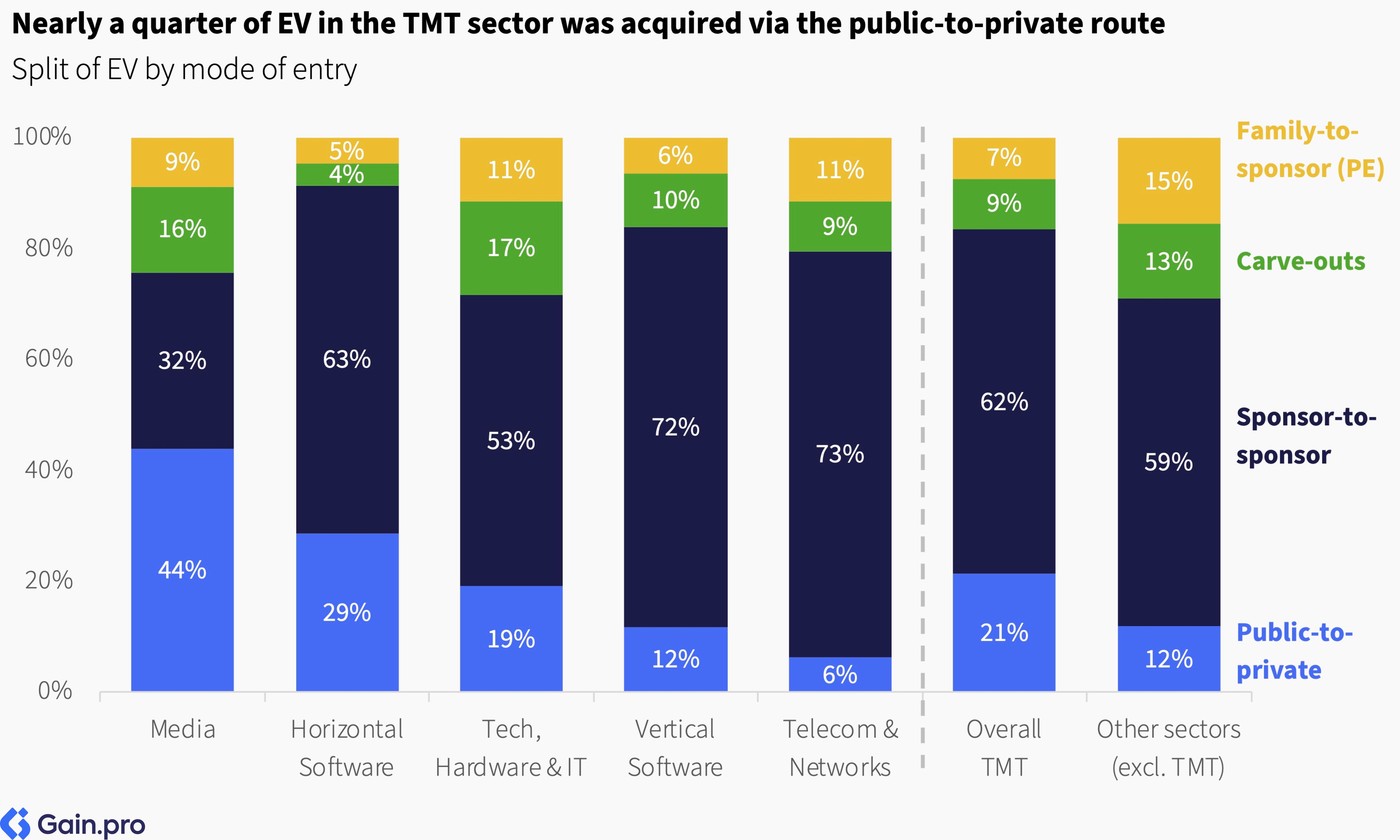
21% of EV in the TMT sector was acquired via the public-to-private route, compared to just 12% in other sectors. Media (44%) and Horizontal Software (29%) show the highest concentration of public-to-private activity. Sponsor-to-sponsor transactions, however, remain the dominant entry route across the sectors.
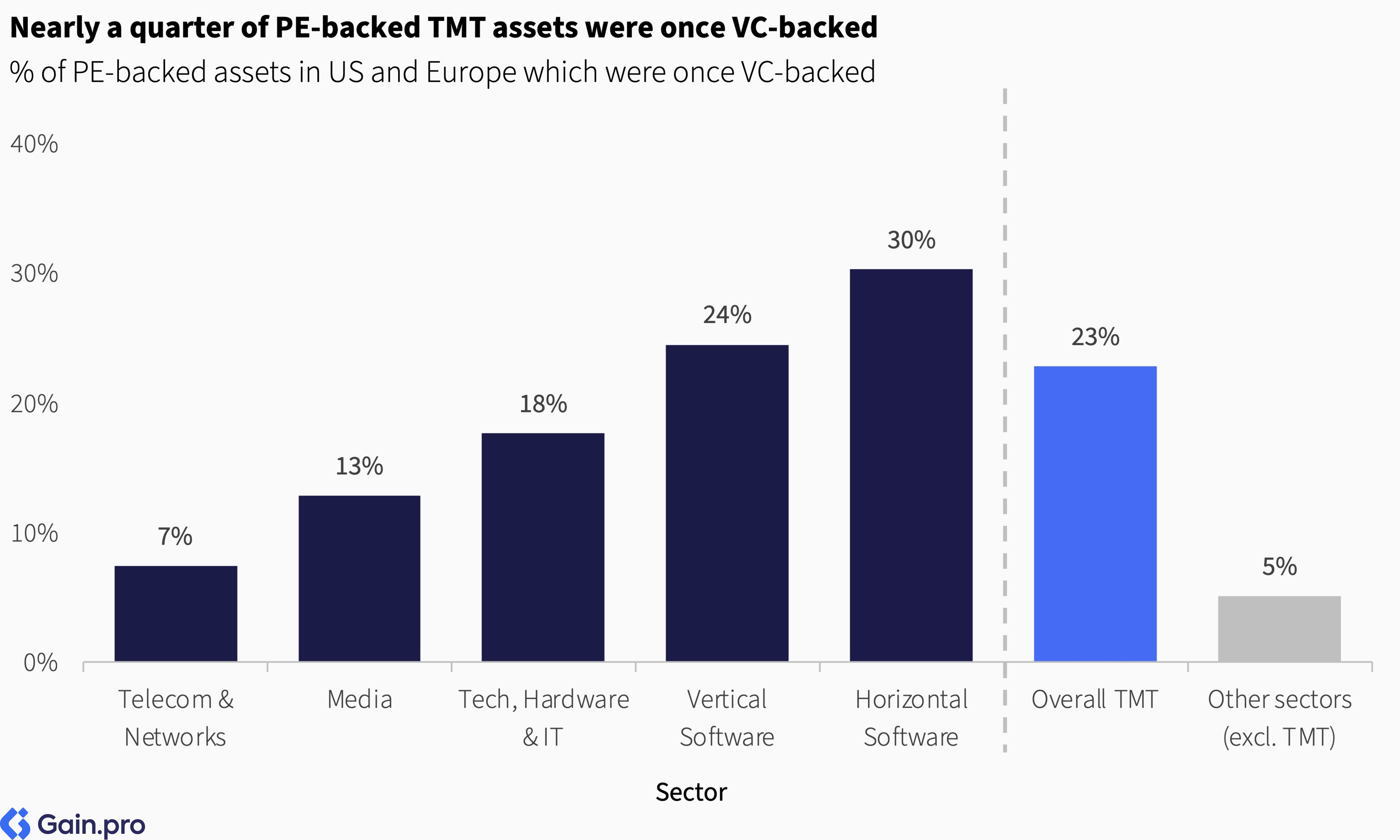
Nearly a quarter of TMT PE-backed assets were previously VC-backed, significantly higher than other sectors (5%). This represents a natural progression of ownership as companies mature and require additional capital. Horizontal Software shows the highest concentration of formerly VC-backed assets at 30%, followed by Vertical Software at 24%, while Telecom & Networks (7%) has much less VC-to-PE activity.
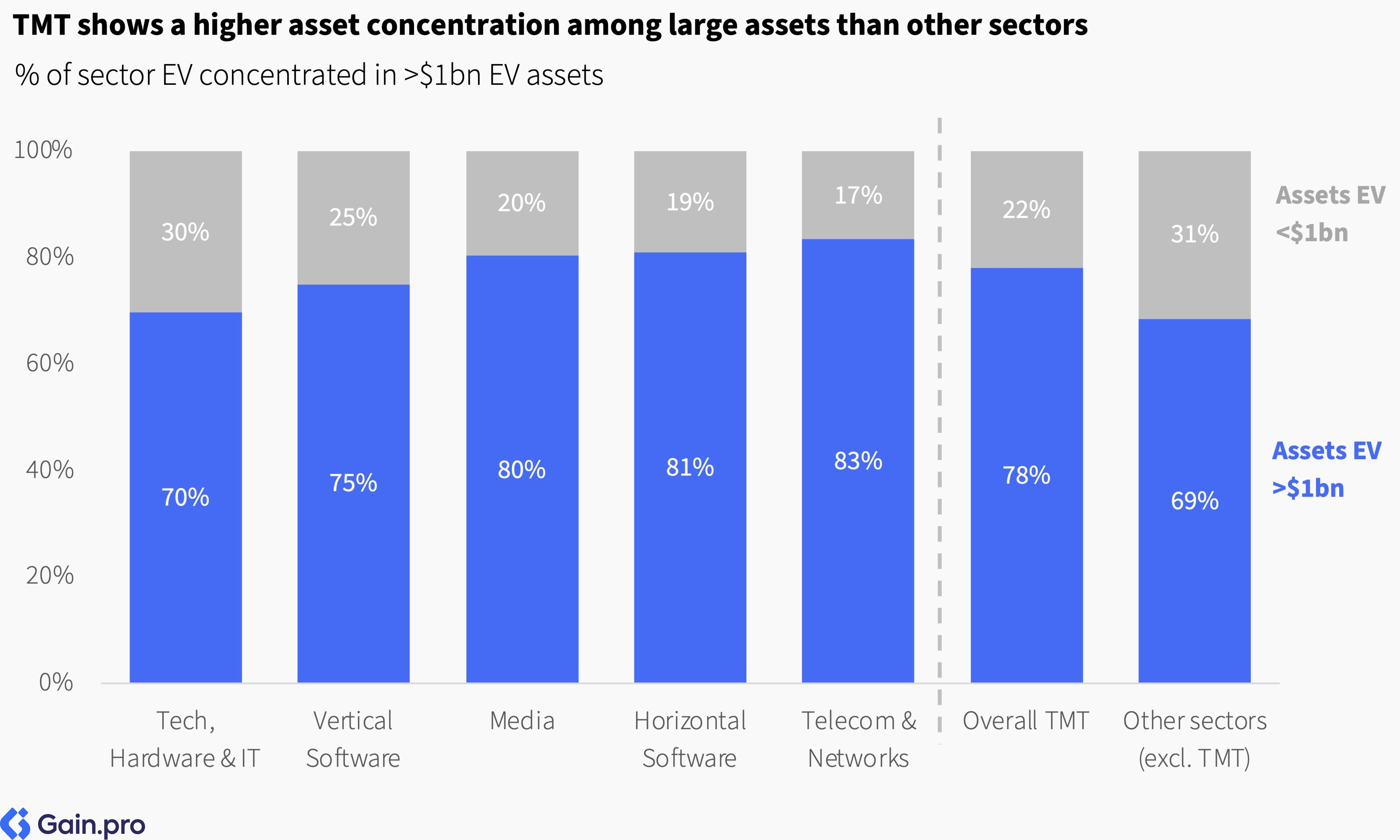
TMT shows a higher asset concentration of large assets than other sectors, with 78% of EV in assets exceeding $1bn versus 69% for other sectors. Within TMT, Telecom & Networks (83%), Horizontal Software (81%), and Media (80%) lead in large asset concentration.
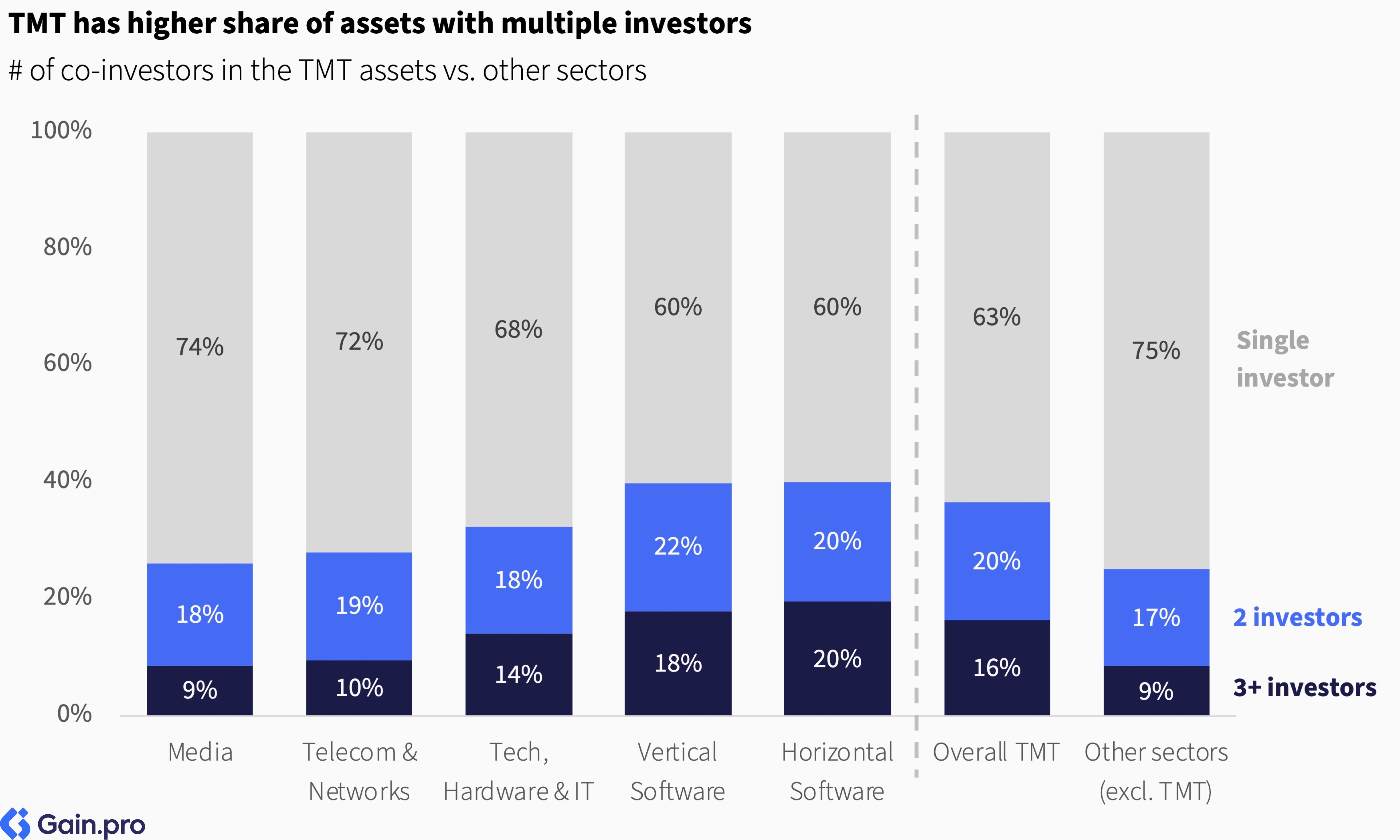
A majority of Software assets (40%) have at least two co-owners, while 19% have three or more, higher than other TMT subsectors. This is partly because Software has long attracted VC funding, with early investors from series rounds often retaining shares or reinvesting minority stakes after PE investments. In contrast, Media and Telecom & Networks have more concentrated ownership, with over 70% of assets held by a single investor.
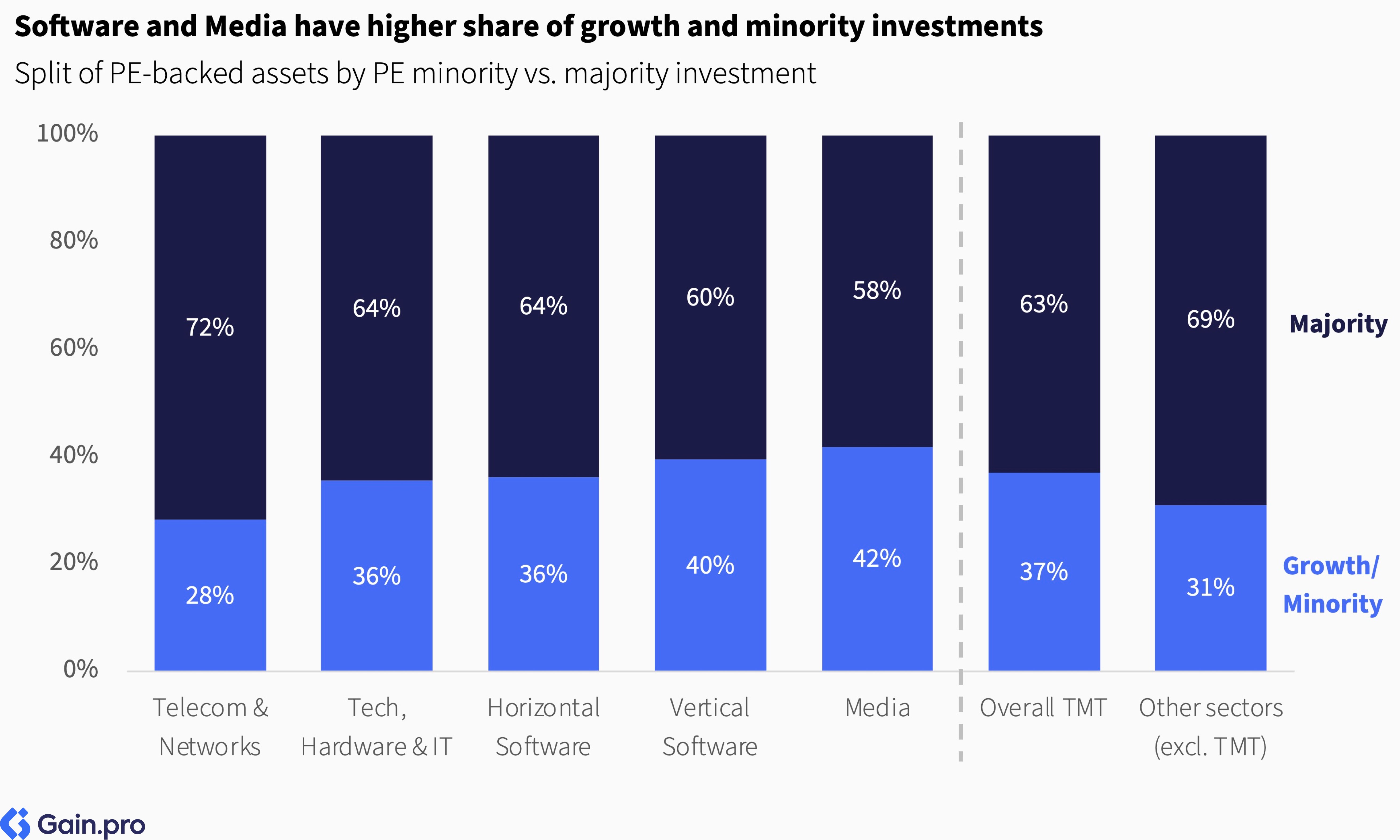
Software and Media have a higher share of growth and minority investments. Many software founders prefer growth equity strategies where they retain control while PE investors participate in the company's growth trajectory. Media's high minority share reflects several factors: larger asset sizes requiring substantial capital, regulatory ownership restrictions, and founder/family preferences to maintain creative and brand control.
Holding Periods & Exits
TMT assets are being held longer than ever with a median holding period of 5.4 years. Interestingly, the gap between TMT and other sectors has also narrowed over the years. We expect next year to be challenging as well, with assets from the high-valuation 2021-23 cohorts starting to come to market.
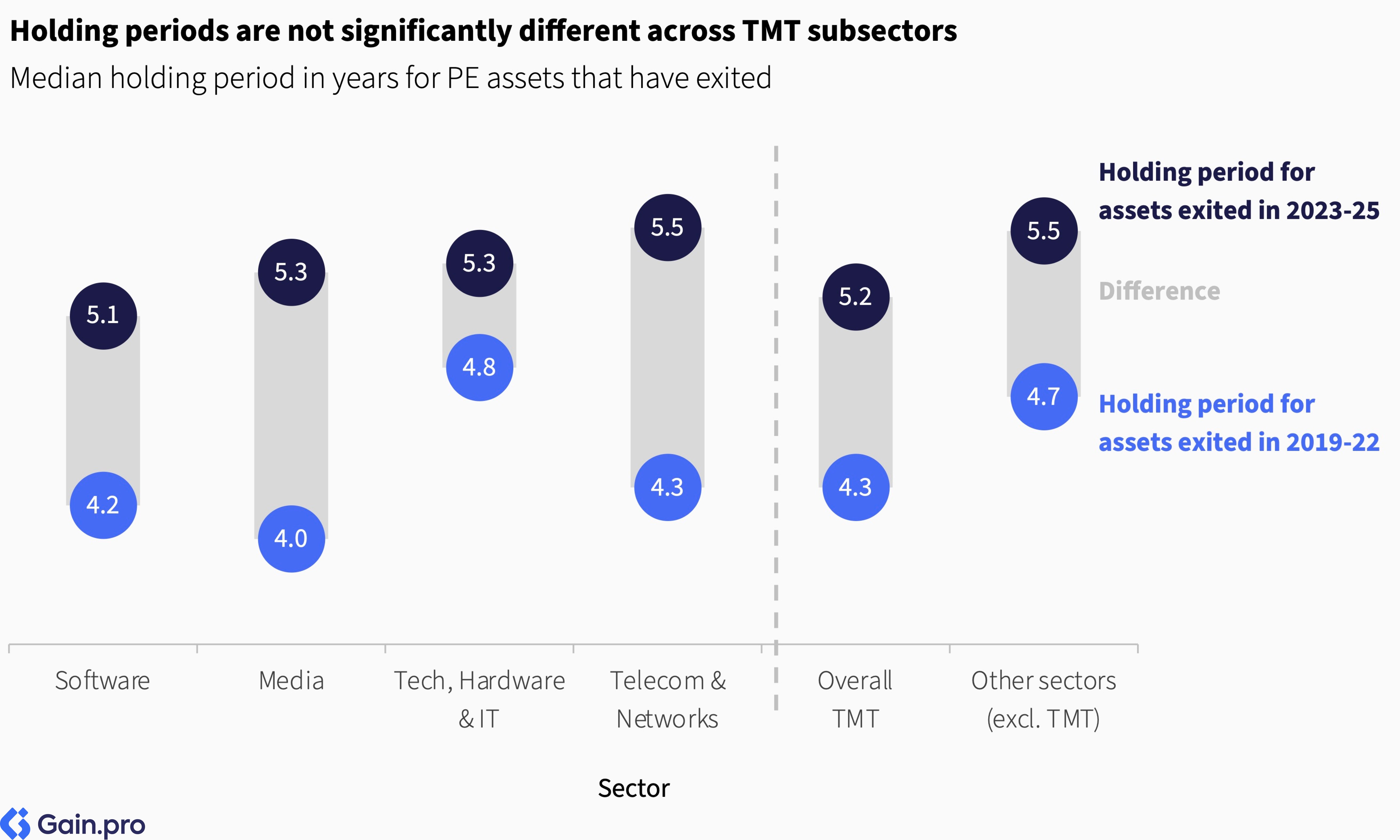
Holding periods are not significantly different across TMT subsectors, though Telecom & Networks holds assets slightly longer at 5.5 years versus 5.1 years for Software. Software's slightly shorter holding periods reflect faster value creation cycles and more liquid exit markets.
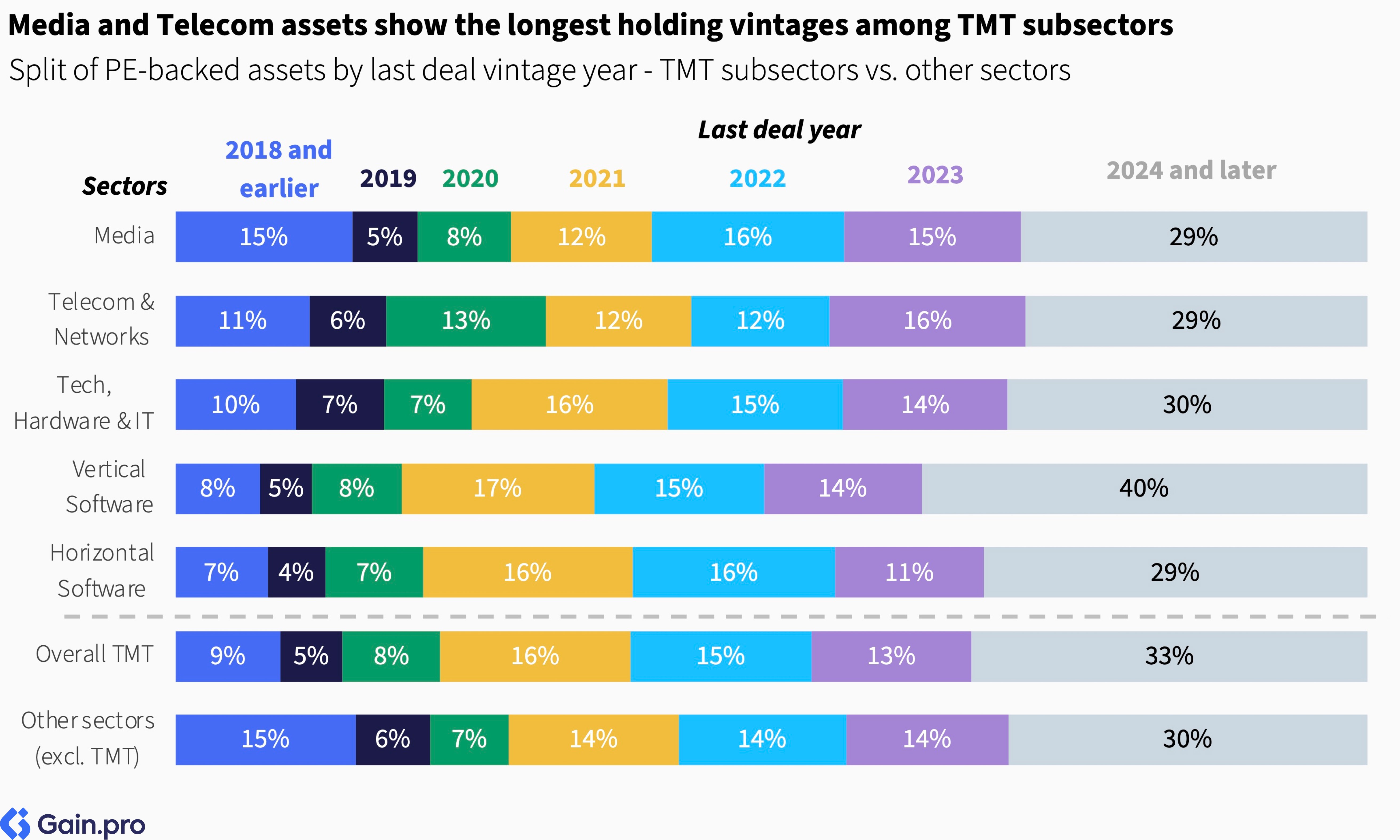
Media and Telecom assets have the highest share of long-held assets, while Software has a higher share of more recent vintages. Overall, TMT has more recent vintages compared to other sectors.
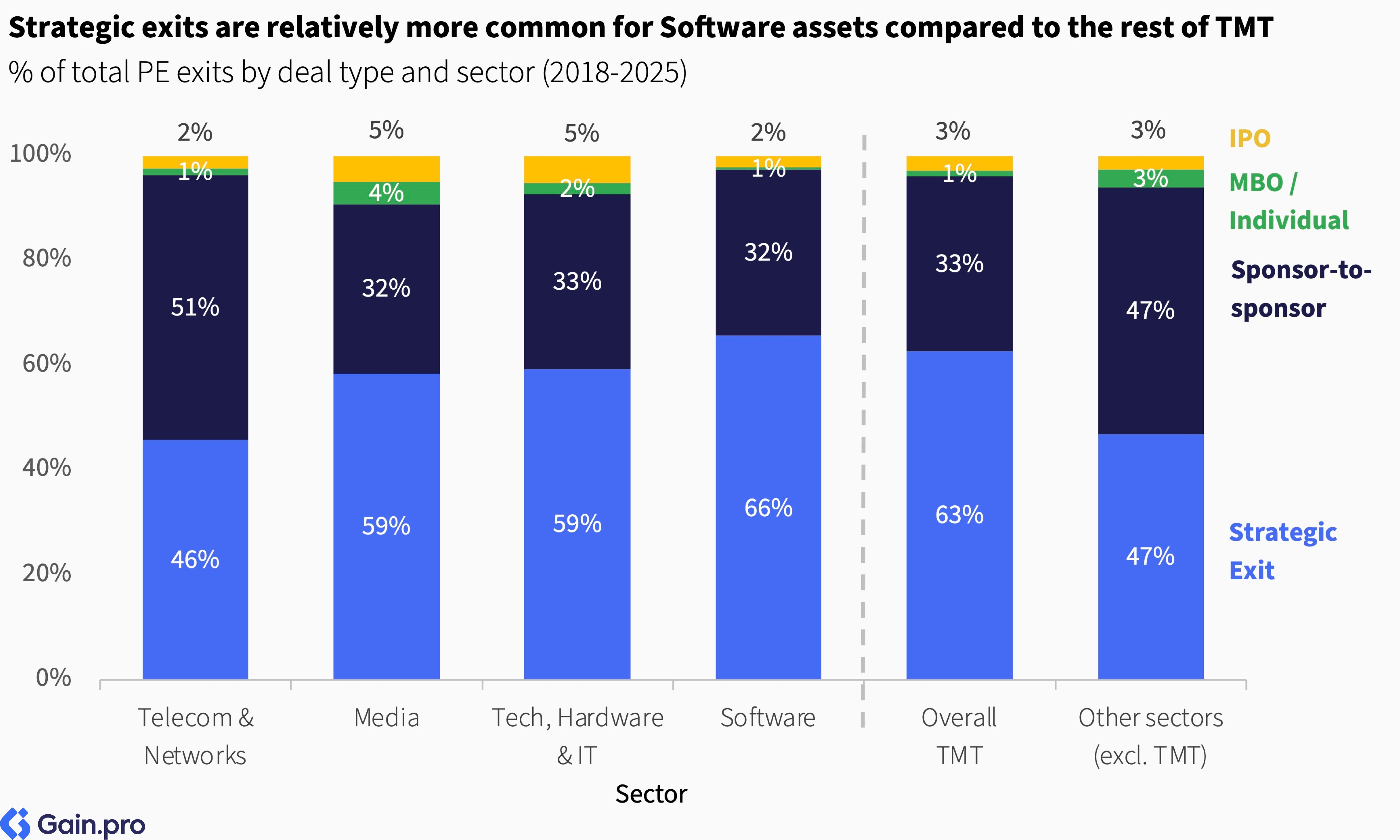
TMT sees significantly higher strategic exit activity than other sectors. Within TMT, Software has the highest share of strategic exits (66%), as tech giants and corporate buyers aggressively pursue acquisition targets to accelerate growth and enhance their product offerings. In contrast, Telecom & Networks sees more exits via the sponsor-to-sponsor route.
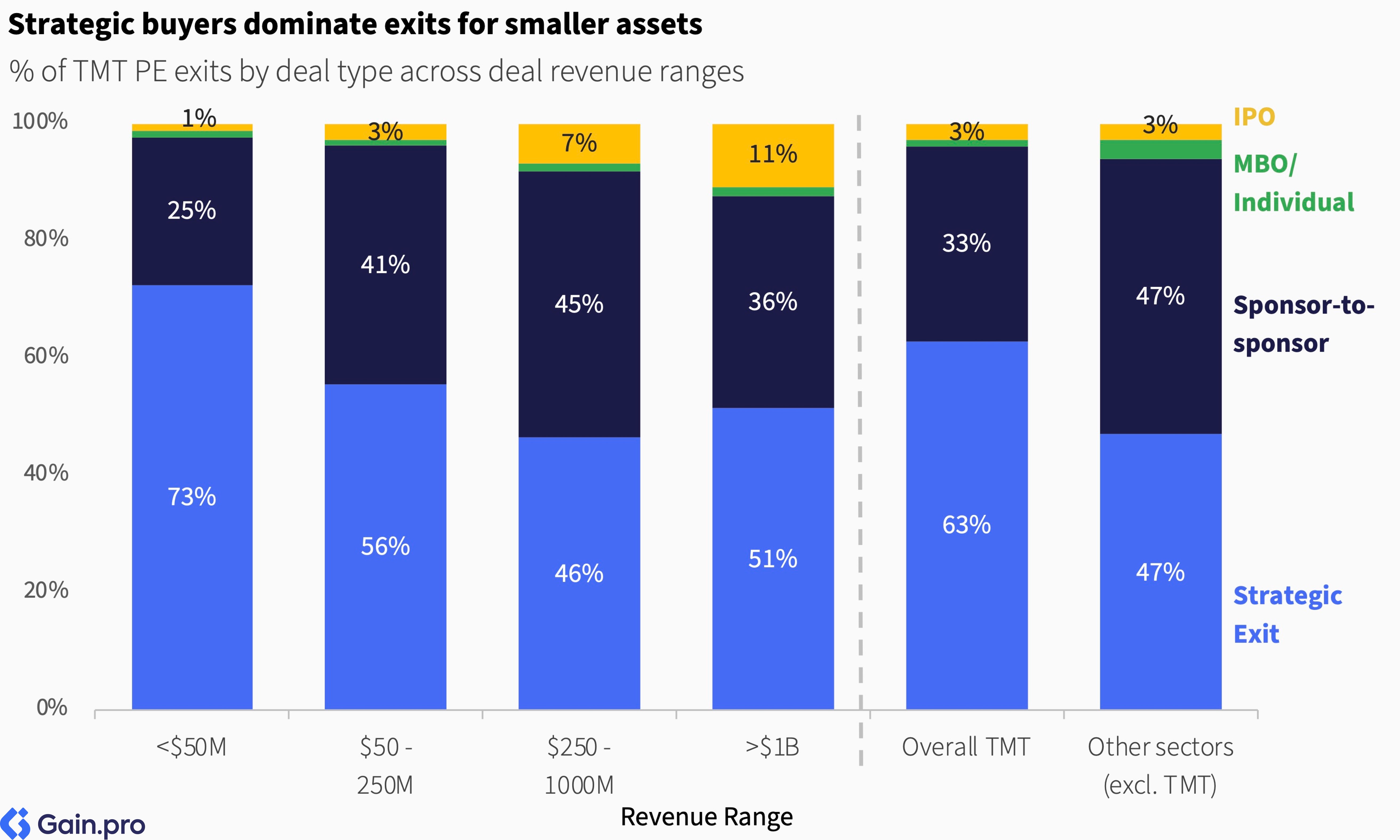
Strategic buyers dominate exits for smaller assets, while sponsor-to-sponsor activity increases for mid-sized assets. IPO activity rises with asset size, reaching 11% for mega-large deals (companies with >$1bn in revenue).
Chapter 04: Returns and Value Creation
MOIC
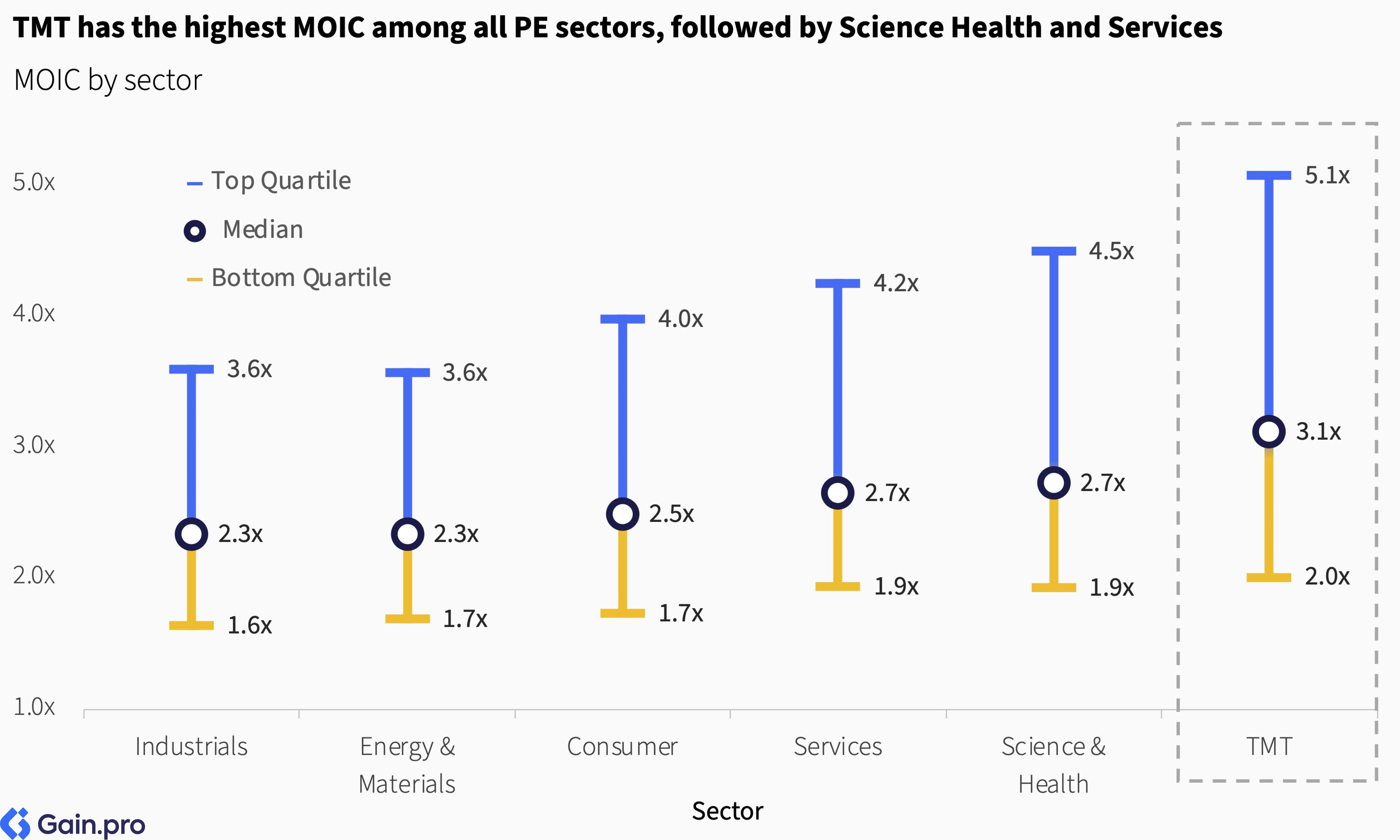
Of all sectors, MOIC is highest in TMT (median of 3.1x), while the sector maintains among the lowest loss rates at approximately 5%. Unsurprisingly, given the returns, investors have moved aggressively into the sector making TMT the largest PE sector in the US and the second largest in Europe.
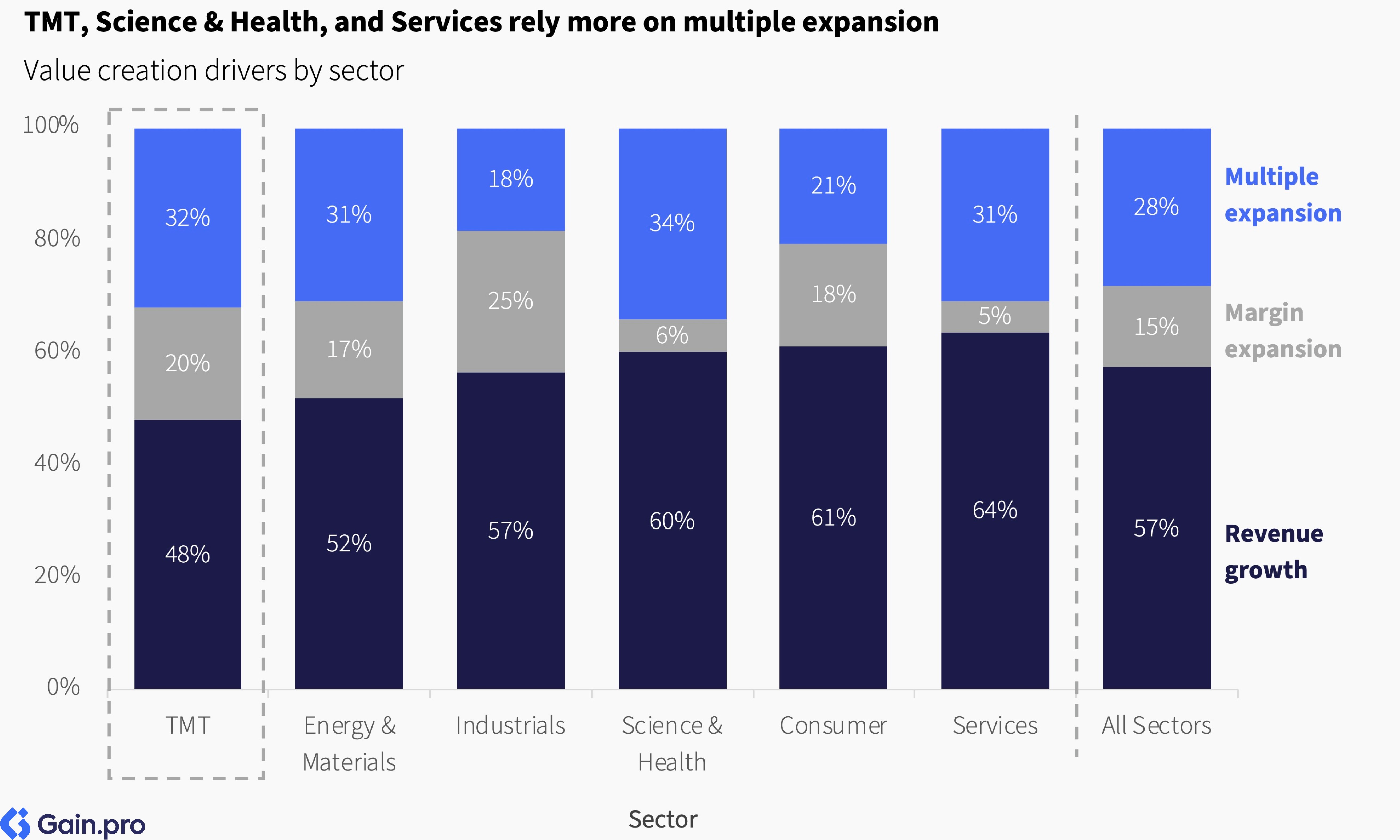
Revenue growth and multiple expansion account for the bulk of value creation in TMT. Growth has been consistently strong and among the highest across all sectors, driving strong returns. Valuations have also re-rated in recent years as more capital has flowed into the sector, with TMT multiples rising faster than other sectors. Finally, margin expansion contributes more significantly to value creation in TMT, particularly in public-to-private deals where there is more scope for operational improvements away from the public limelight.
Buy-and-Build
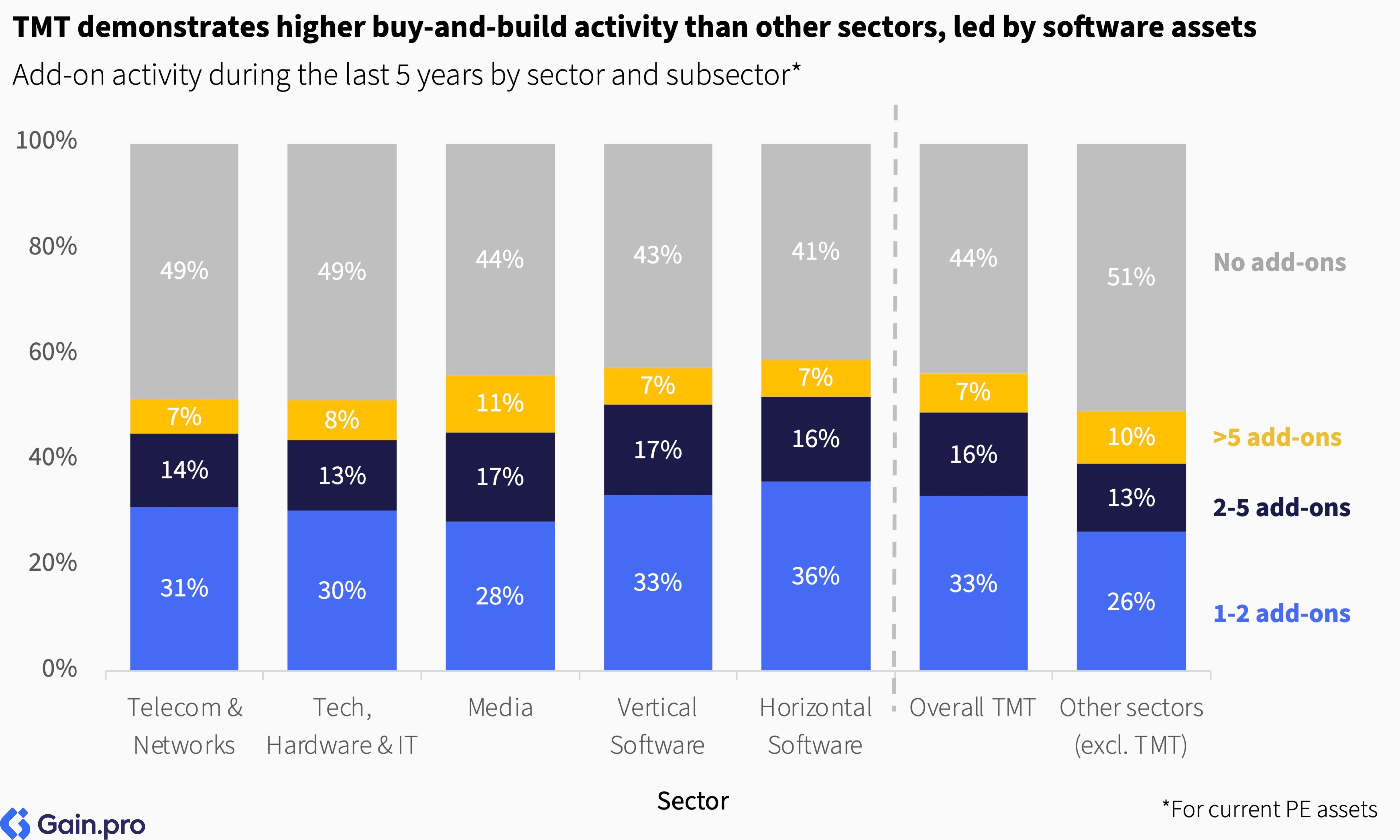
Add-ons drive significant value creation by accelerating revenue growth and margin expansion. 56% of TMT assets pursue acquisitions, compared to 49% in other sectors. Within TMT, Horizontal Software platforms are most acquisitive, followed by Vertical Software and Media.
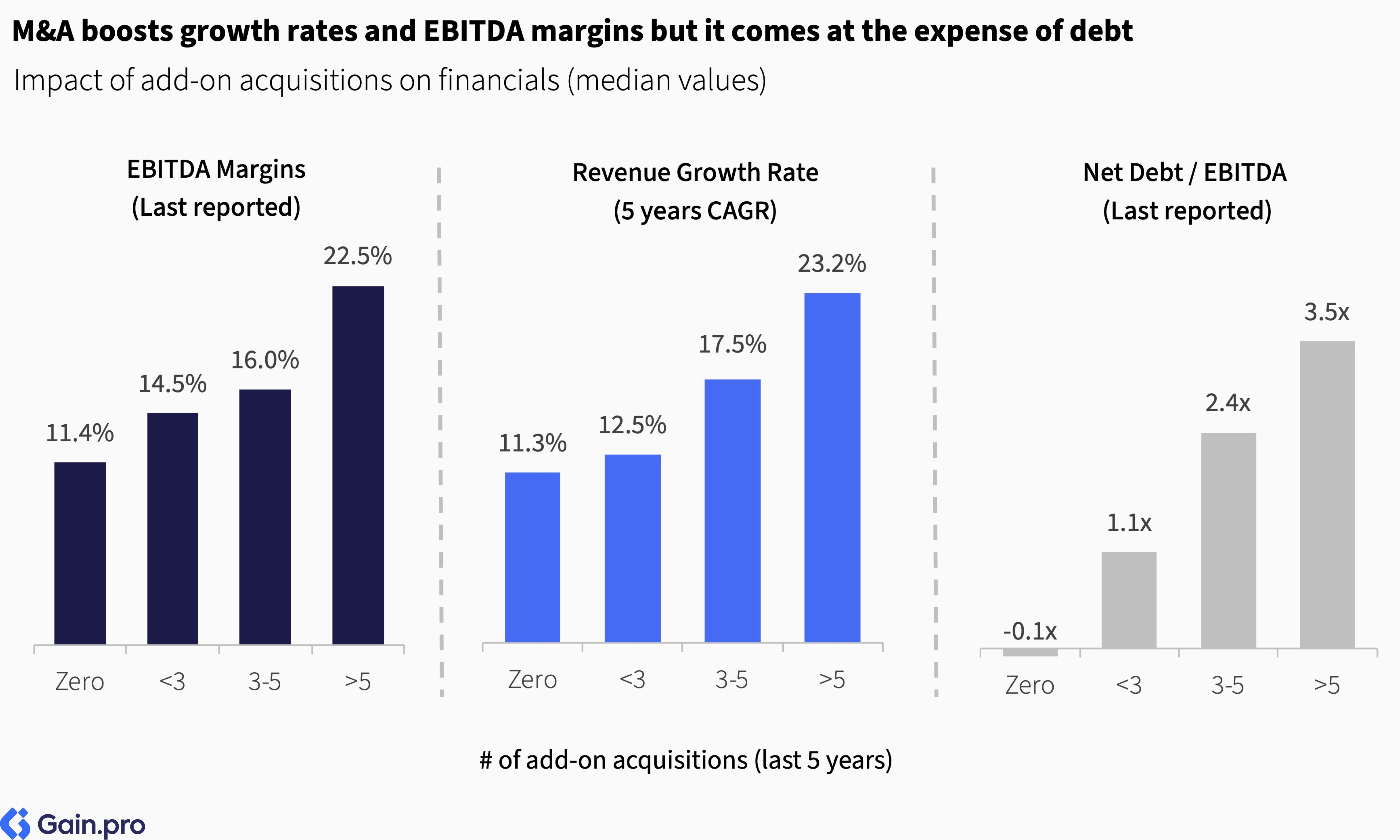
TMT assets with over 5 acquisitions grew at a 5-year CAGR of 23.2%, more than double the 11.3% growth for businesses with no acquisitions. These active acquirers also benefit from improved margins (22.5% versus 11.4%). However, we do see an increase in debt to finance these acquisitions, which elevates the overall risk profile of the investment.
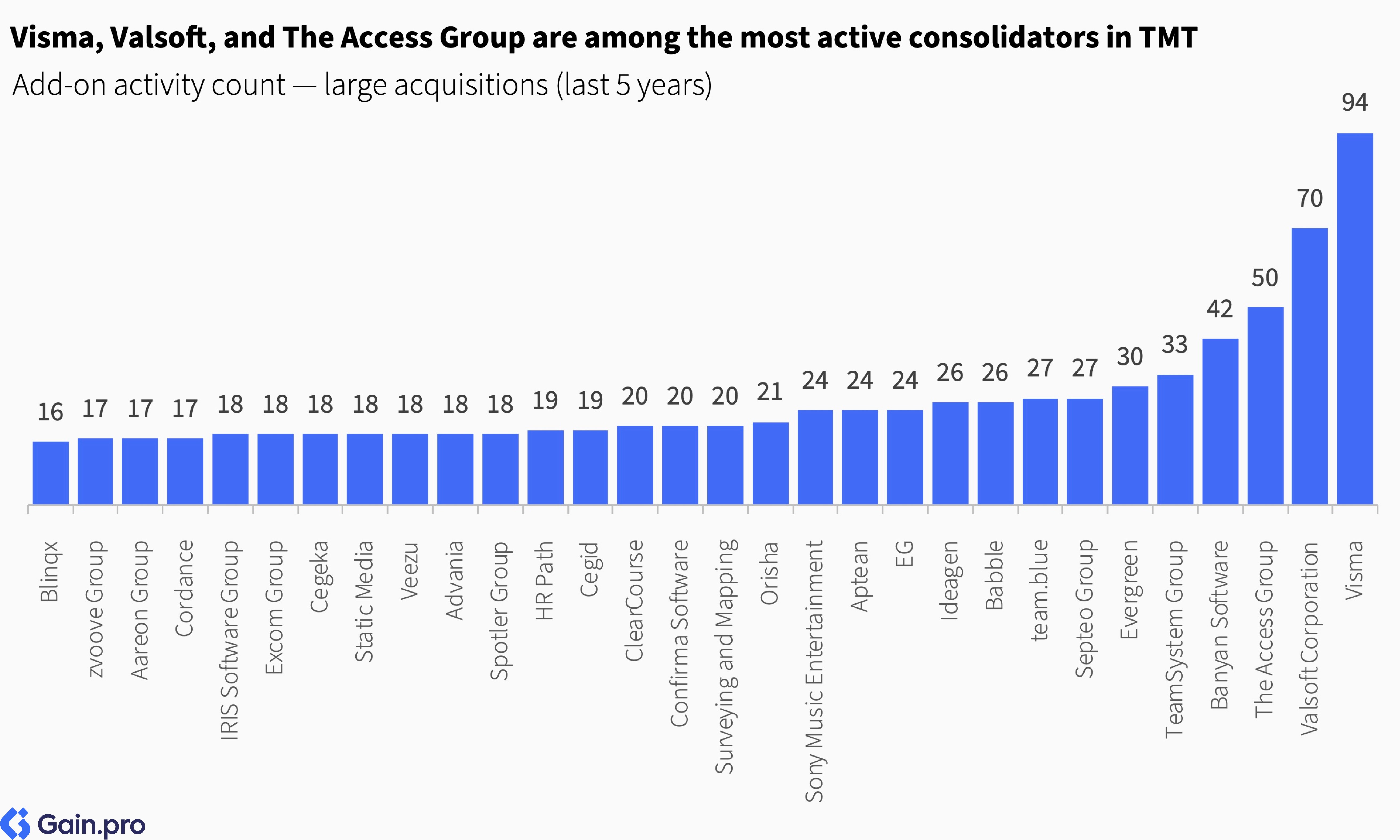
Visma, Valsoft Corporation, and The Access Group are the most active consolidators in TMT. Visma targets fragmented accounting and ERP software, Valsoft operates as a holding company that develops and acquires vertical-market software businesses, and Access Group consolidates business management software. By investor, Hg, H&F, Silver Lake, and TA Associates are most active in the buy-and-build space.
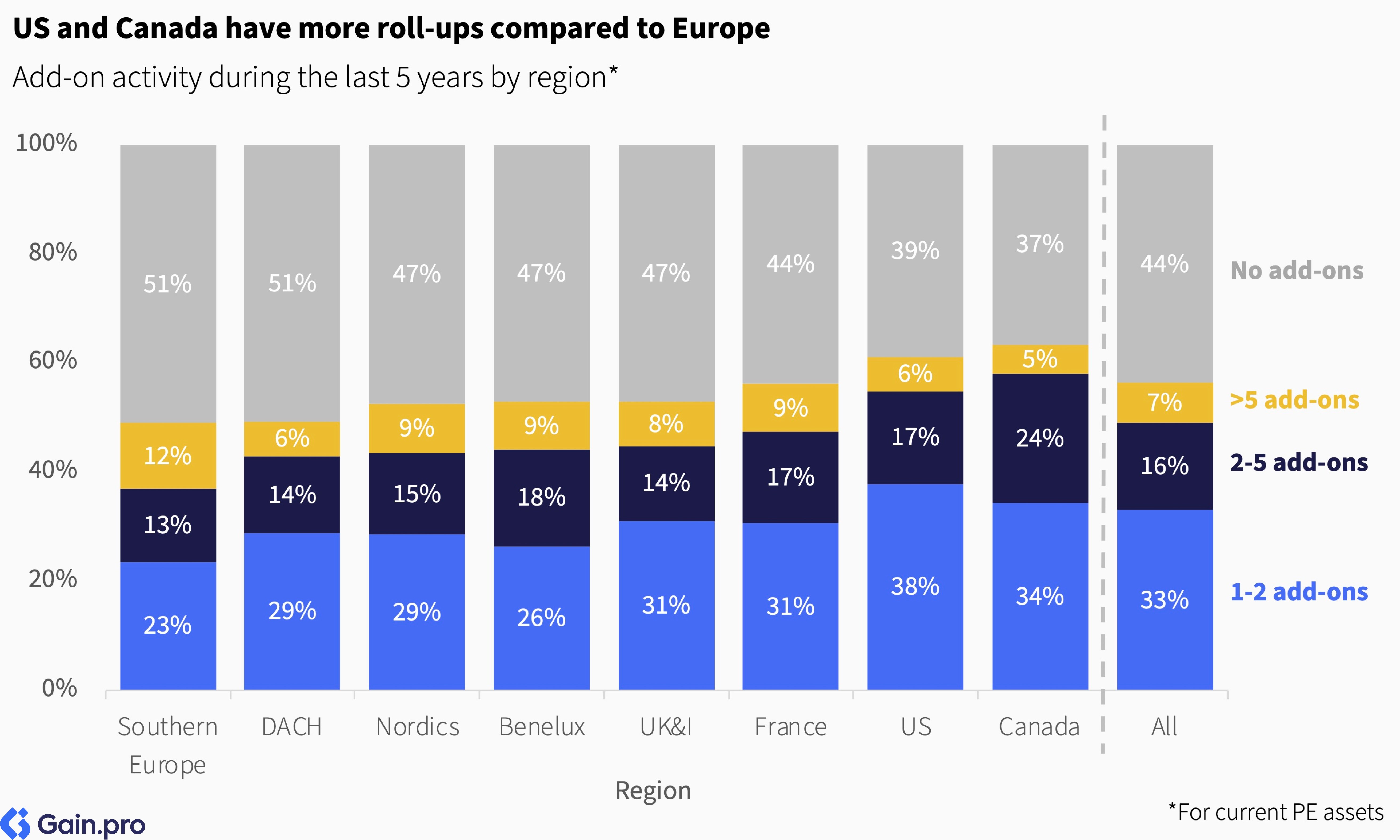
By region, the US and Canada have more add-ons compared to Europe. North America benefits from larger market size, greater fragmentation, and a unified market that facilitates scale.
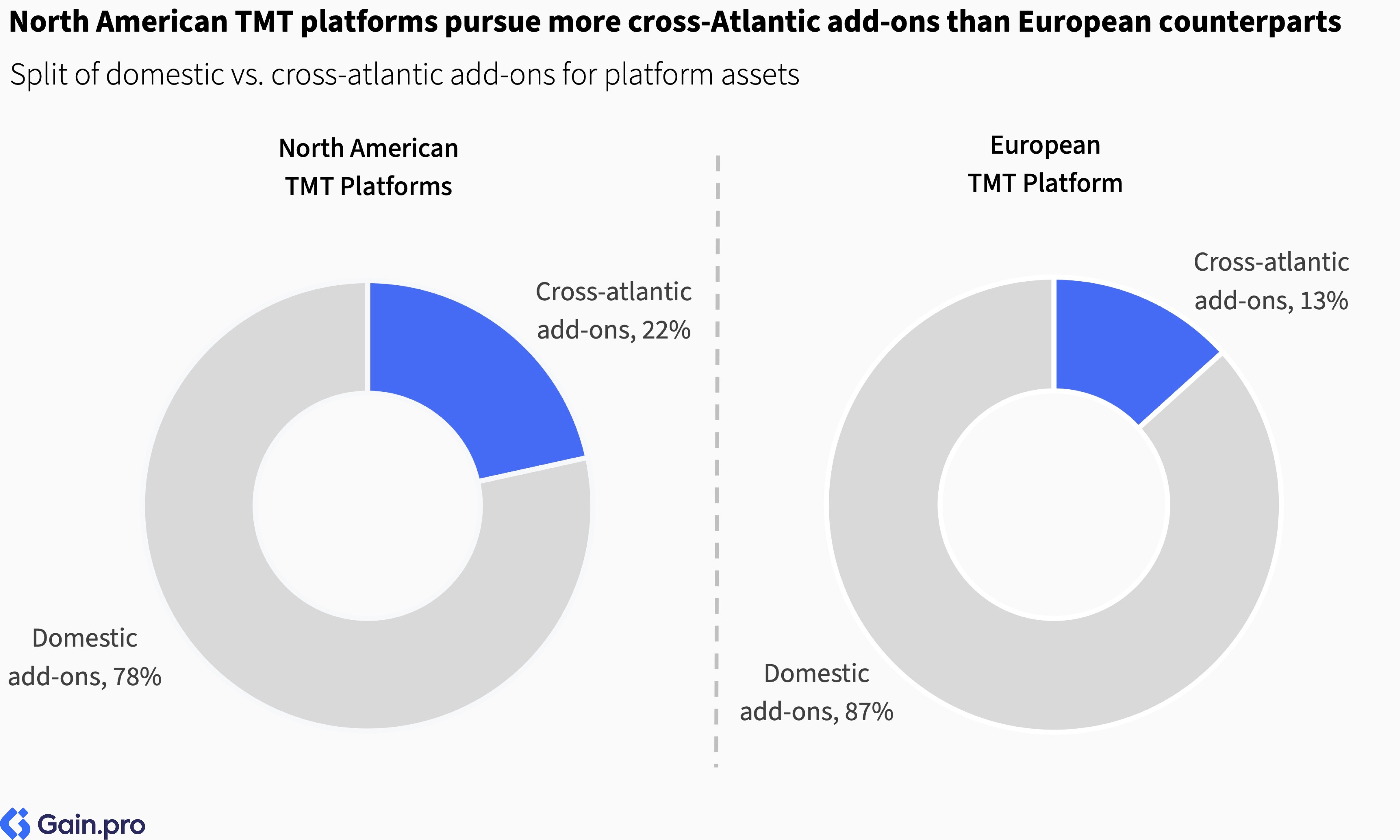
North American TMT platforms pursue more cross-Atlantic add-ons than their European counterparts. 22% of add-ons for North American platforms are in Europe, compared to just 13% of European add-ons in North America. The higher American cross-border activity in Europe reflects attractive valuations and a favorable USD/EUR exchange rate. In contrast, European platforms face stiffer competition in the US in addition to higher valuations.
Chapter 05: Growth, Margins, and Multiples
Revenue Growth
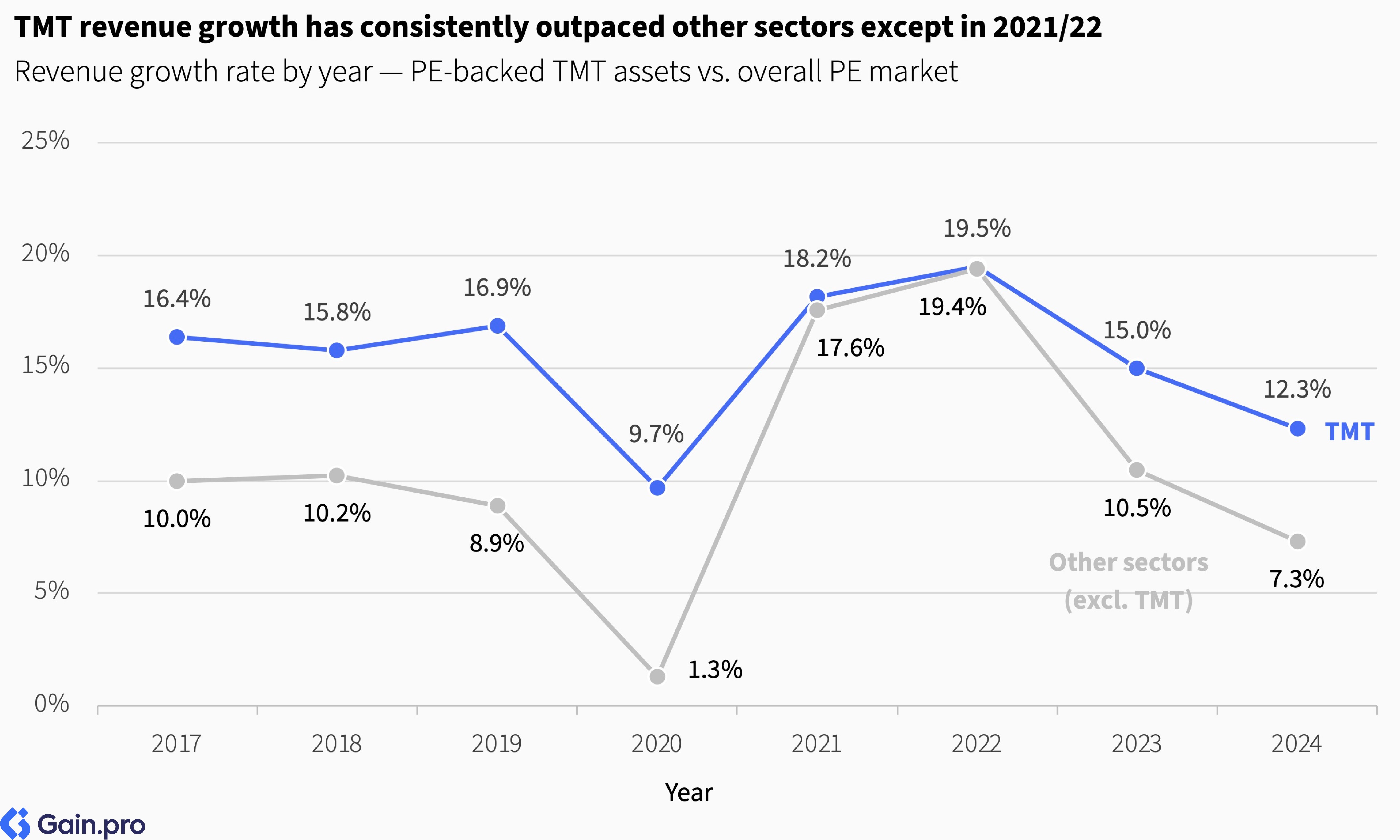
TMT revenue growth has consistently outpaced other sectors by 5-6 percentage points (except in 2021/22), driven by cloud and software adoption. However, absolute growth rates have recently moderated and are now approaching 2020 lows. Given growth's importance to PE value creation, further deceleration could dampen returns despite the narrative around AI.
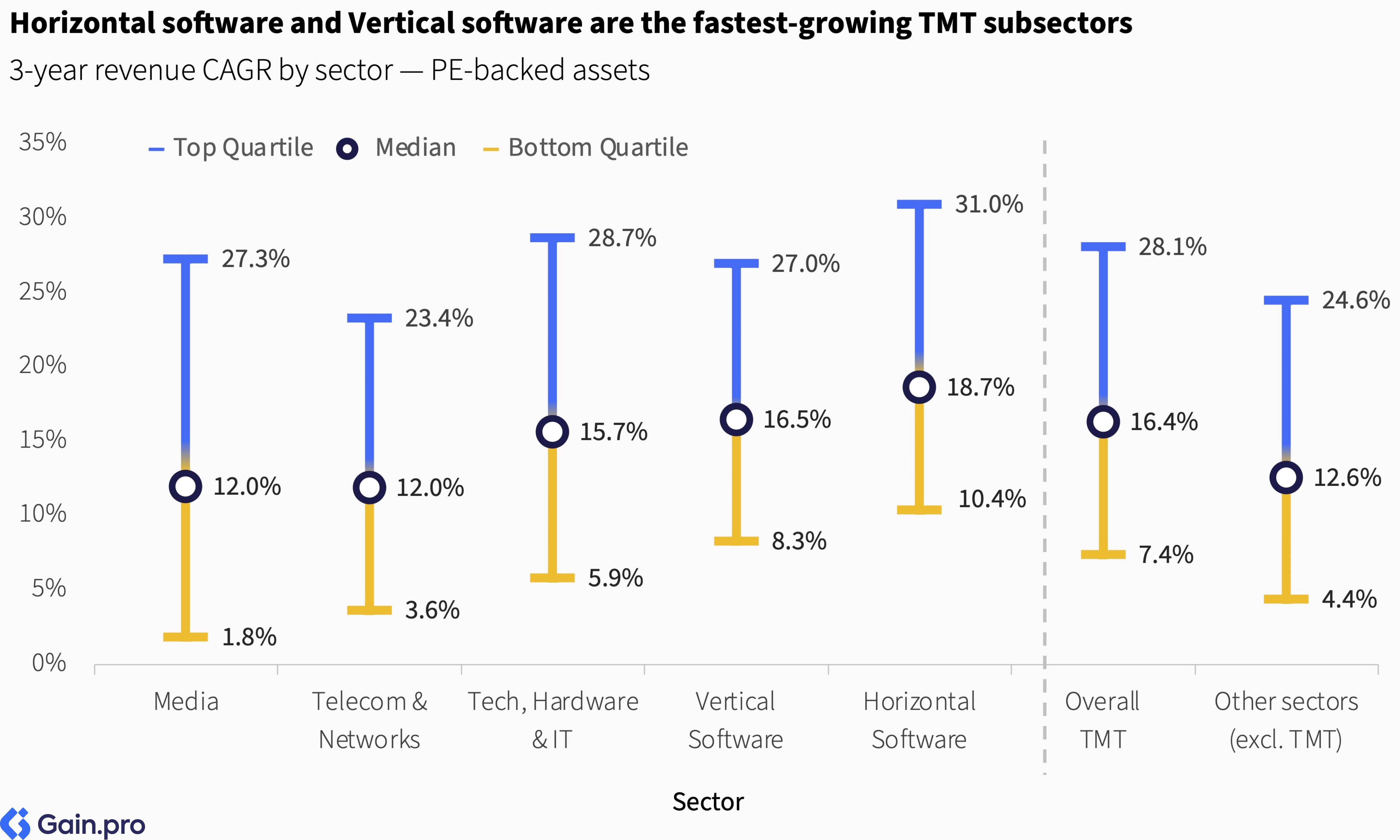
Horizontal Software and Vertical Software are the fastest-growing subsectors within TMT, with 3-year CAGRs of 18.7% and 16.5%, respectively. Software assets benefit from recurring SaaS revenue and scalable models with minimal incremental costs to serve additional customers. Horizontal Software edges ahead due to larger addressable markets across industries.
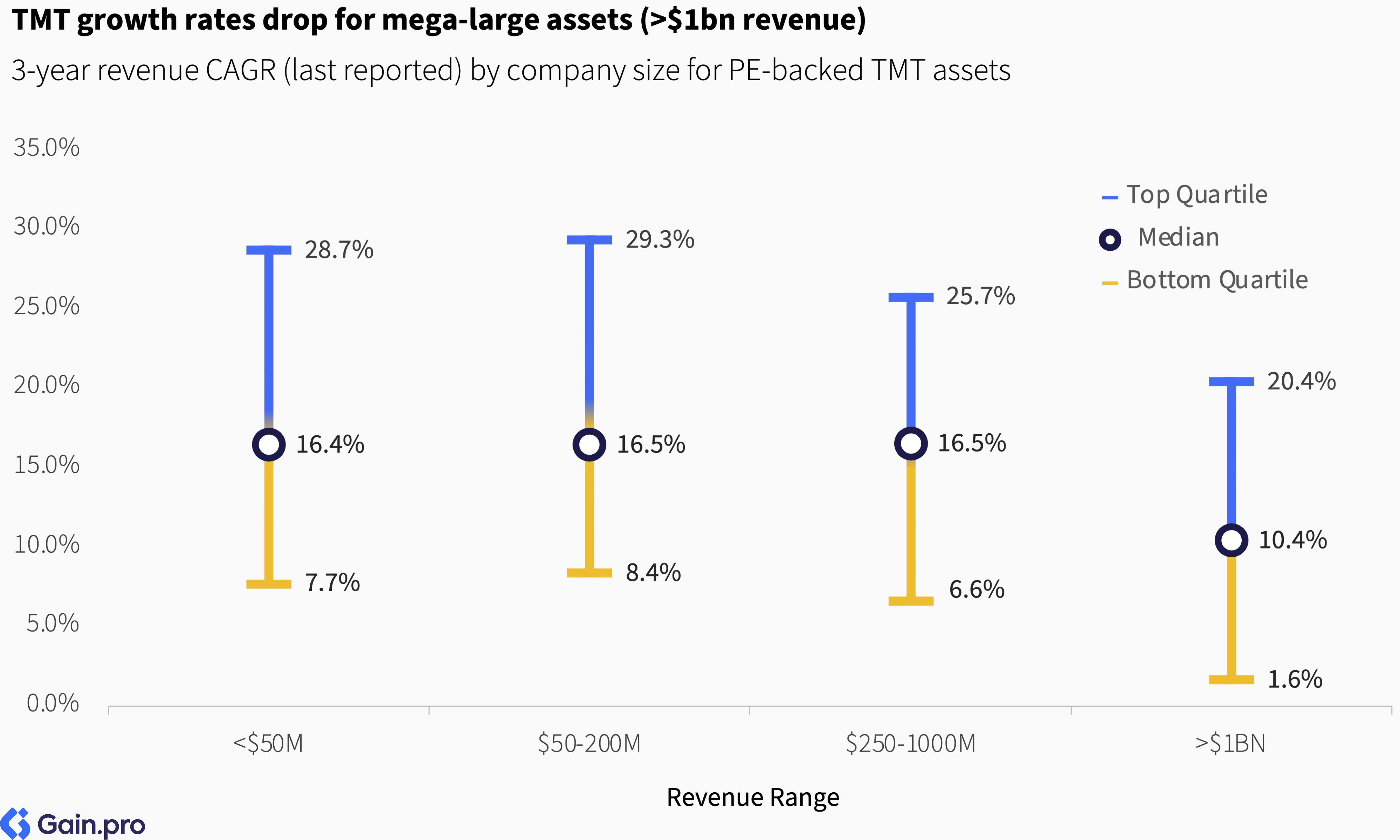
TMT growth rates remain consistent across small to mid-sized assets (16-17% median), but drop for mega-large assets (>$1bn revenue). Mega-large assets face inherent challenges maintaining high growth rates at scale, as market penetration increases and addressable markets become more saturated.
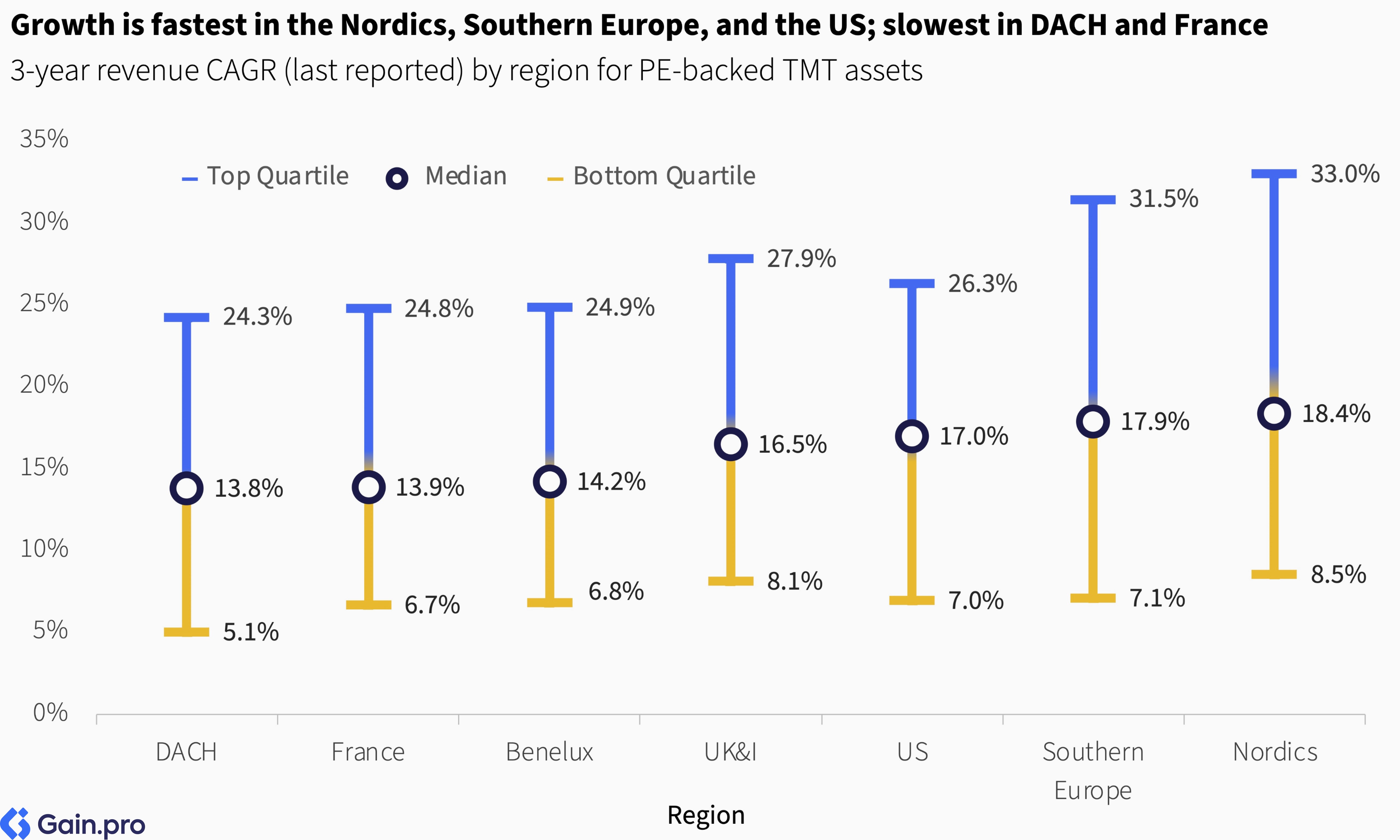
Growth for TMT assets is fastest in the Nordics, Southern Europe, and the US, while DACH and France lag behind. Southern Europe's strong performance is driven by a higher concentration of earlier-stage businesses, which typically grow faster.
EBITDA Margins
TMT assets maintain a 3–5 percentage point margin premium over other sectors. Over the last 7 years, businesses in TMT have become more efficient, with margins jumping +240 bps vs. +80 bps for other sectors. Looking ahead, it is unclear whether AI adoption will further enhance margins through automation and efficiency gains, or if increased spend will offset these benefits.
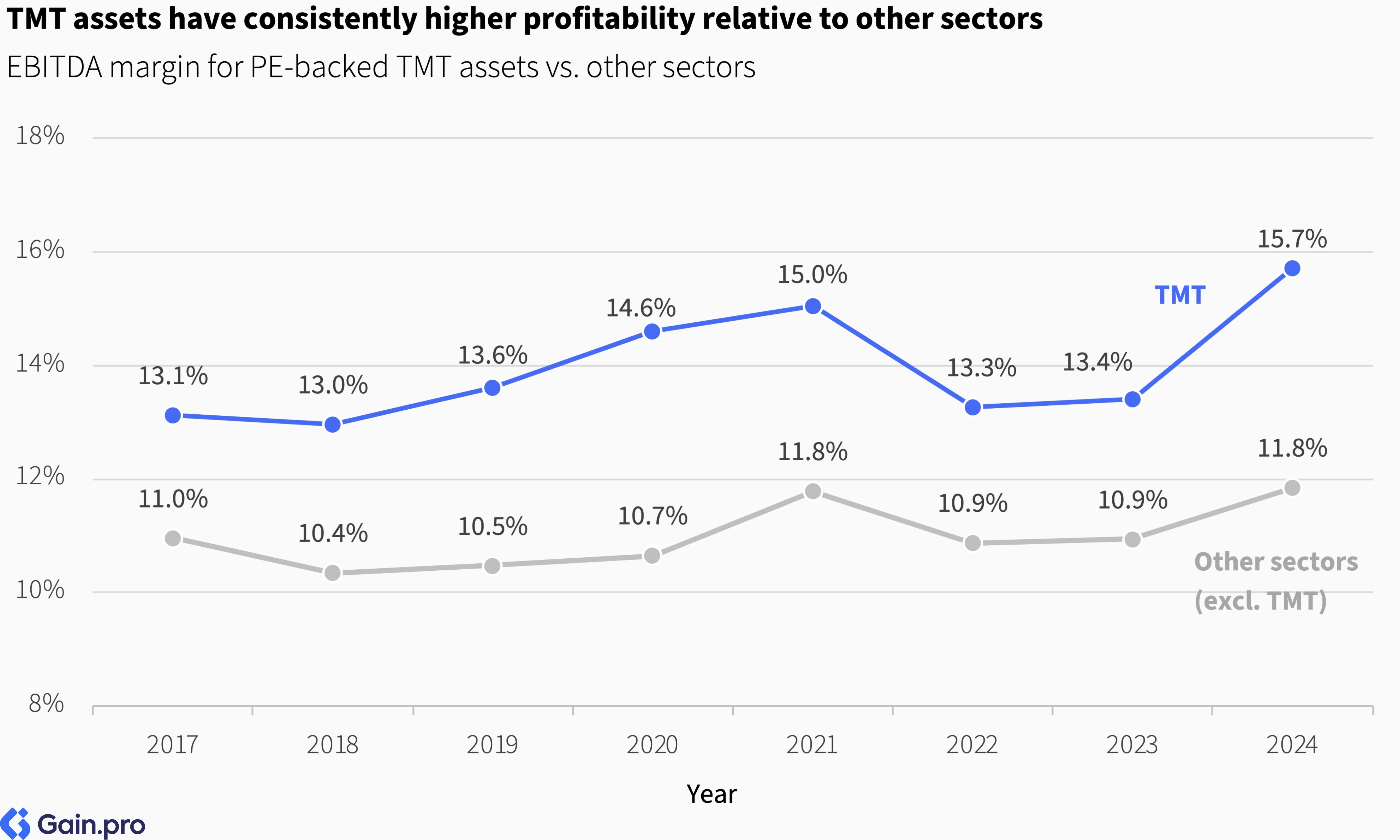
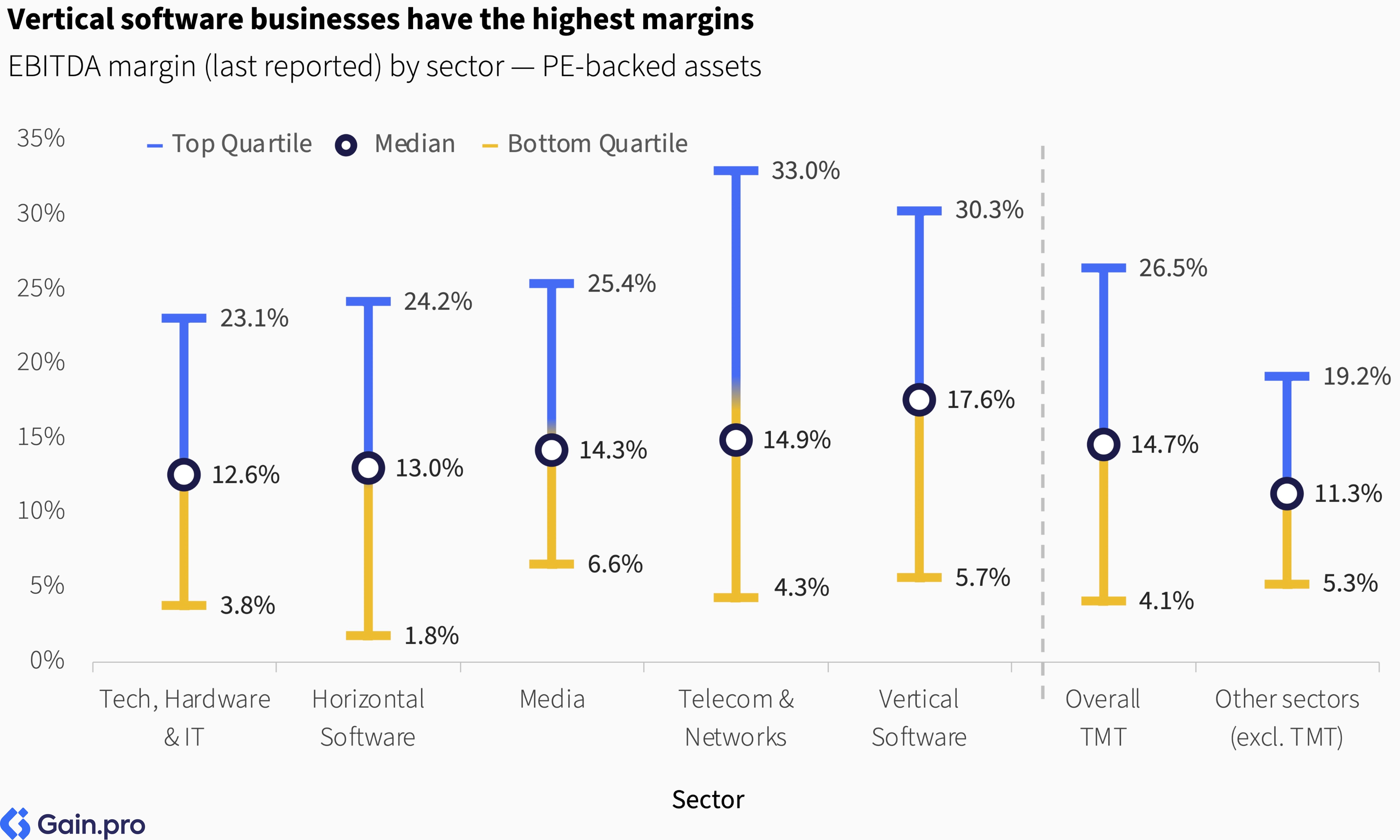
Overall, margins in TMT (14.7%) are higher than other sectors (11.3%), driven primarily by Software businesses. Within Software, Vertical Software businesses have higher margins (17.6%) than Horizontal Software (13.0%). Deep industry specialization yields pricing power and operational efficiency, allowing Vertical Software to command premium margins despite comparable growth rates.
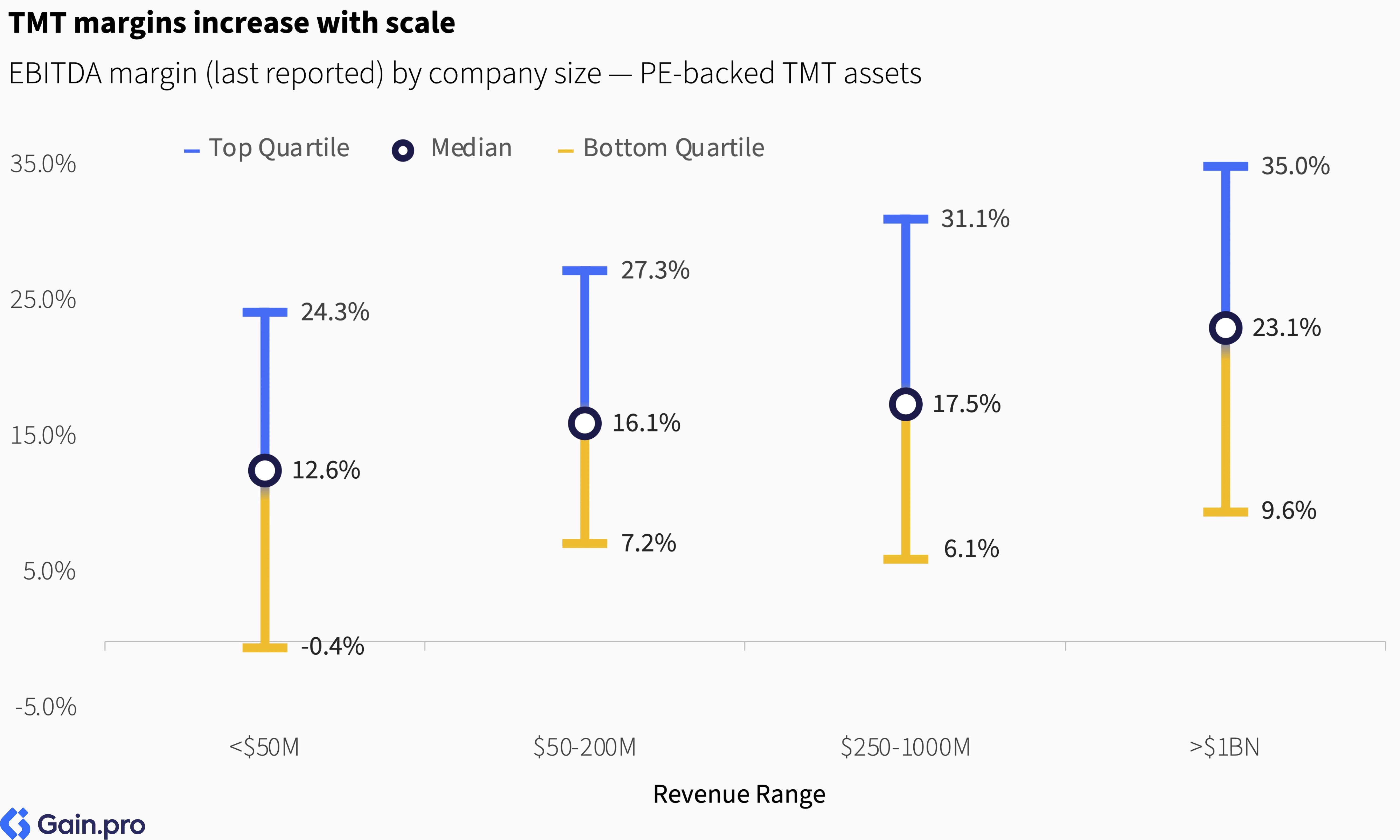
TMT margins increase with scale, with median EBITDA margins nearly doubling from 12.6% for small assets (<$50m revenue) to 23.1% for mega-large companies (>$1bn revenue). Larger assets benefit from operating leverage as fixed costs are spread across a growing revenue base.
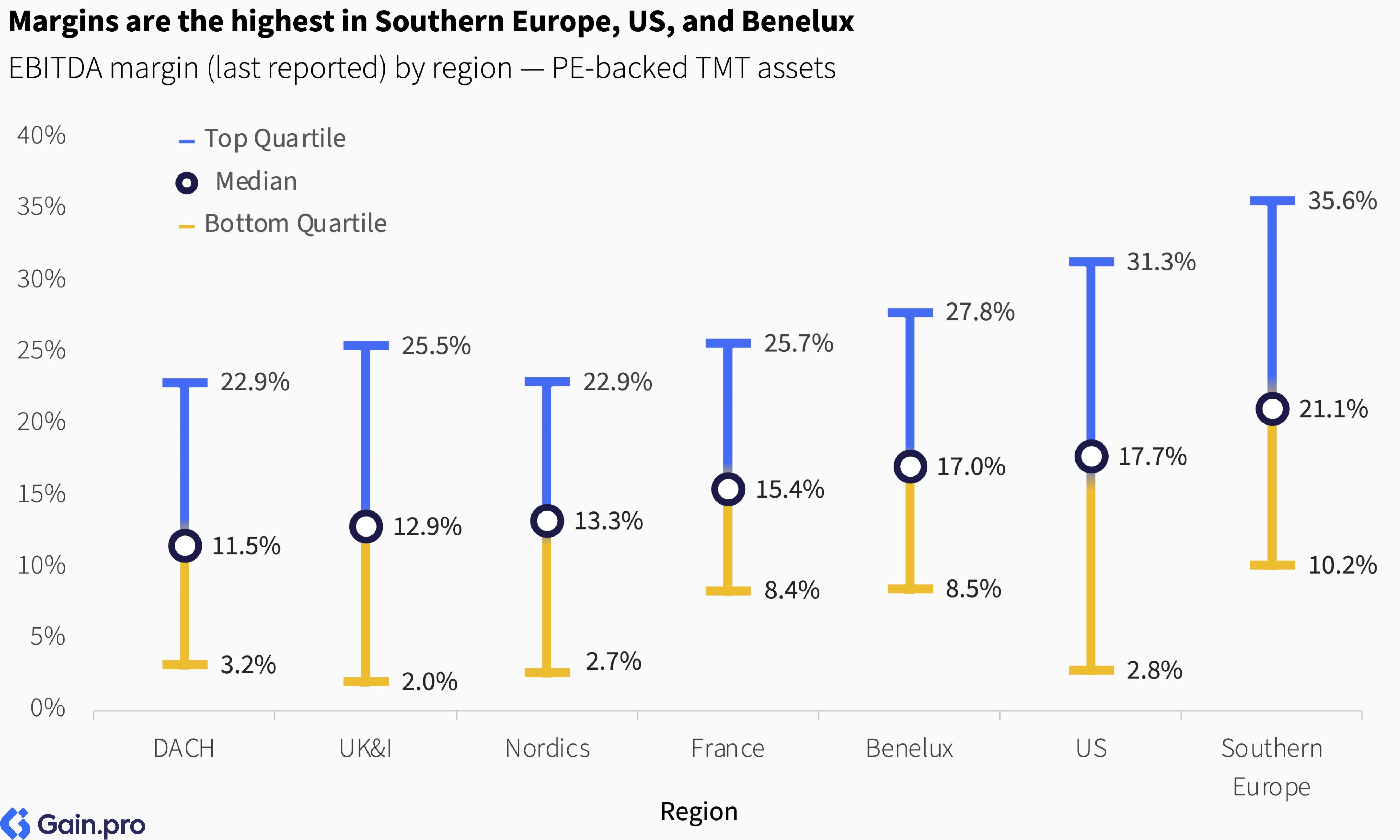
Southern Europe and North American assets have the highest margins (21% and 18%, respectively), driven by Southern Europe's lower cost base and concentration of specialized Vertical Software, and North America's scale advantages. In contrast, DACH (12%), UK&I (13%), and Nordics (13%) lag behind, weighed down by higher labor costs and more competitive market dynamics.
Multiples
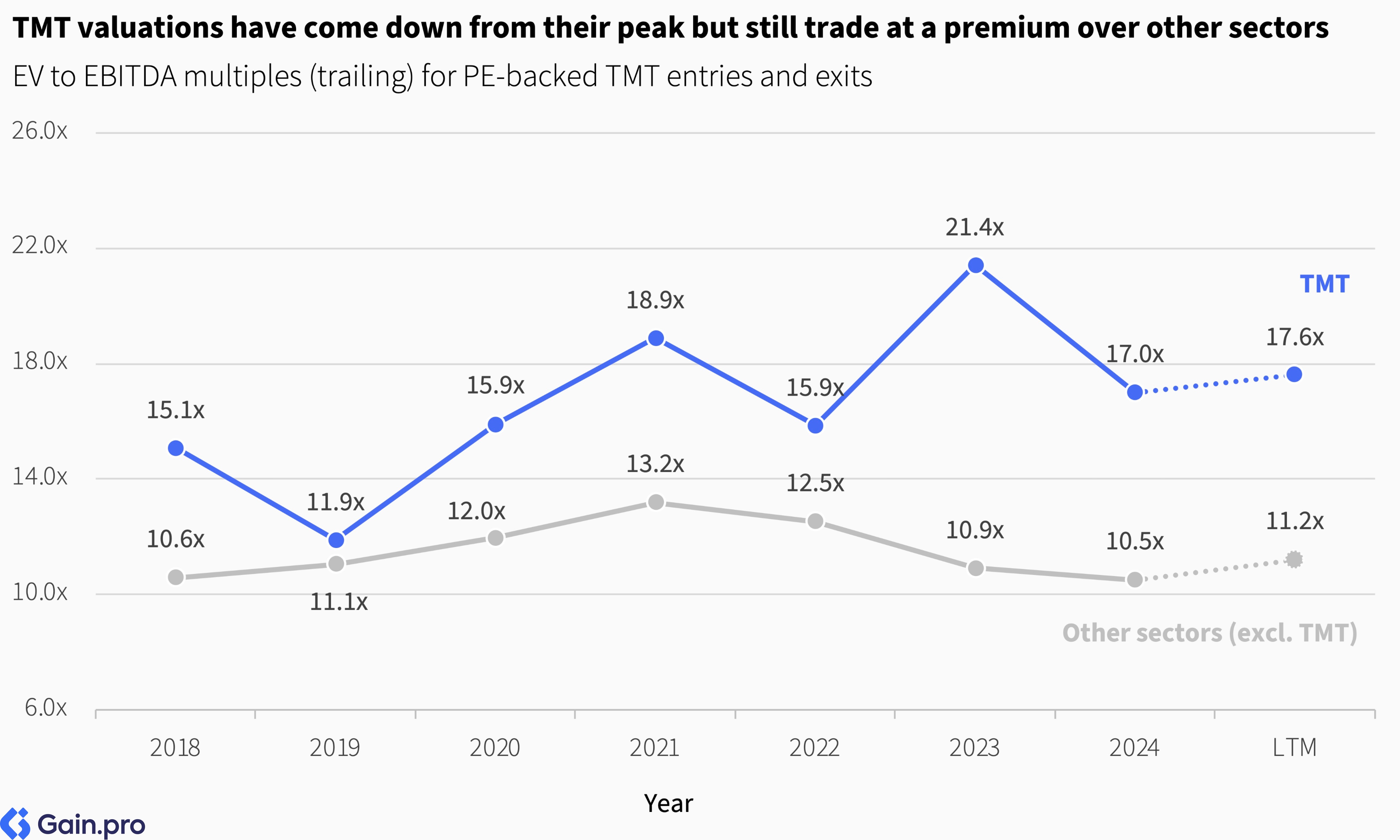
TMT valuations have come down from their peak but still trade at a premium over other sectors, partly justified by higher growth rates. Interestingly, a valuation gap has opened up: private market TMT multiples remain elevated while public software valuations have contracted sharply.
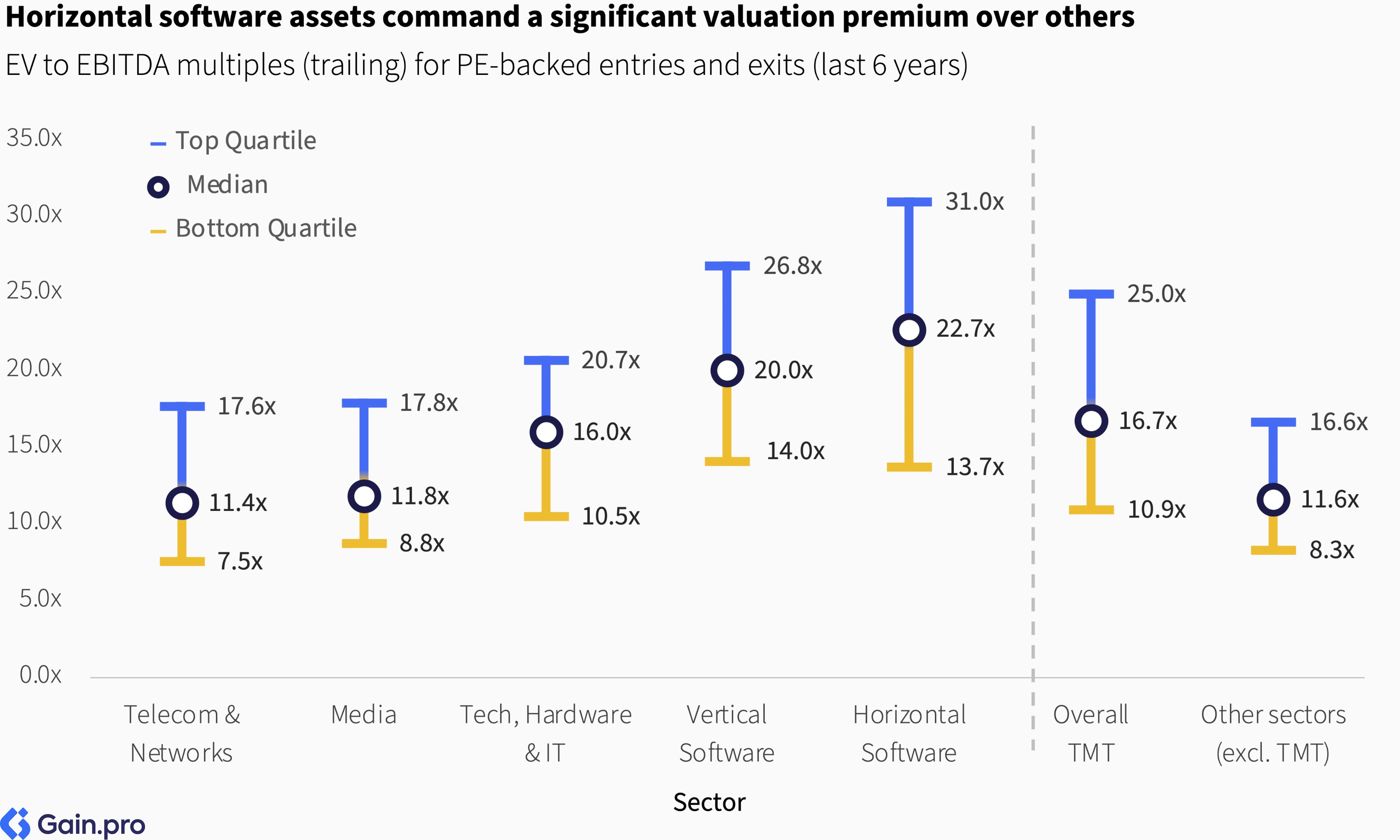
Software assets trade at a premium to other TMT subsectors; within Software, Horizontal Software trades at a premium to Vertical Software (32x vs. 20x), reflecting faster 3-year growth (18.7% vs 16.5% CAGR) and larger addressable markets across industries. In contrast, Media (12x) and Telecom & Networks (11x) trade at significant discounts, consistent with their slower growth profiles.
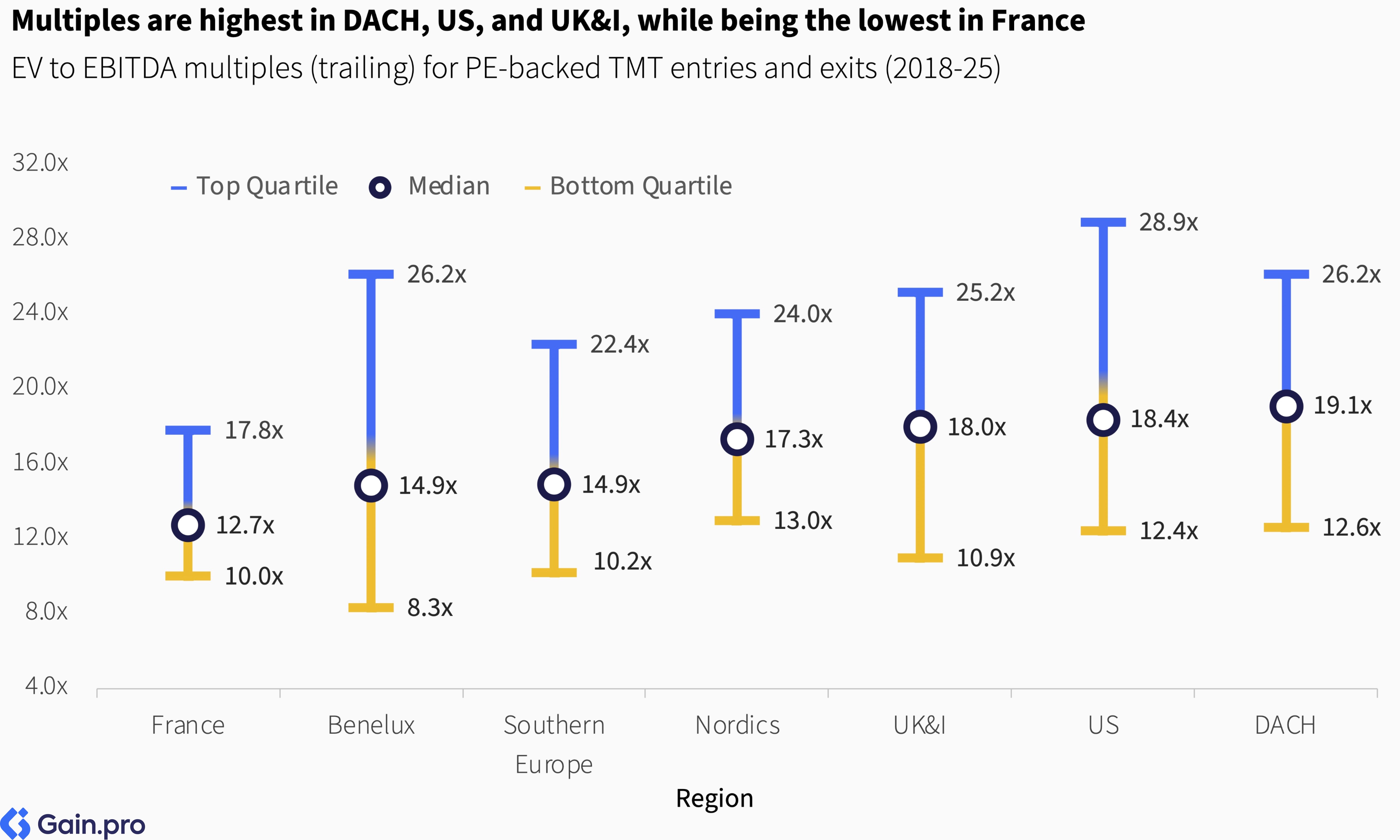
US and DACH markets trade at premium valuations. US assets consistently command higher multiples, reflecting deeper capital markets and a broader investor base. DACH presents an anomaly—the highest multiples despite lower growth and margins—likely driven by strong investor appetite for high-quality Mittelstand tech companies. France posts the lowest multiples at 12.7x, weighed down by slower revenue growth and generally lower multiples in the region.
Methodology
The data for this report comes from Gain.pro.
We take a novel approach to our ranking, which is based on total managed enterprise value (EV). At Gain.pro, we track over 18,000 investor portfolios in detail.
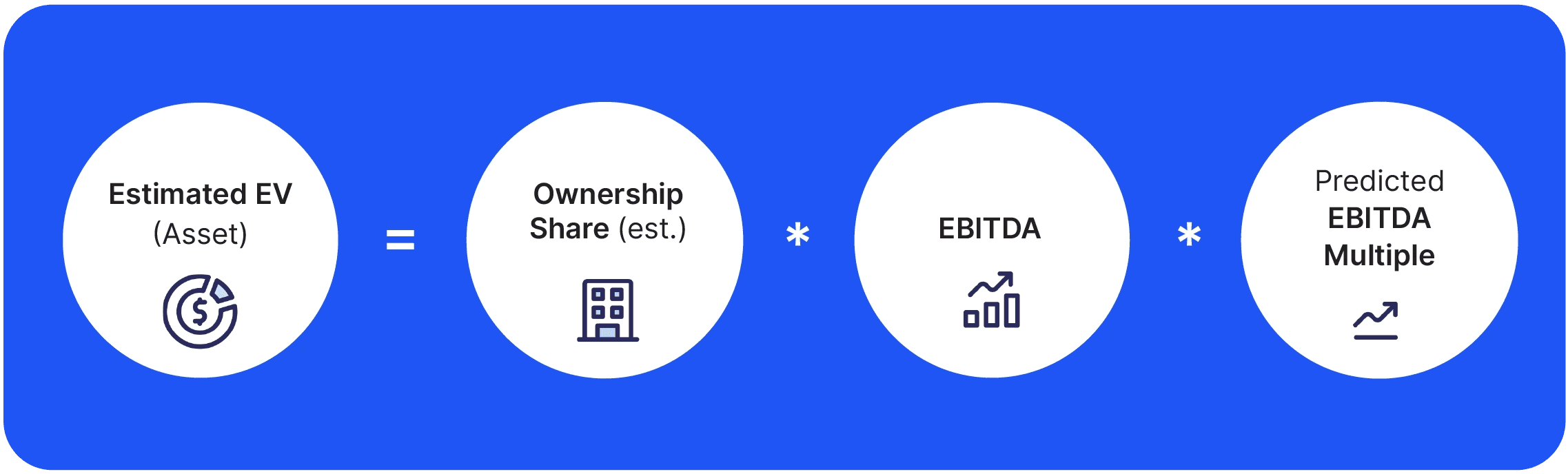
To estimate the managed enterprise value (EV), we estimate the EV for each asset in an investor’s portfolio. We begin with the latest reported deal value, where publicly available. If it's not available, we estimate the EV by multiplying EBITDA by the predicted exit multiple. The total EV is then aggregated at the investor level.
We scale the last reported deal value by a growth multiplier to estimate its current holding value. We also adjust EV for the investor's estimated ownership share in an asset.
Where there aren't reported deal figures or financials, we estimate them using the asset's revenue, subsector margins and revenue/FTE calculations.
To predict exit multiples, we consider an asset's sector, size, growth rate, margin profile and cash generation.
We only consider majority buyout and minority-owned PE assets for our rankings. We exclude any VC investments and publicly listed stakes. To predict exit multiples, we consider an asset’s sector, size, growth rate, margin profile, and cash generation.
Our ranking is limited to North American and European-headquartered portfolio TMT (Technology, Media, and Telecom) companies in which PE firms hold either majority (buyout) or minority stakes.
We exclude venture capital (VC) investments and publicly listed stakes. Additionally, we include only active investors in the ranking with i) 5 or more portfolio companies in the US; ii) 3 or more entries since 2019.
Unless otherwise stated, all metrics and calculations are based solely on an investor's TMT portfolio in North America and Europe.