Executive Summary
In this report, we share insights on the largest Nordic investors, entries, add-ons, exits, holding periods, PE portfolio, growth rates and much more. Here is a summary of our key findings:
Largest Nordic HQ’d investors — EQT has emerged as the leading Nordic HQ’d investor, managing a total estimated EV of €93bn in Europe (including the Nordics), followed by Nordic Capital (€20bn) and A.P.Møller (€10bn). Collectively, the largest 50 Nordic HQ’d investors manage an estimated EV of €193bn in Europe, with the top 10 alone managing €158bn (82%).
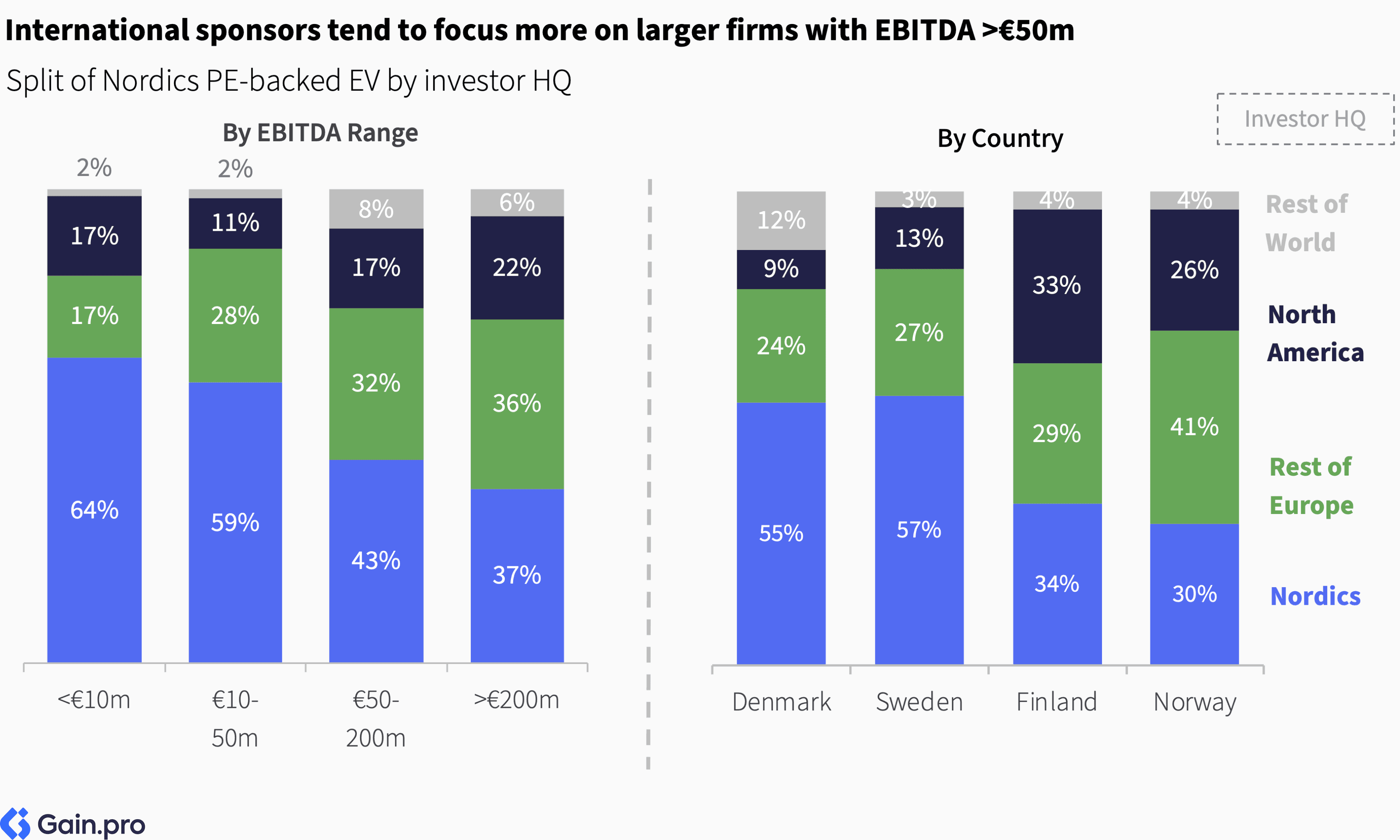
PE portfolio — The Nordic PE market is one of the most domestically focused in Europe. 47% of PE-owned EV assets in the Nordics are owned by domestic investors. The presence of North American sponsors is limited and the lowest of all European regions (18% by EV).
Entries — Compared to the rest of Europe, PE entry activity in the Nordics remains subdued. By sector, activity has held up better in TMT and Services, while Industrials and Consumer have lagged. Sweden is the most active region, accounting for 40% of all Nordic PE entries.
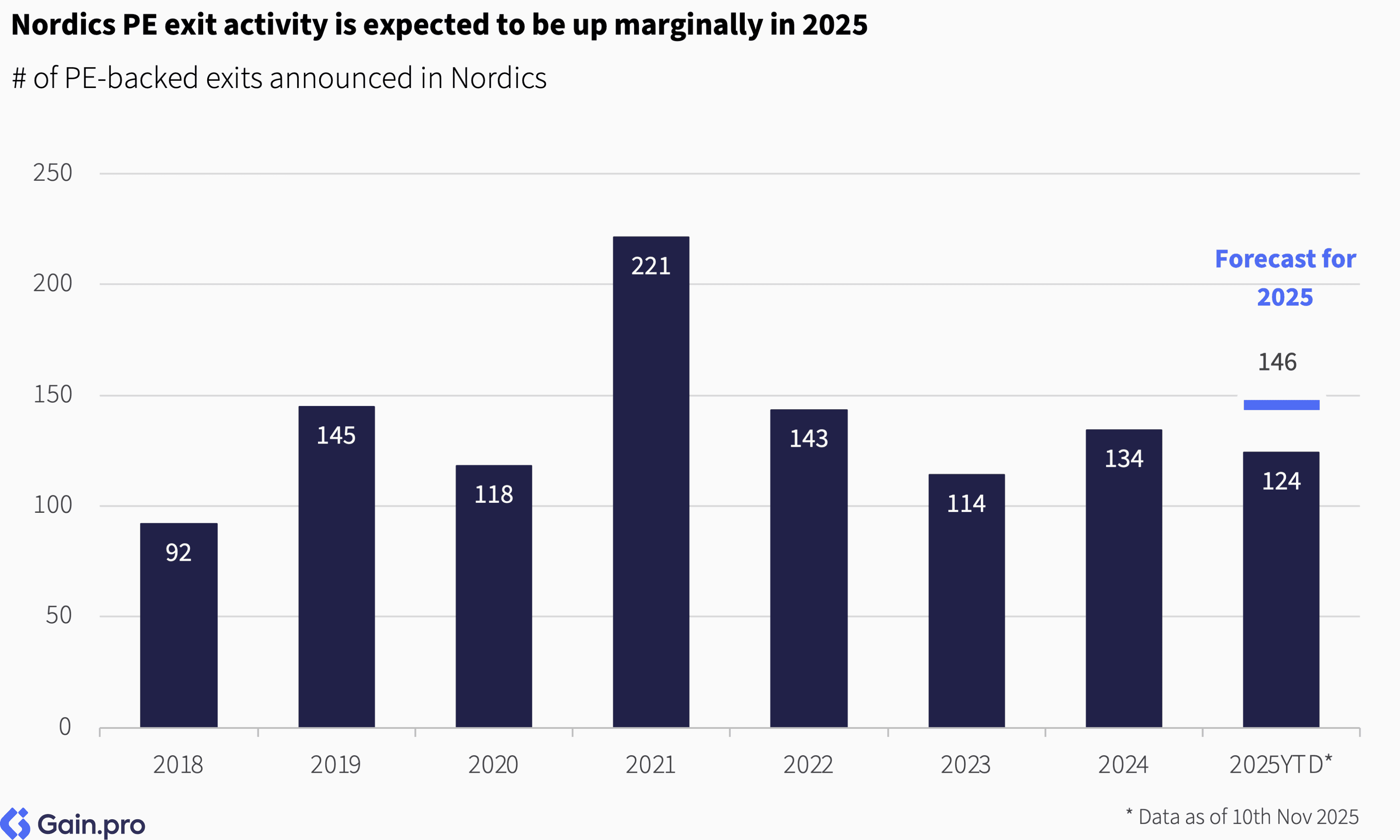
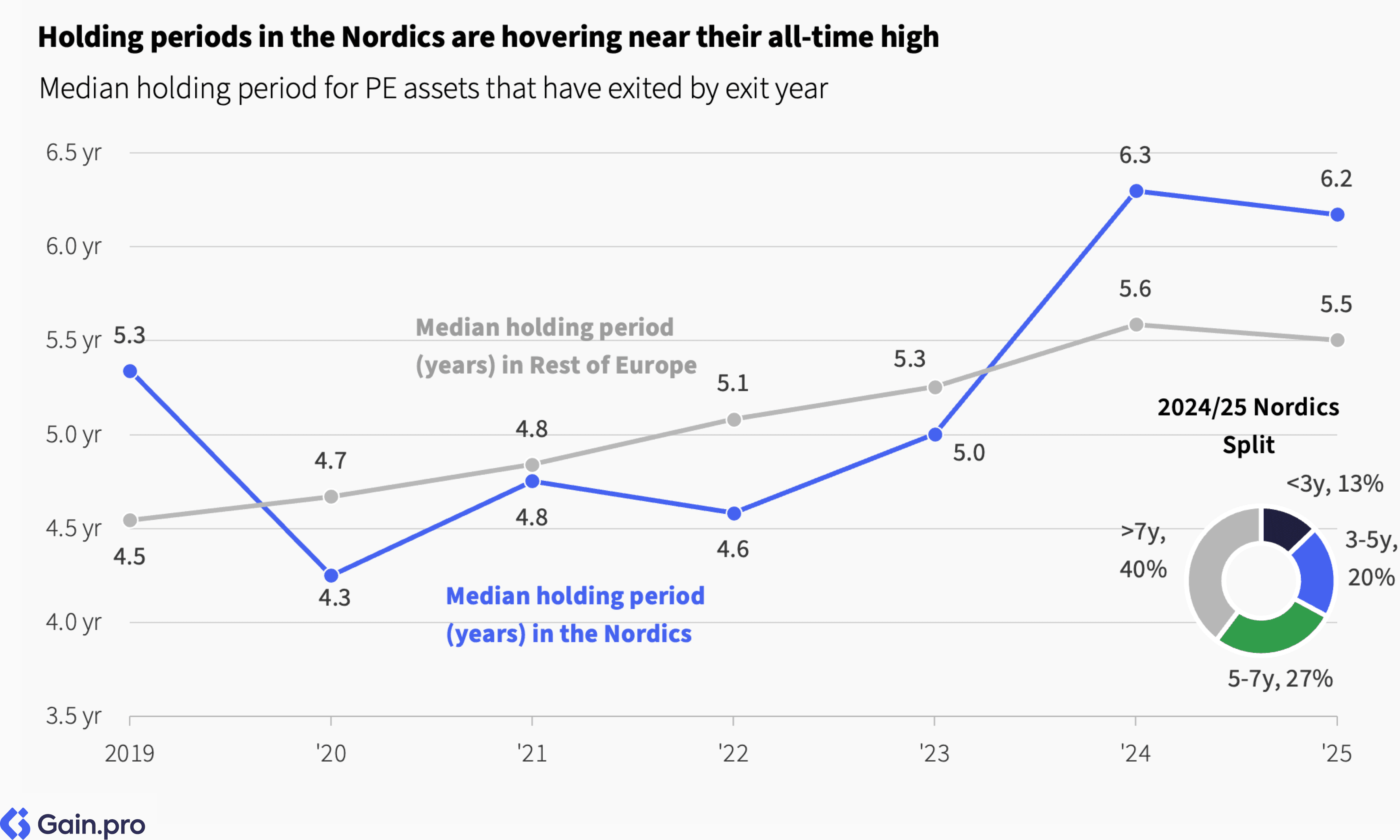
Exits — Exit activity is expected to be up marginally in 2025. Holding periods are up (6.2 years YTD, up from 4.3 years in 2020), with 40% of exited assets held in portfolio for more than 7 years.
Buy-and-build — The Nordics are the most add-on-heavy region in Europe, with 54% of portfolio companies there pursuing a buy-and-build strategy. 82% of all PE deals in 2025 were add-ons, with services being the acquisitive sector (47% of deals), followed by TMT (18%) and Industrials (15%).
E-mail any questions about the data or the report to insights@gain.pro.






Chapter 01: Largest Investors
Largest Global Investors Investing in the Nordics
EQT has emerged as the largest investor in the Nordics, managing an estimated enterprise value (EV) of €28.3bn, followed by Hg Capital (€19.8bn) and CVC Capital Partners (€16.1bn).
Other investors in the top 10 include KKR (€10.4bn), Triton (€8.8bn), Macquarie (€7.9bn), Nordic Capital (€7.6bn), Altor Equity Partners (€6.8bn), Norvestor (€5.4bn) and Goldman Sachs Asset Management (€5.3bn).
Collectively, the largest 50 investors in the Nordics manage an estimated €211bn in enterprise value in the Nordics, with the top 10 alone accounting for around €116bn (~55% of the total), reflecting a higher level of concentration than the French and DACH regions.
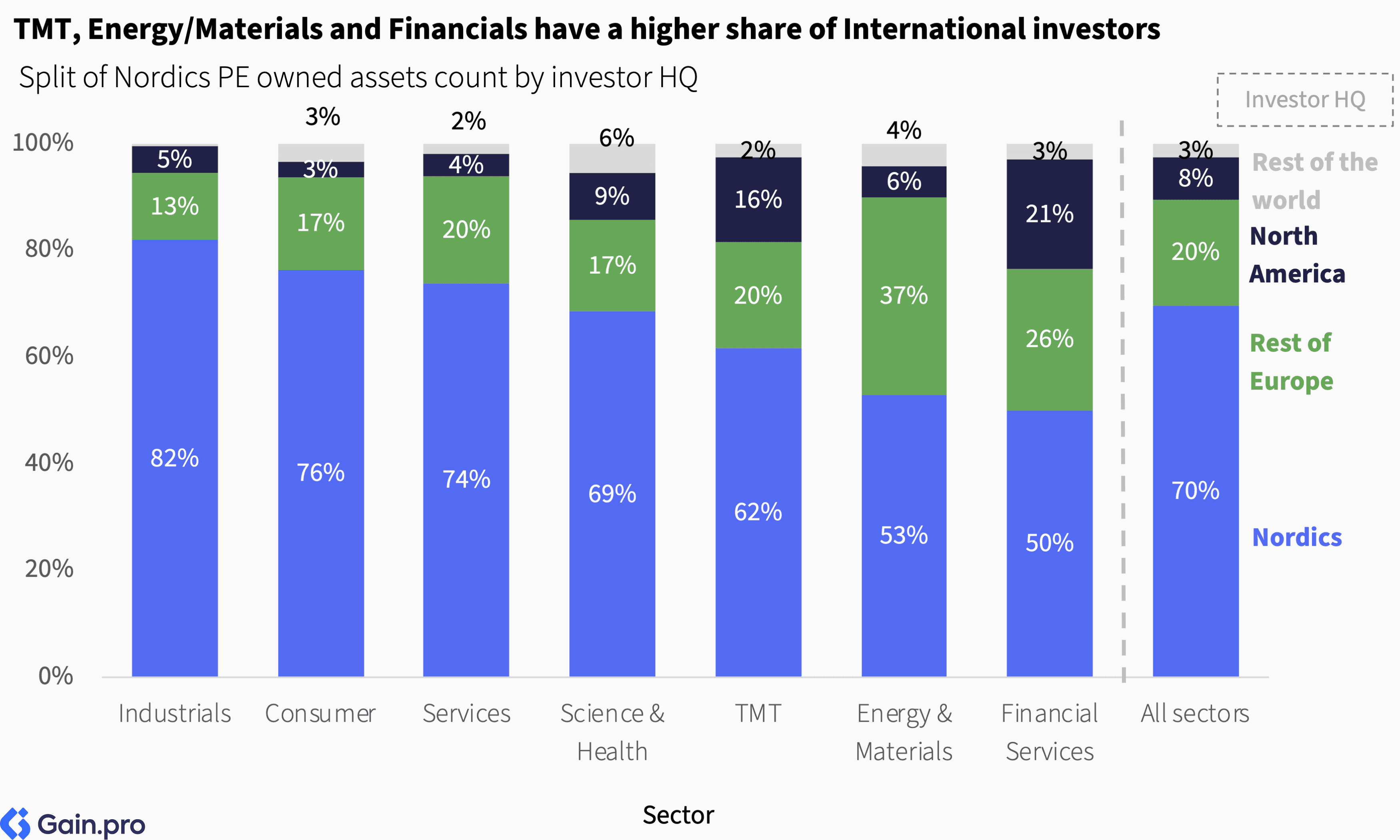
The Nordic PE market is one of the most domestically focused in Europe. 47% of PE-owned EV assets in the Nordics are owned by domestic investors. While activity from North American sponsors is increasing in the region, it still remains limited and is the lowest of all European regions (18%).
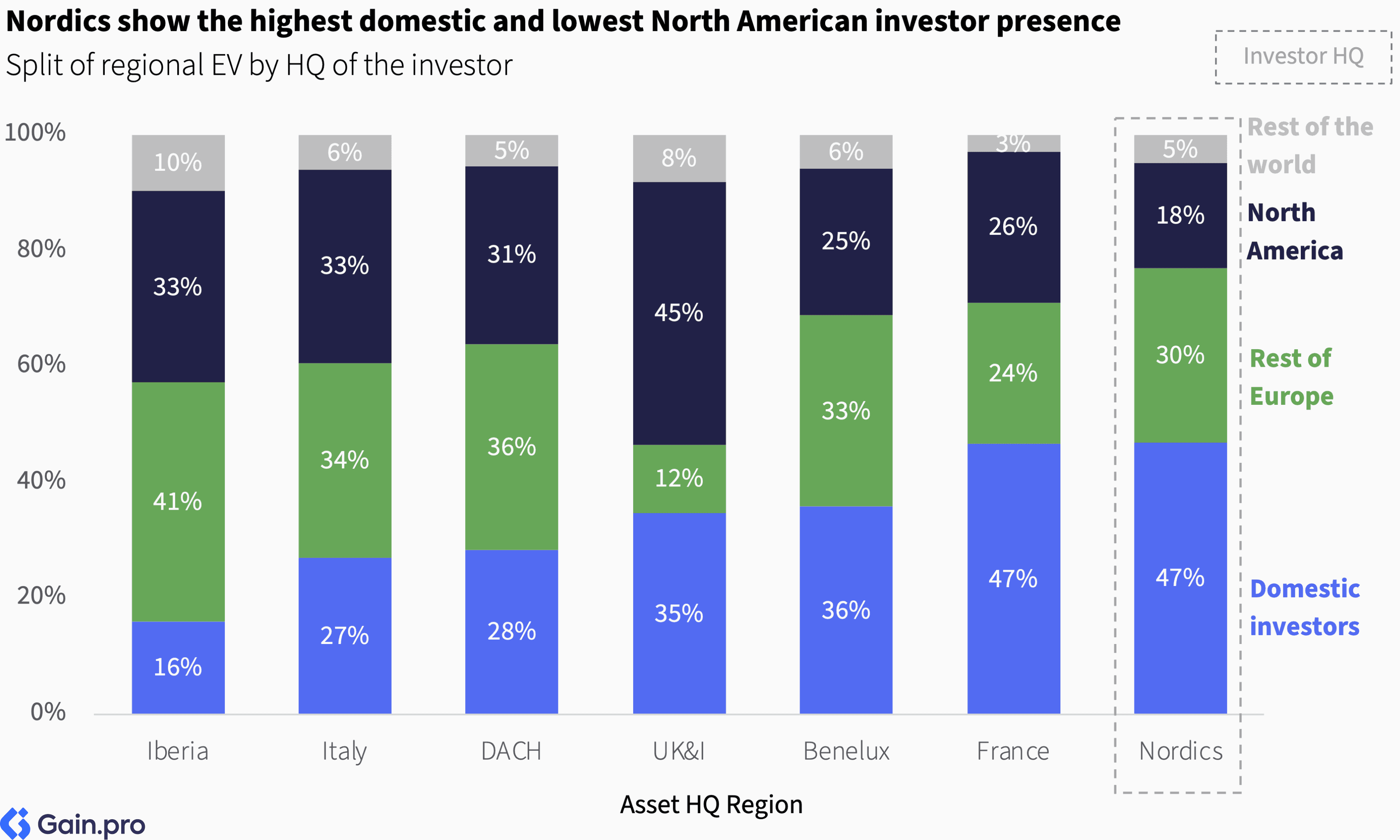
Activity from international sponsors tends to focus more on larger firms with EBITDA over €50m, where the greater scale justifies cross-border investment. At the country level, Norway and Finland see higher participation from international investors, while Sweden and Denmark have a higher concentration of domestic sponsors.
By sector, international investors dominate deal activity in TMT, Energy & Materials and Financials. Domestic sponsors, in contrast, remain more active in Industrials and Consumer, where they are more familiar with local laws and the regulatory landscape.
Largest Nordics HQ’d Investors Investing in Europe
EQT has emerged as the leading Nordics-headquartered investor, managing an estimated €92.9bn in enterprise value (EV) across Europe, followed by Nordic Capital (€19.7bn) and A.P. Møller (€10.1bn).
Other investors in the top 10 include Altor Equity Partners (€8.8bn), FSN Capital (€5.5bn), Norvestor (€5.5bn), Axcel (€5.2bn), Novo Holdings (€4.1bn), Adelis Equity Partners (€3.0bn) and Verdane (€2.9bn). Collectively, the largest 50 Nordics-headquartered investors manage an estimated €193bn in enterprise value across Europe, with the top 10 accounting for roughly €158bn (82%).
On average, the largest Nordics HQ’d investors have a portfolio EBITDA of €31m and manage 17 companies each. Over the last 6 years, they have bought 1.7x as many assets as they have sold. Specifically, there have been 798 new investments and 481 exits.
Except for EQT and Novo Holdings, all other Nordic-headquartered investors maintain a predominantly PE-focused investment strategy. EQT, the largest of all, has evolved into a diversified global investment platform with significant allocations to infrastructure, real assets, growth equity and venture capital alongside traditional private equity. Novo Holdings similarly invests significantly in venture capital alongside its PE operations.
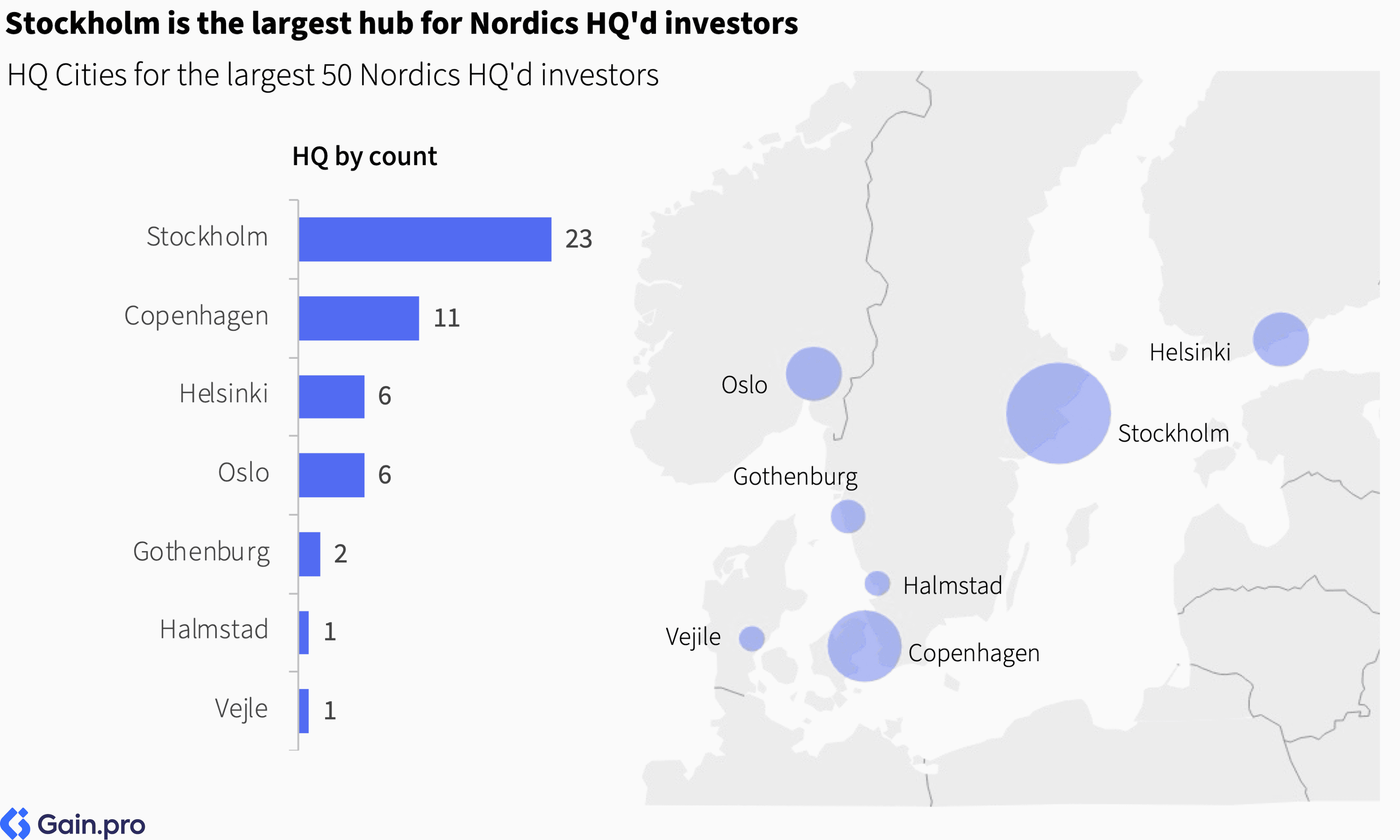
Of the 50 largest Nordic investors, 23 are headquartered in Stockholm, 11 in Copenhagen, 6 in Oslo and 6 in Helsinki. Stockholm is home to EQT, Nordic Capital, Altor, Adelis and Nalka. Copenhagen is home to leading investors including A.P. Møller, Axcel, Polaris and Novo Holdings, while Oslo hosts firms such as FSN Capital, Norvestor and Verdane. Lastly, Helsinki houses prominent domestic players like CapMan, Intera Partners and Vaaka Partners.
Portfolio Insights
In this section,we explore the investment portfolios of the largest 30 Nordics HQ’d investors, analyzing key metrics such as EBITDA range, growth rates, buy-and-build activity, holding periods and the sector/regional makeup of their European investments.
By Region & Sector
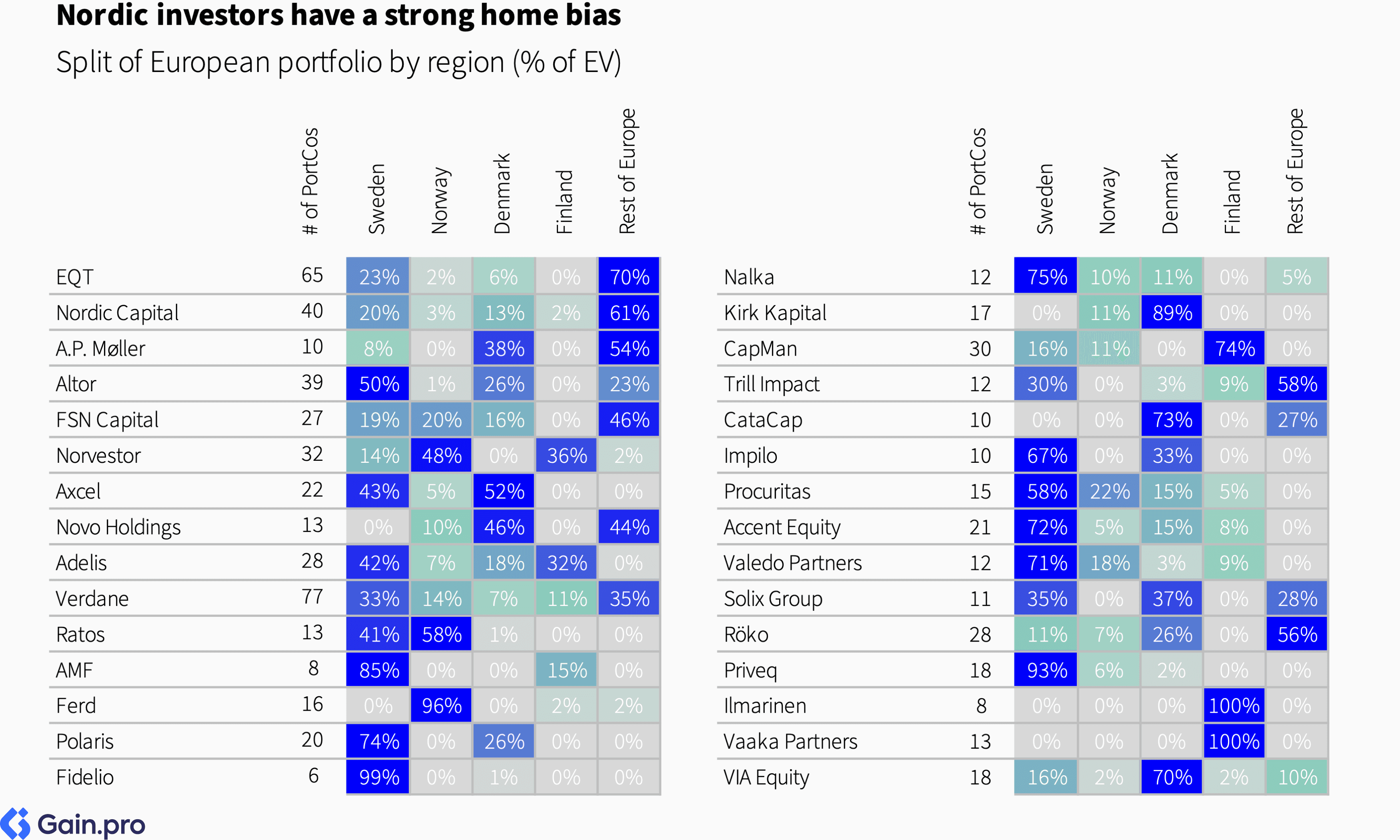
Nordic-headquartered investors maintain a strong home bias, with most sponsors concentrating over 90% of their portfolio EV domestically. Investors with particularly high single-country allocations include Fidelio (holding 99% of its EV in Sweden), AMF (85% Sweden), Priveq (93% Sweden), Ilmarinen and Vaaka Partners (100% Finland), Kirk Kapital (89% Denmark), CataCap (73% Denmark) and Ferd (96% Norway).
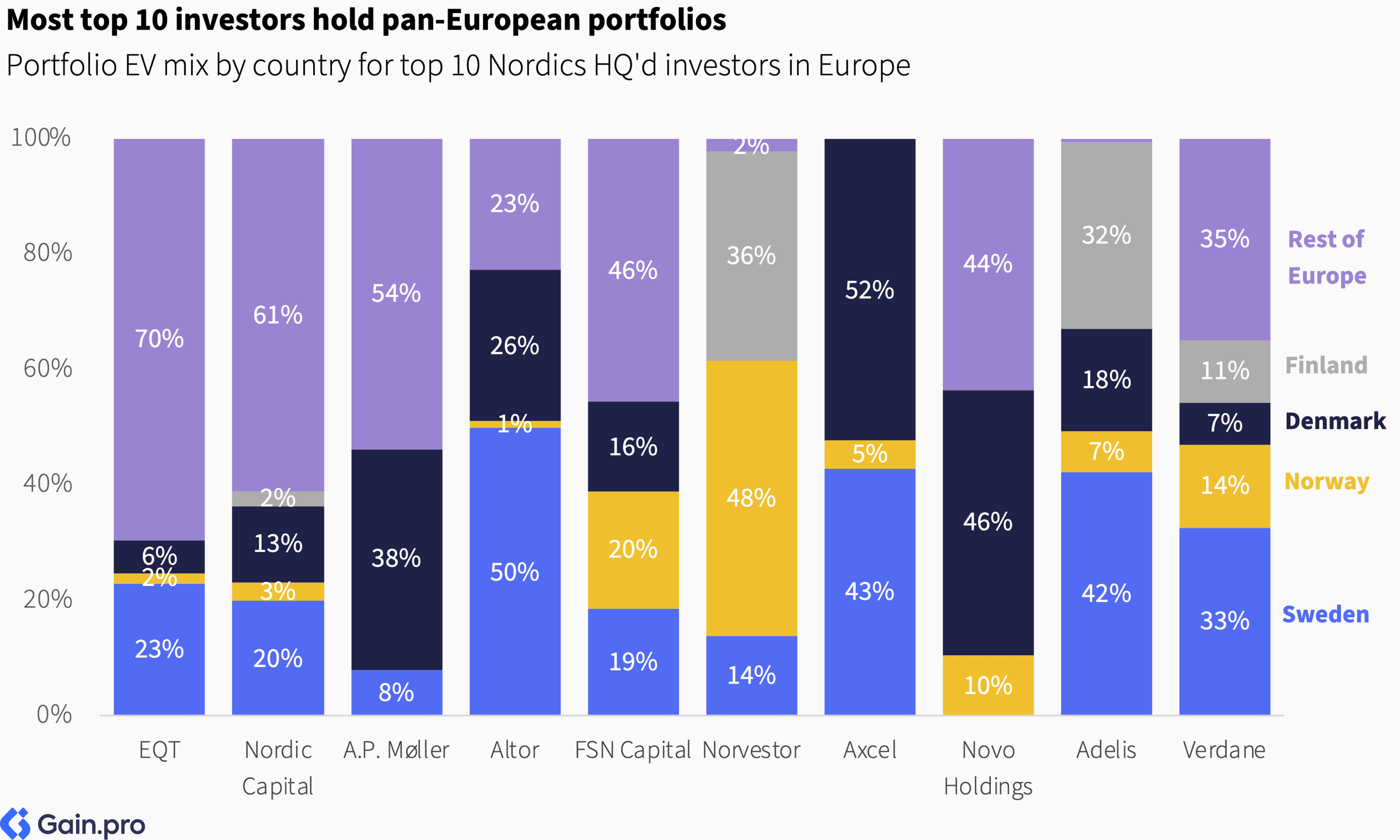
The top 10 Nordics HQ’d investors have more diverse pan-European portfolios than other investors in the ranking. Larger investors such as EQT and Nordic Capital have over 60–70% of portfolio EV in assets headquartered outside the Nordics.
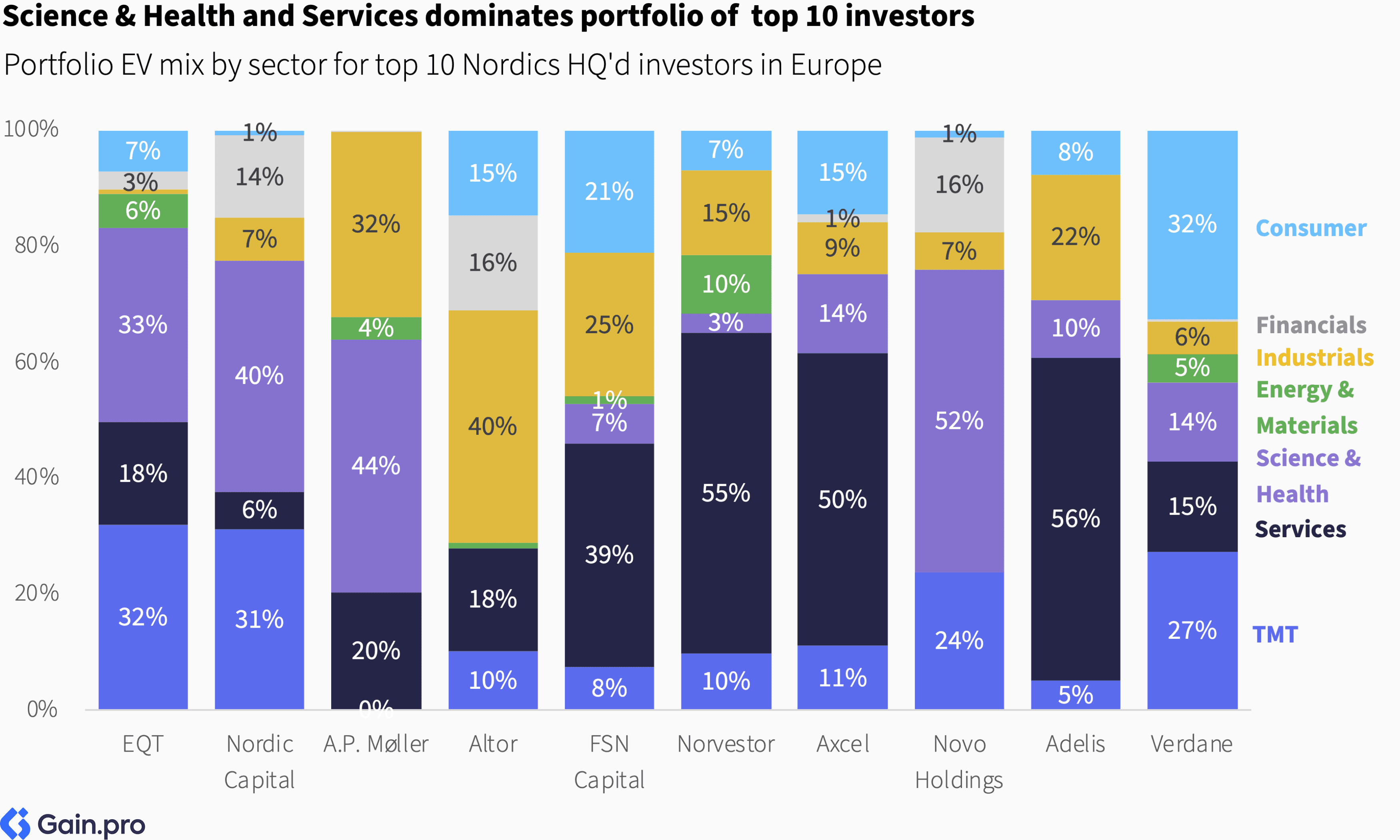
Services is the most dominant sector among the top 10 Nordic investors, followed by Science & Health. Nordic Capital, A.P. Møller, EQT and Novo Holdings each have over 30% exposure to Science & Health, making it the core focus of their portfolios. FSN Capital, Norvestor, Adelis and Axcel are more concentrated in Services, with exposures ranging from 40% to 55%. Altor stands out for its focus on Industrials (40%), while Verdane is the most diversified investor, maintaining a balanced mix across sectors.
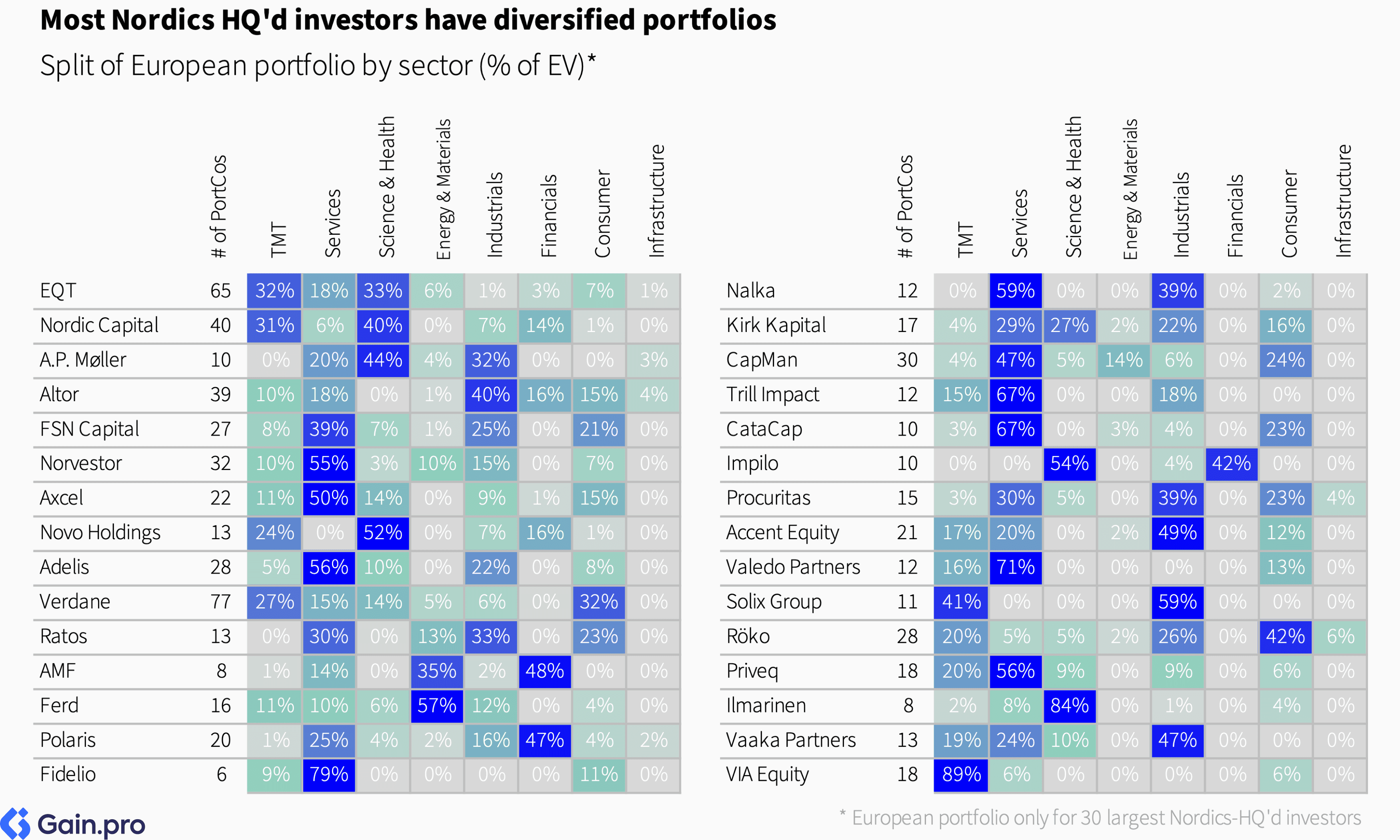
Outside the top 10, several investors demonstrate strong sector specialization, with over 50% allocation to a single sector: Ferd in Energy & Materials (57%), Ilmarinen and Impilo in Science & Health (84% and 54% respectively), VIA Equity in TMT (89%) and Solix Group in Industrials (59%). Services attracts the most specialized investors, including Fidelio (79%), Valedo (71%), Trill Impact (67%), CataCap (67%), Nalka (59%), Adelis (56%) and Priveq (56%).
By Size & Deal Type
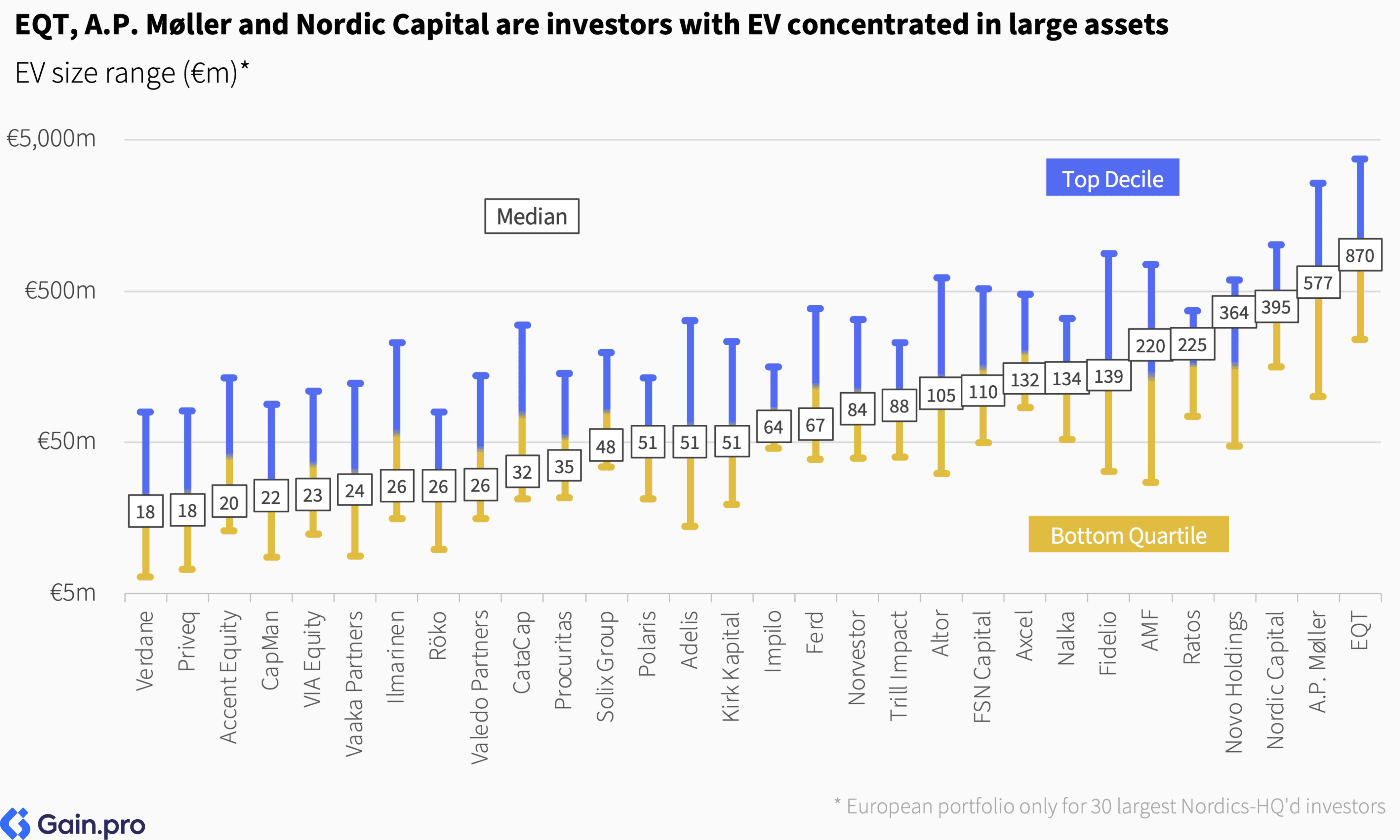
EQT, A.P. Møller and Nordic Capital focus on larger assets. Backed by sizable funds and global mandates, they deploy significant capital both within the Nordics and across borders. On the other side, there is a long list of Nordic investors targeting smaller and mid-market businesses, including Verdane, Priveq, Accent Equity, CapMan, VIA Equity, Vaaka Partners and many more.
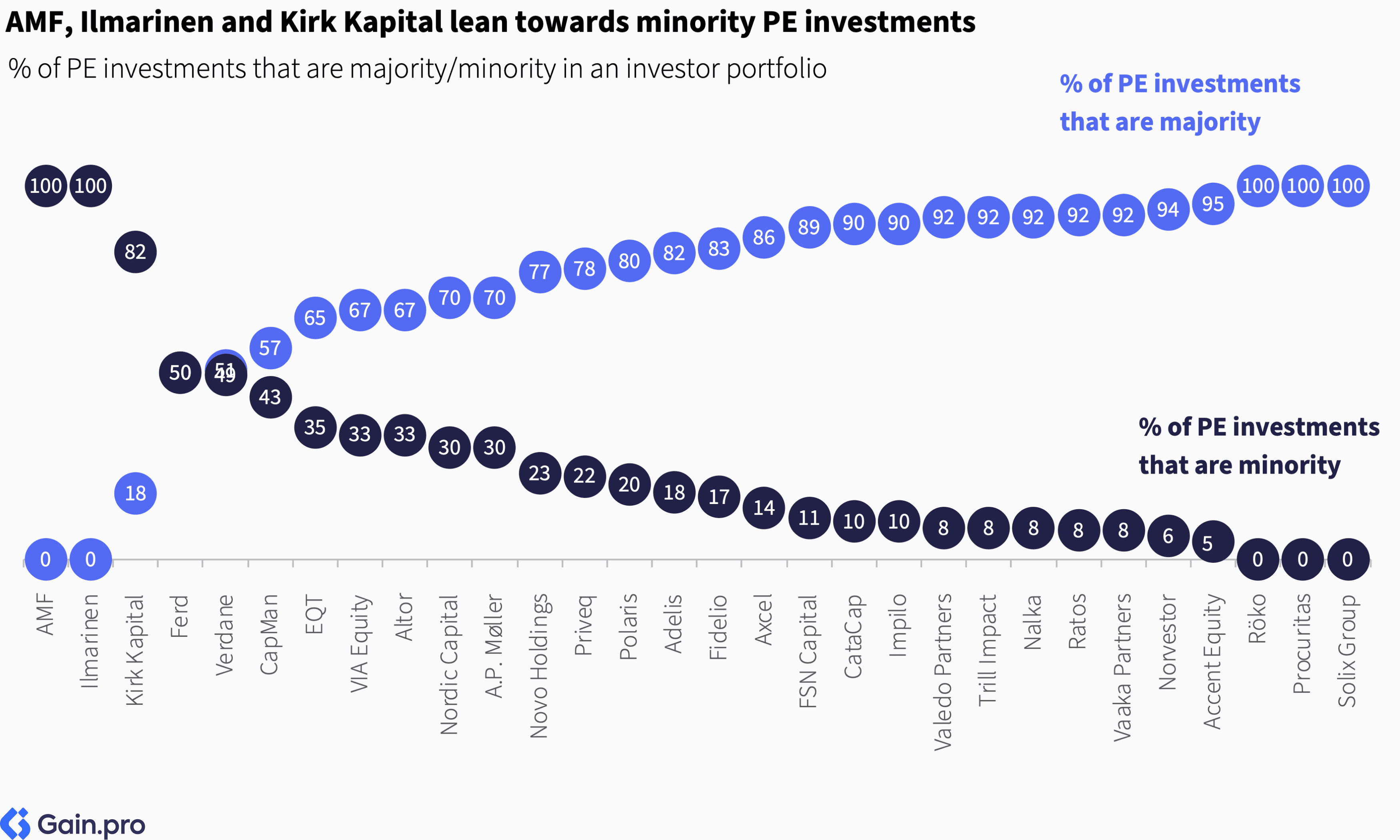
Most Nordic PE investors typically acquire majority stakes in their portfolio companies. Only AMF, Ilmarinen and Kirk Kapital hold a higher share of minority positions. AMF’s 38% exposure to Energy involves large, capital-intensive projects that often rely on co-investment. Ilmarinen, as a pension fund, acts primarily as a passive investor alongside a lead sponsor. Kirk Kapital, finally, has a family office structure that enables it to take a flexible investment approach, favoring strategic minority partnerships.
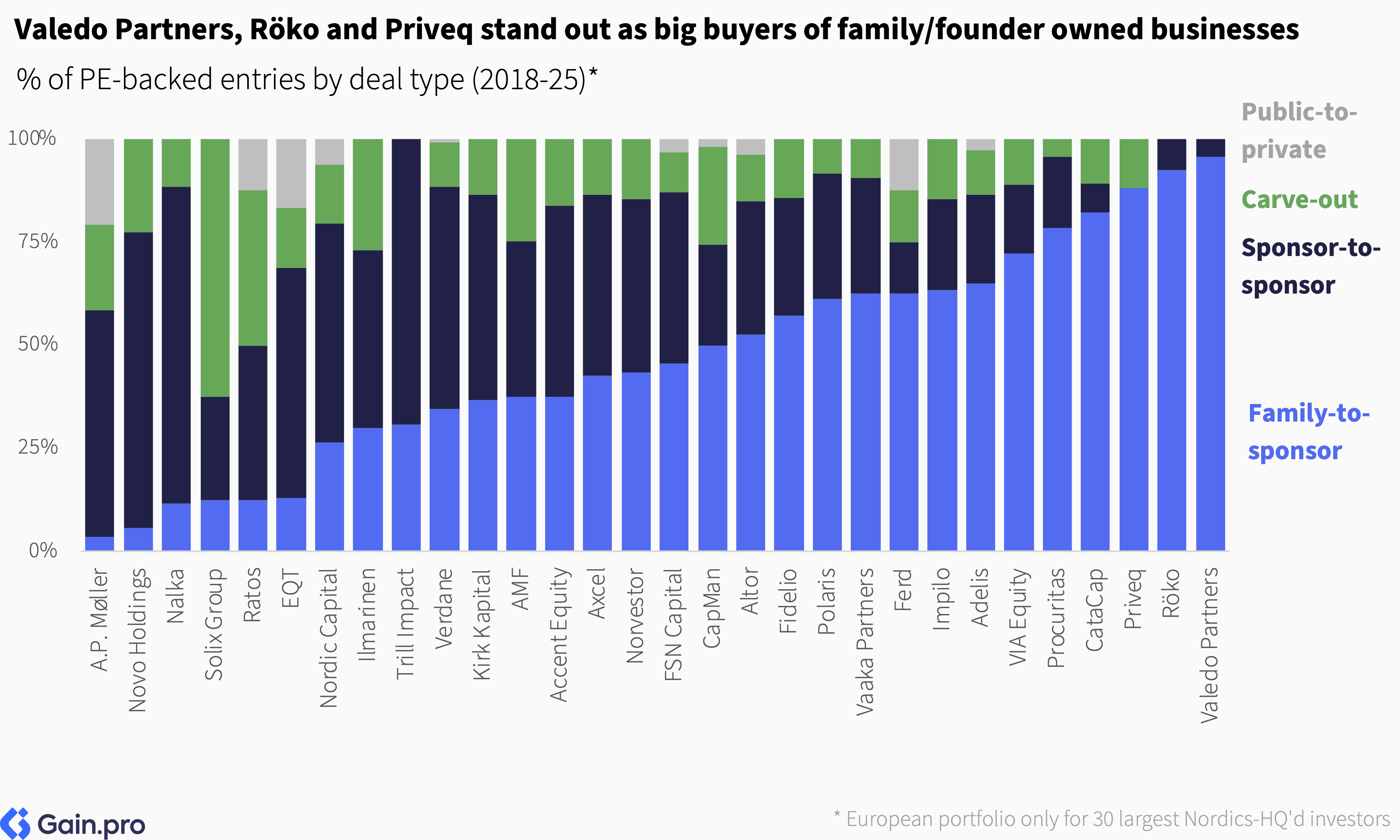
By deal type, Valedo Partners, Röko and Priveq emerge as leading acquirers of family- and founder-owned businesses. Solix Group, Ratos and Ilmarinen, on the other hand, stand out for their higher share of carveouts. A.P. Møller, Novo Holdings, Nalka and Trill Impact are more active in sponsor-to-sponsor transactions given their focus on larger, more established assets.
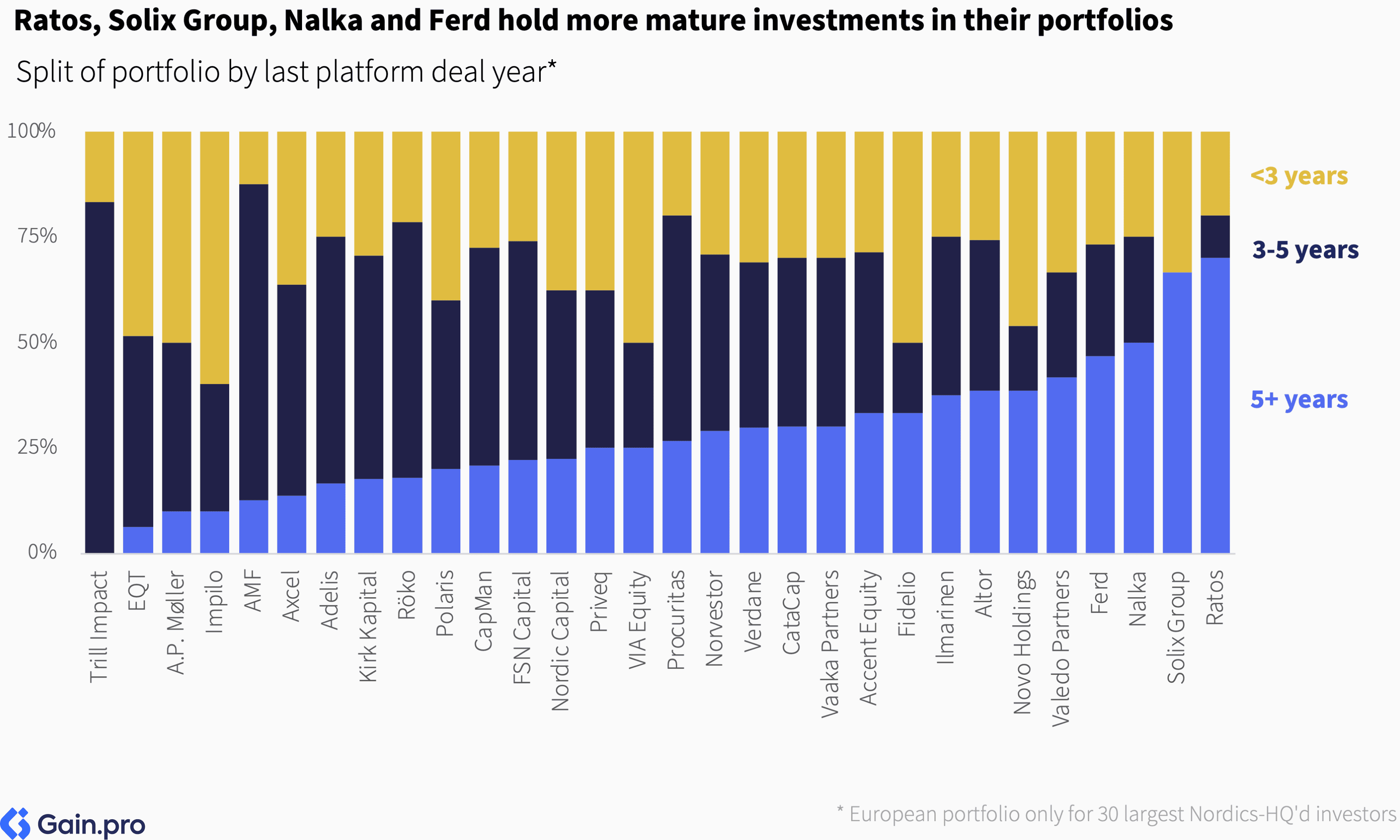
Ratos, Solix Group and Nalka hold more mature portfolios, with more than half of their portfolio linked to platform deals closed over five years ago. In contrast, investors like Trill Impact, EQT and A.P. Møller have portfolios more heavily weighted toward recent acquisitions.
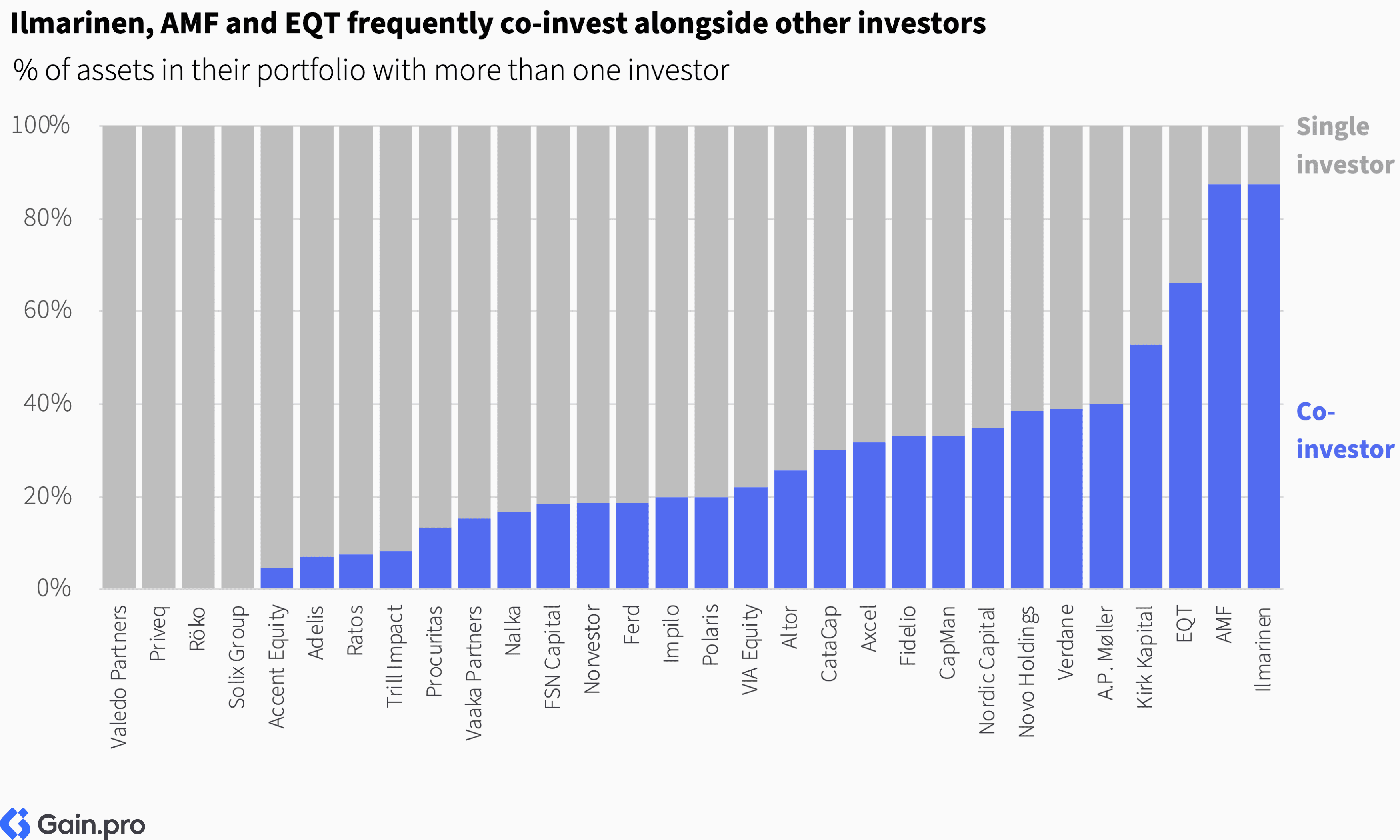
Ilmarinen, AMF and EQT frequently co-invest alongside other investors, with over 60% of their portfolio investments made in partnership. This reflects AMF and Ilmarinen's roles as institutional LPs providing capital alongside GP-led deals rather than leading transactions, while EQT's focus on larger deal sizes requires syndication. In contrast, Valedo Partners, Priveq and Röko typically pursue solo ownership, reflecting their mid to small-cap focus and preference for full control.
Growth and Margin
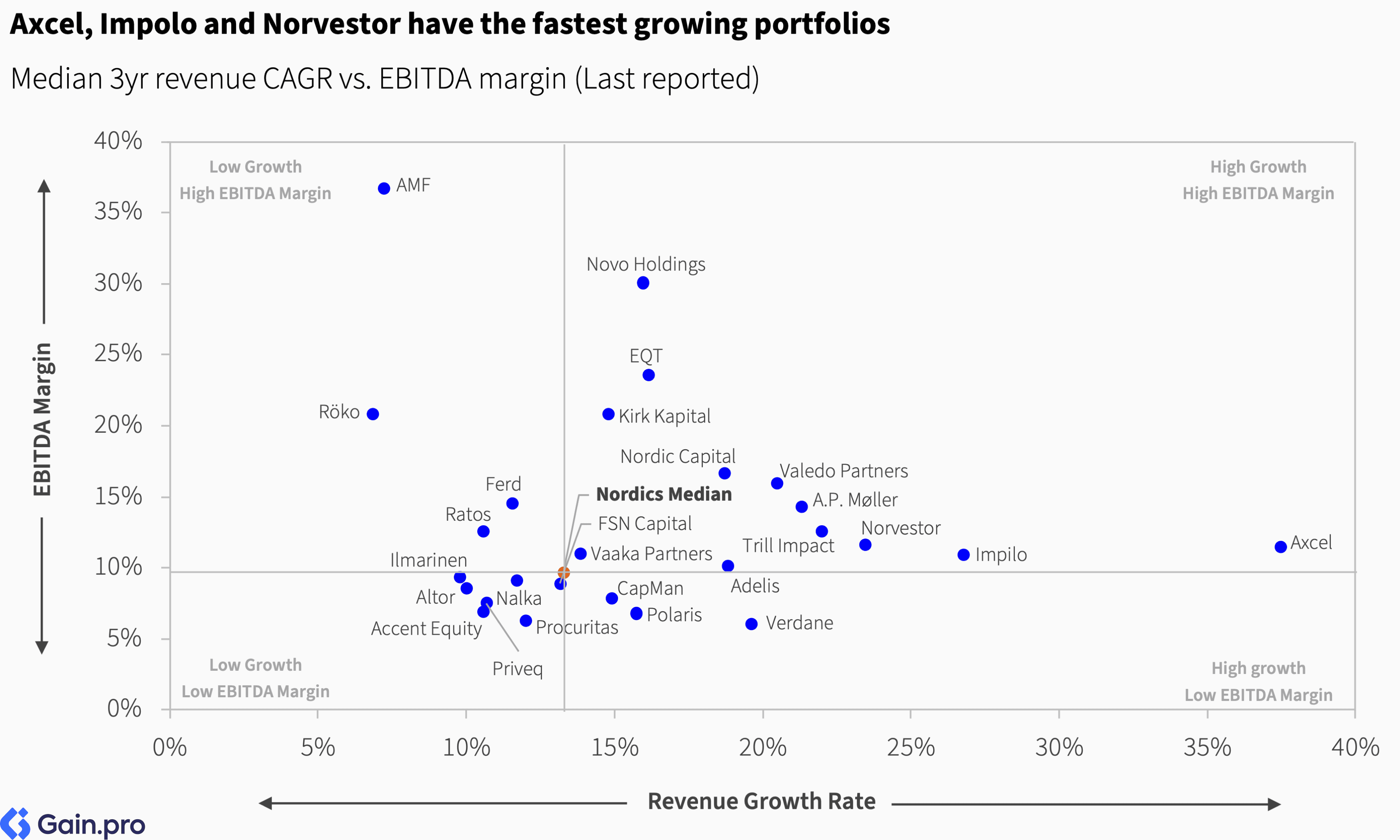
Axcel, Impilo, Norvestor and Trill Impact are among investors with the fastest growing portfolios. While part of the growth is organic, it's heavily supported by buy-and-build initiatives. Novo Holdings and EQT are also notable for their focus on high margins in addition to growth.
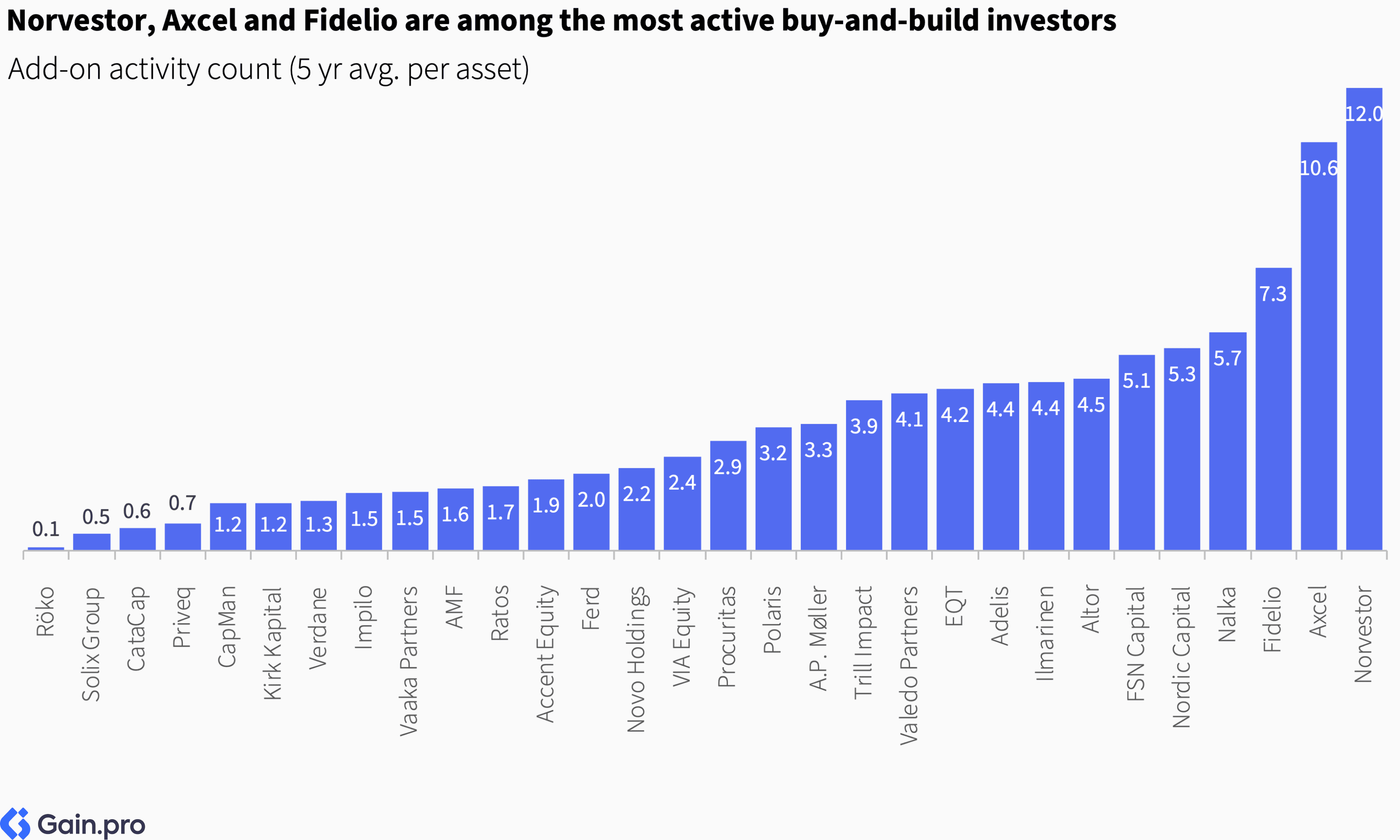
Norvestor, Axcel and Fidelio are among the most active buy-and-build investors. Buy-and-build has become a key value-creation strategy among Nordic investors, where PE-backed assets complete more add-ons per platform than anywhere else in Europe.
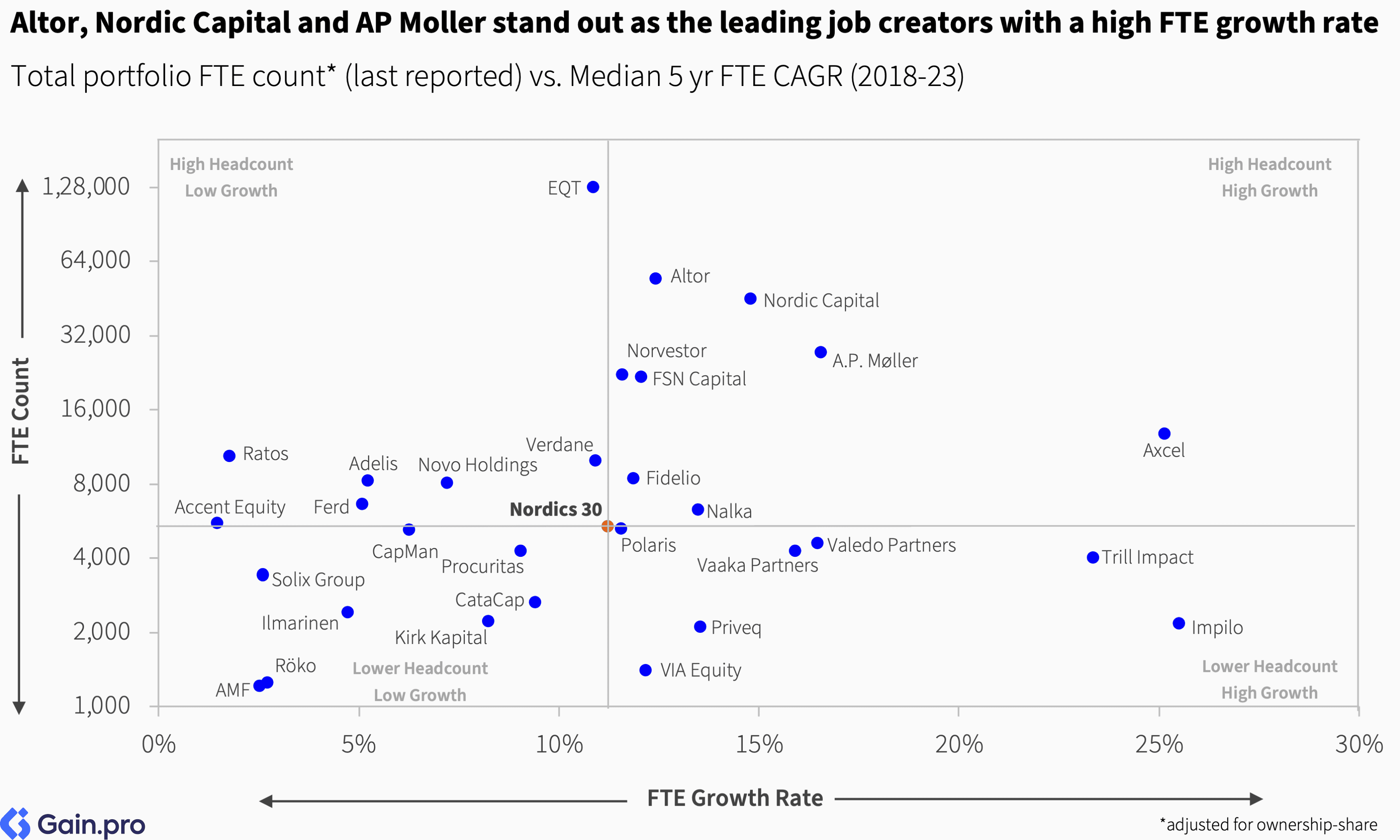
On an absolute basis, EQT, Altor and Nordic Capital stand out as the leading employers across Europe. Axcel, Impilo and Trill Impact stand out for their high FTE growth rate.
Chapter 02: Entries
Overall PE Entries
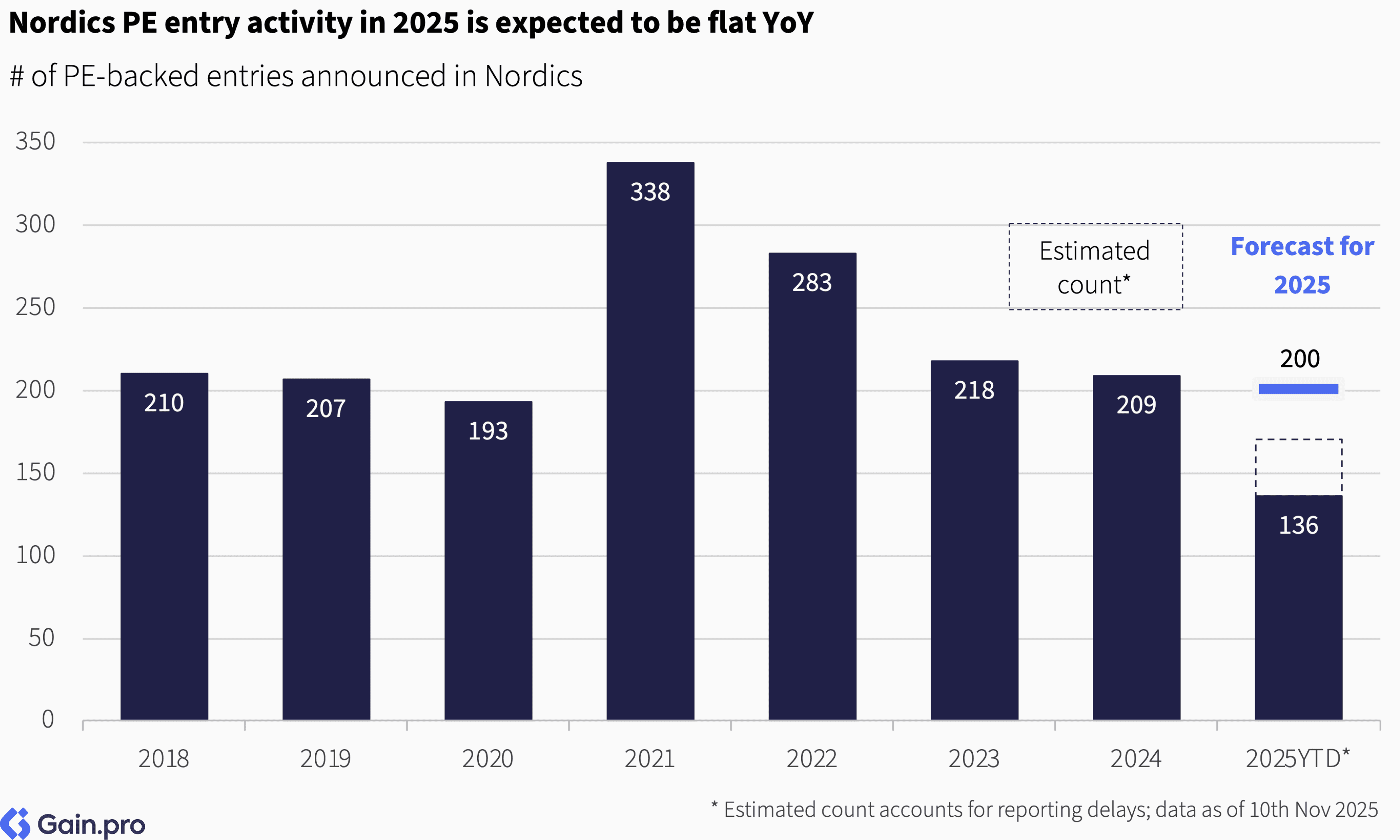
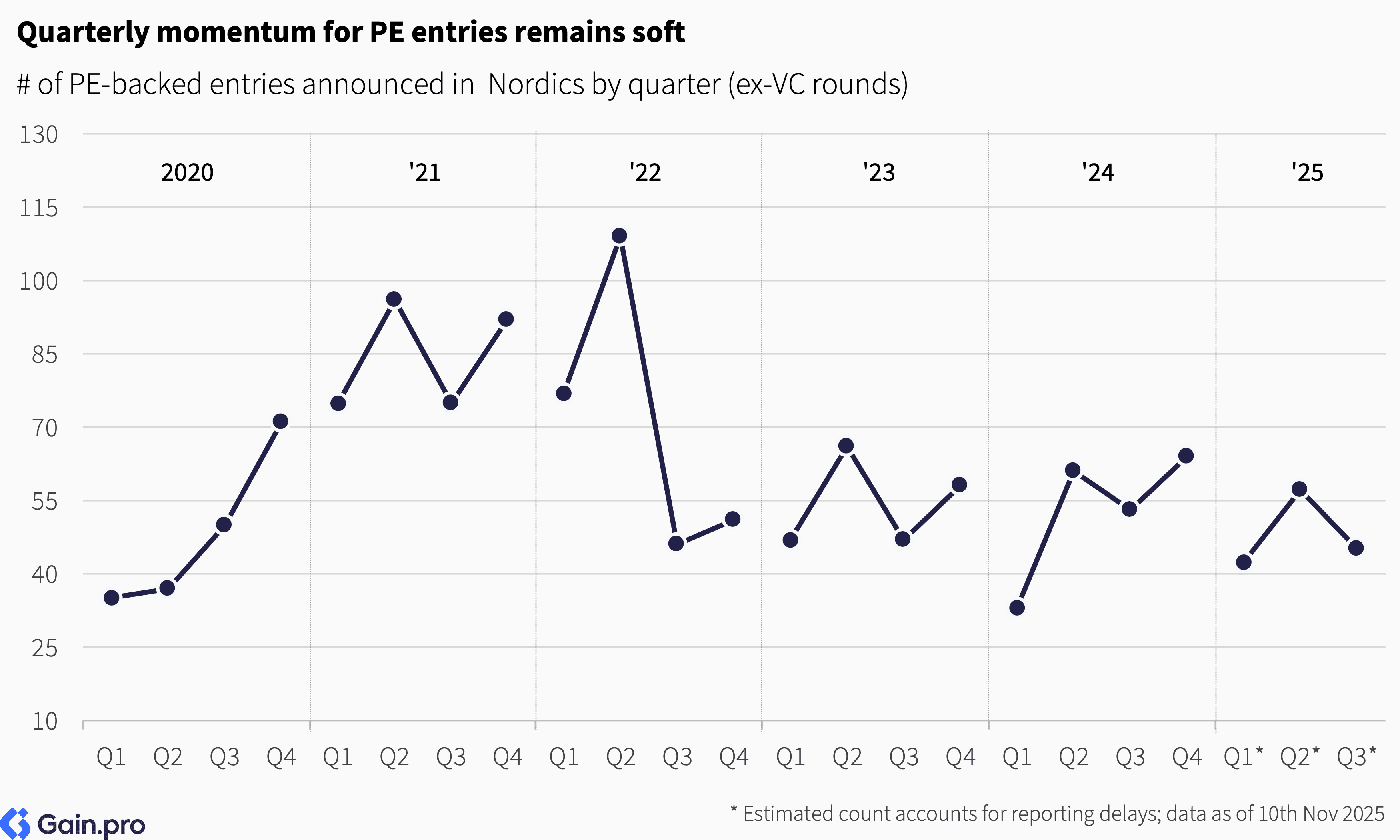
We expect Nordic PE entry activity in 2025 to be flat year-on-year, continuing the stabilization trend seen in 2024. While credit spreads have eased, there is still a degree of uncertainty in the market holding back investors.
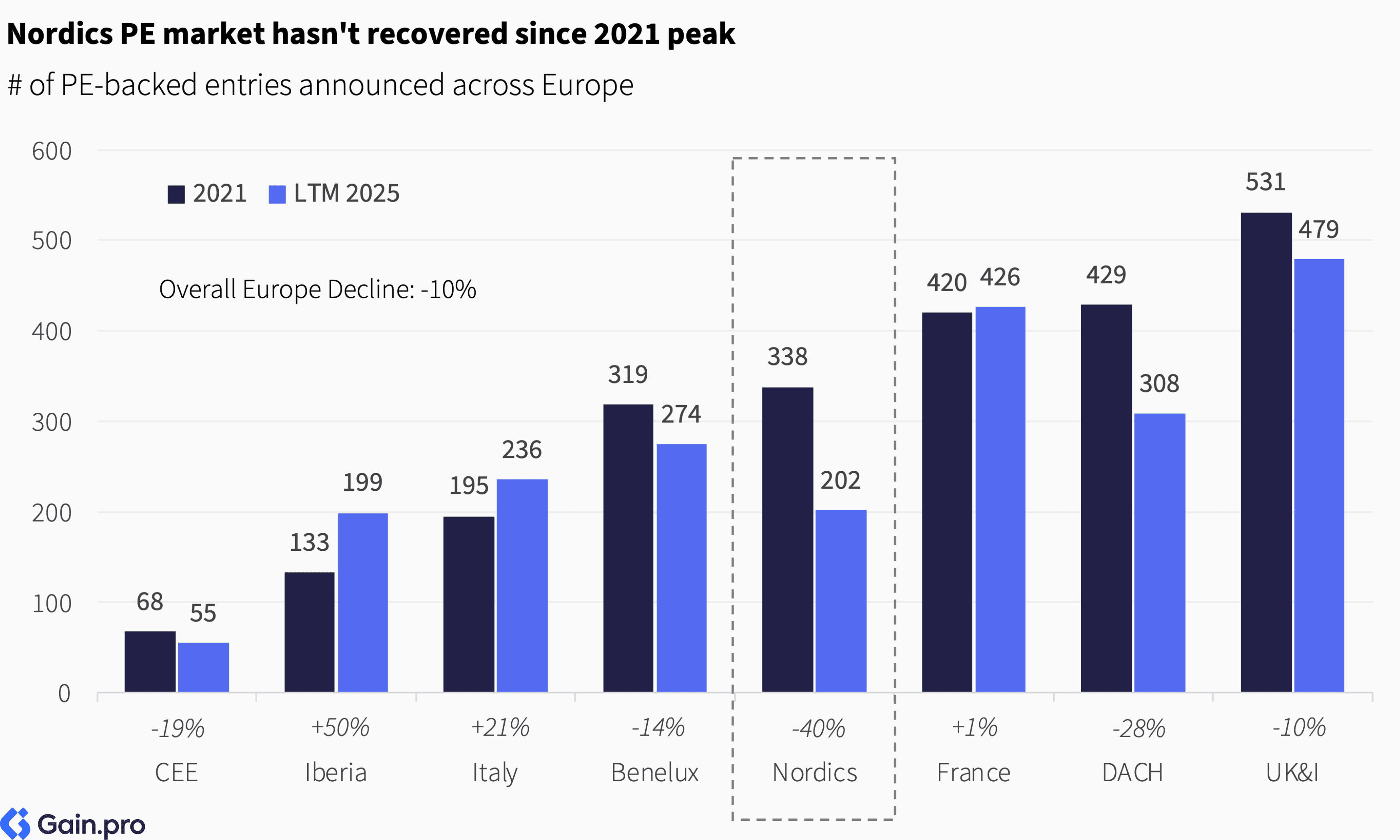
Compared to the rest of Europe, PE entry activity in the Nordics remains subdued. It has declined 40% from 2021 levels — a far steeper drop than the 10% decline seen across Europe.
Deal activity rose from Q1 to Q2 but nudged lower in Q3. Q4 typically sees a pickup in momentum as sponsors accelerate deployments toward year-end, suggesting activity could rebound in the final quarter if market conditions remain stable.
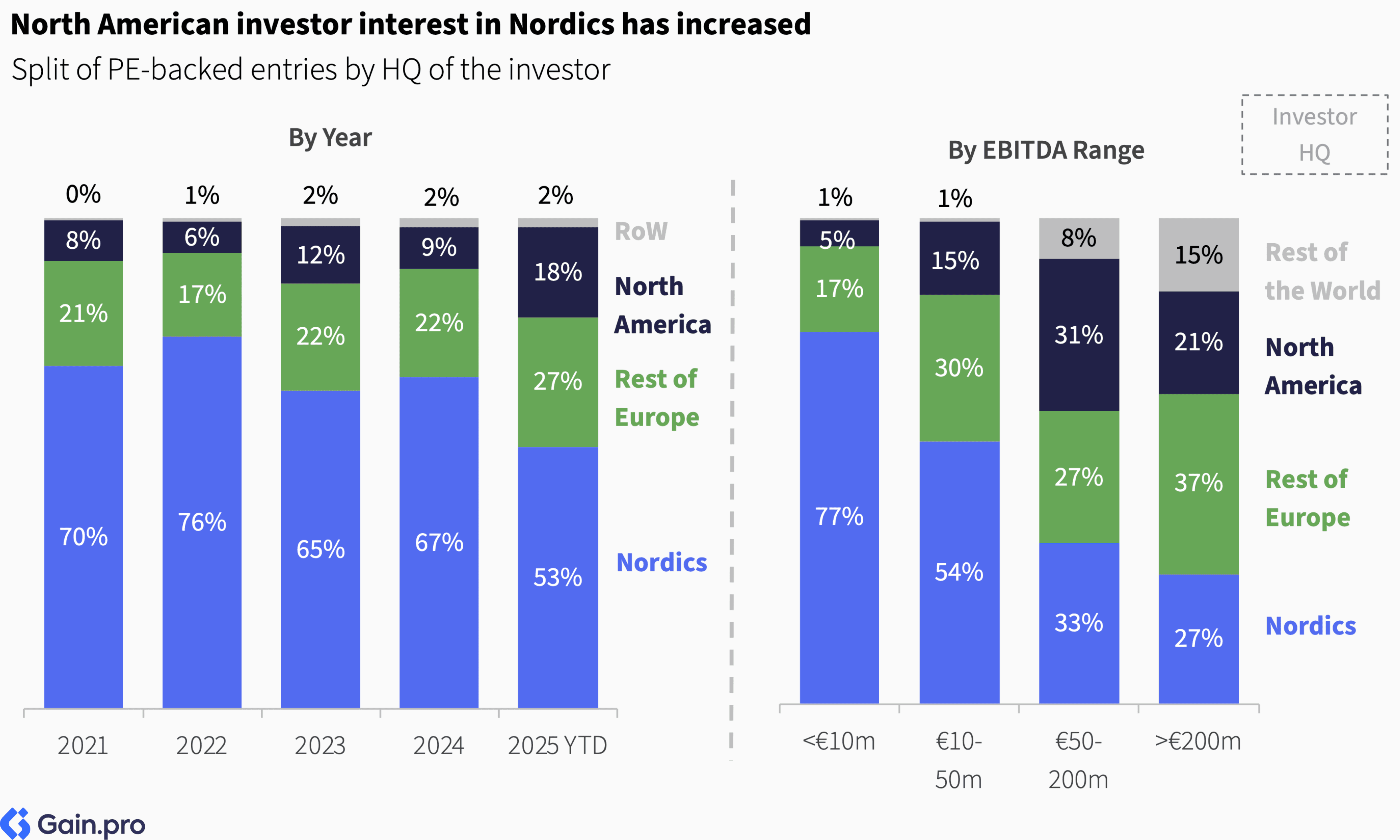
Cross-border deal activity from North American investors has risen by 10pp over the last four years. North American investors predominantly focus on acquiring high-growth, larger firms with EBITDA above €50m, where the scale justifies cross-border complexity. These deals often face less domestic competition given the significant scale and resources required to execute them successfully.
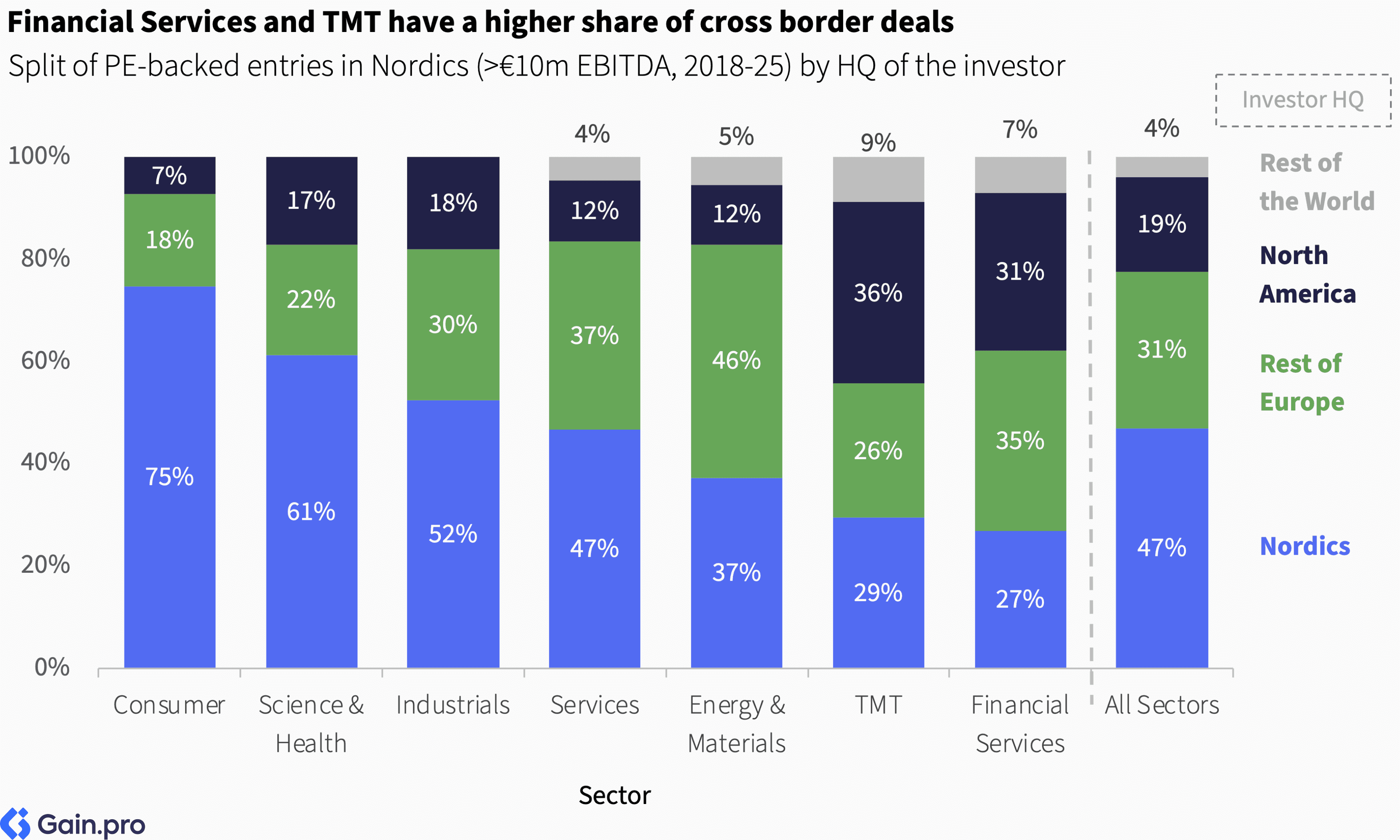
North American investors account for a larger share of entries in TMT (36%) and Financial Services (31%), given their experience and expertise in these sectors. In contrast, Nordic investors dominate Consumer and Science & Health investments, benefiting from deep local market knowledge, established relationships and understanding of regional business models.
Entries by Sector
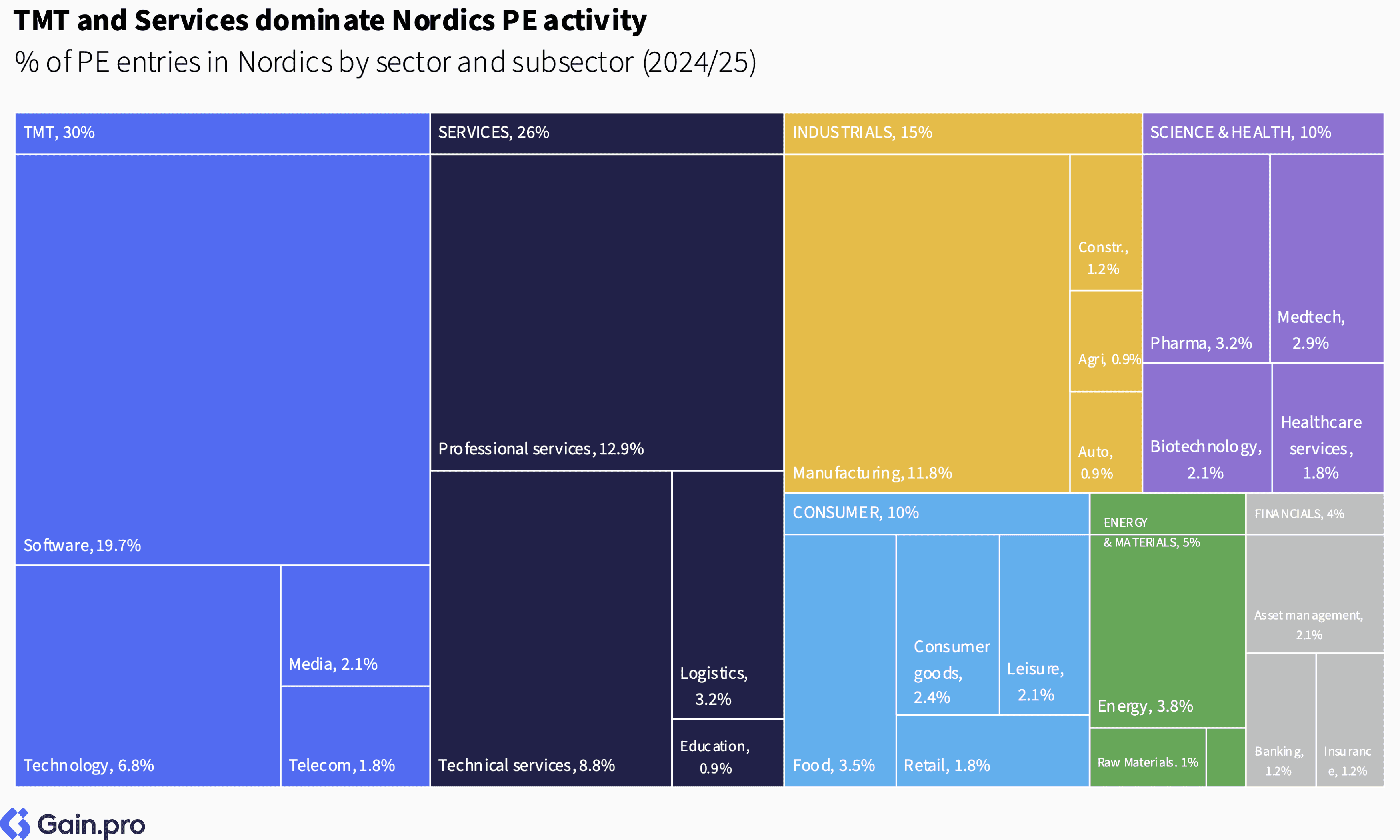
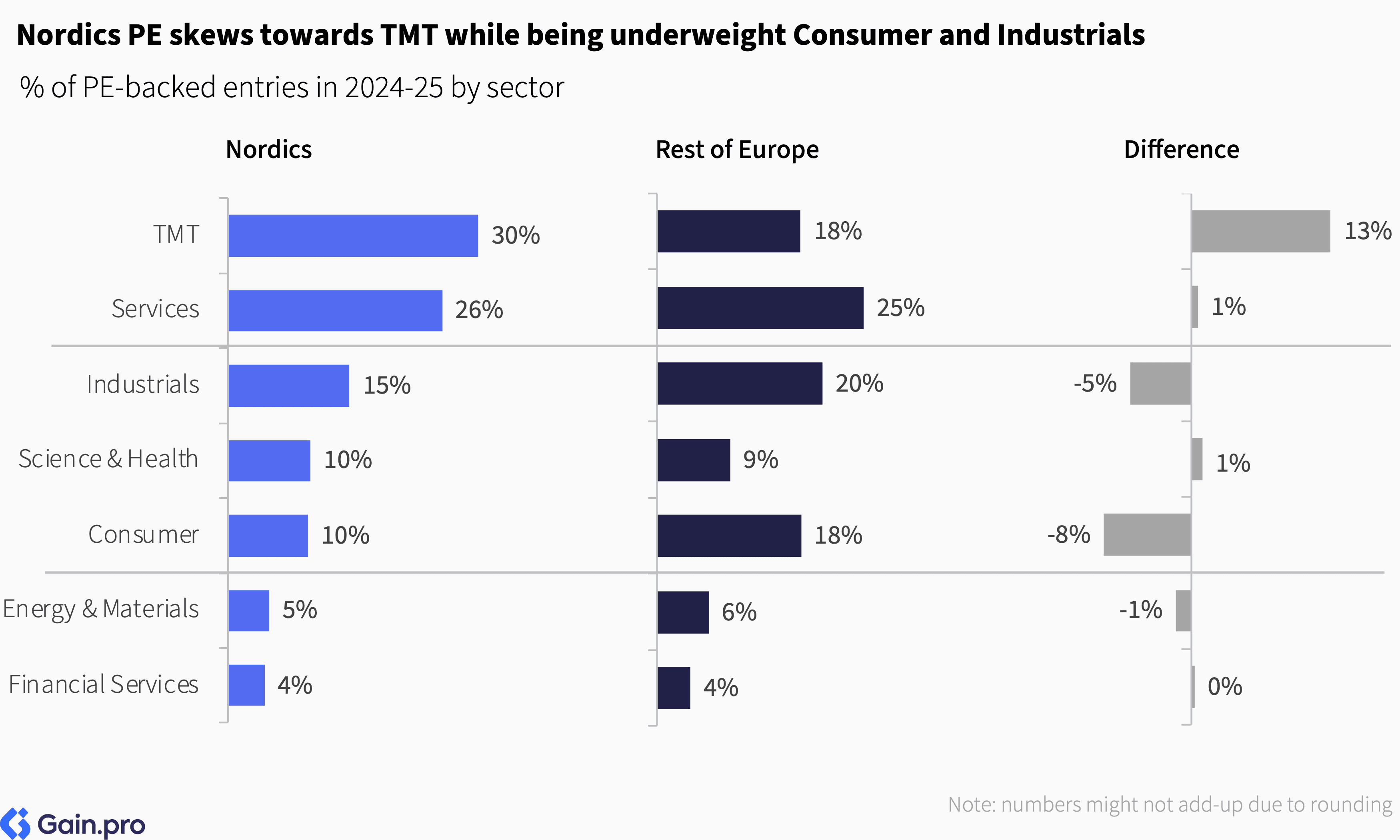
By sector, TMT (30%) and Services (26%) together accounted for more than half of all new PE entries in 2024/25. At the subsector level, Software (20%), Professional Services (13%) and Manufacturing (12%) were the most active areas for investment. Broadly speaking, similar to other regions, the Nordics have seen the share of Services and TMT increase while that of Consumer and Industrials decline.
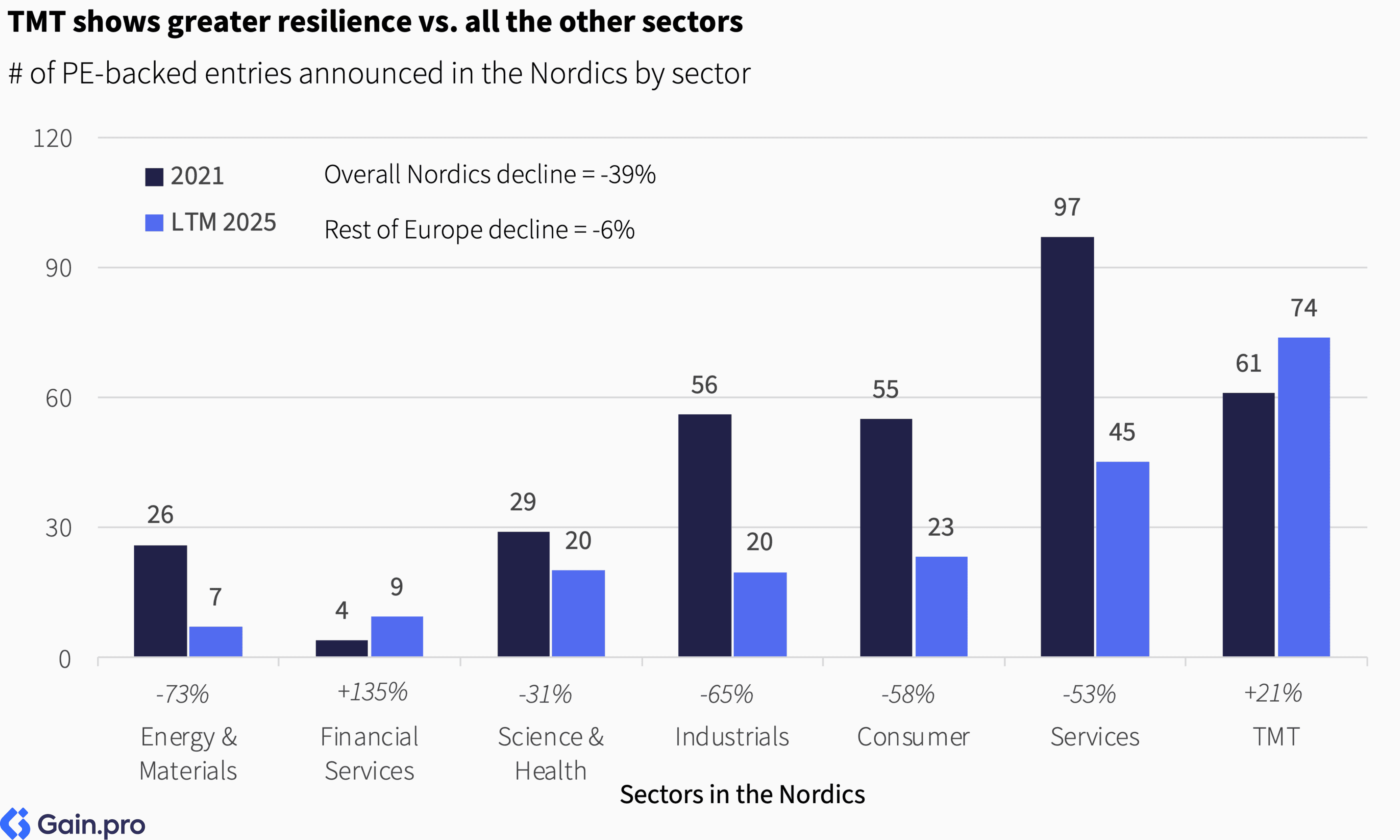
Relative to the 2021 peak, deal activity has held up better in TMT (+21%). In contrast, Energy & Materials (-73%), Industrials (-65%) and Consumer (-58%) have lagged behind. There has been limited appetite to invest in slower-growing sectors with high capital intensity.
Compared to the rest of Europe, the Nordic PE market is overweight TMT (+13pp), Science & Health (+1pp) and Services (+1pp). TMT strength stems from a robust software and tech ecosystem, while Services and Science & Health benefit from fragmented markets and strong life sciences clusters. In contrast, the market is underweight Consumer (-8pp) and Industrials (-5pp), reflecting smaller domestic markets, limited retail scale and the relocation of heavy manufacturing to lower-cost regions.
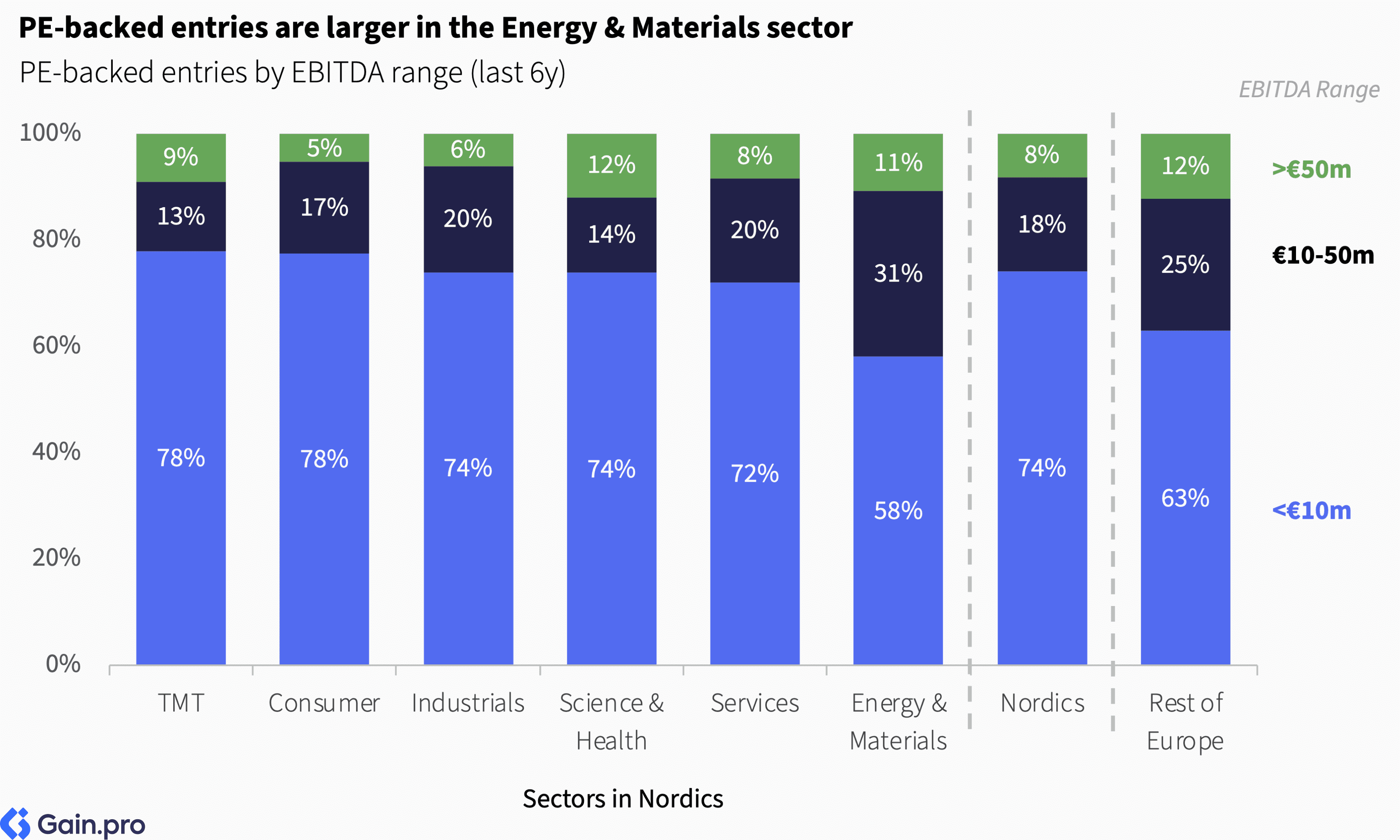
PE-backed entries are larger in the Energy & Materials sector. This is partly due to the capital-intensive nature of these businesses, which requires scale to be economically viable. In contrast, TMT and Consumer sectors have a higher share of smaller entries (<€10m in EBITDA), where upstarts, particularly in TMT, can be profitable even at a lower scale.
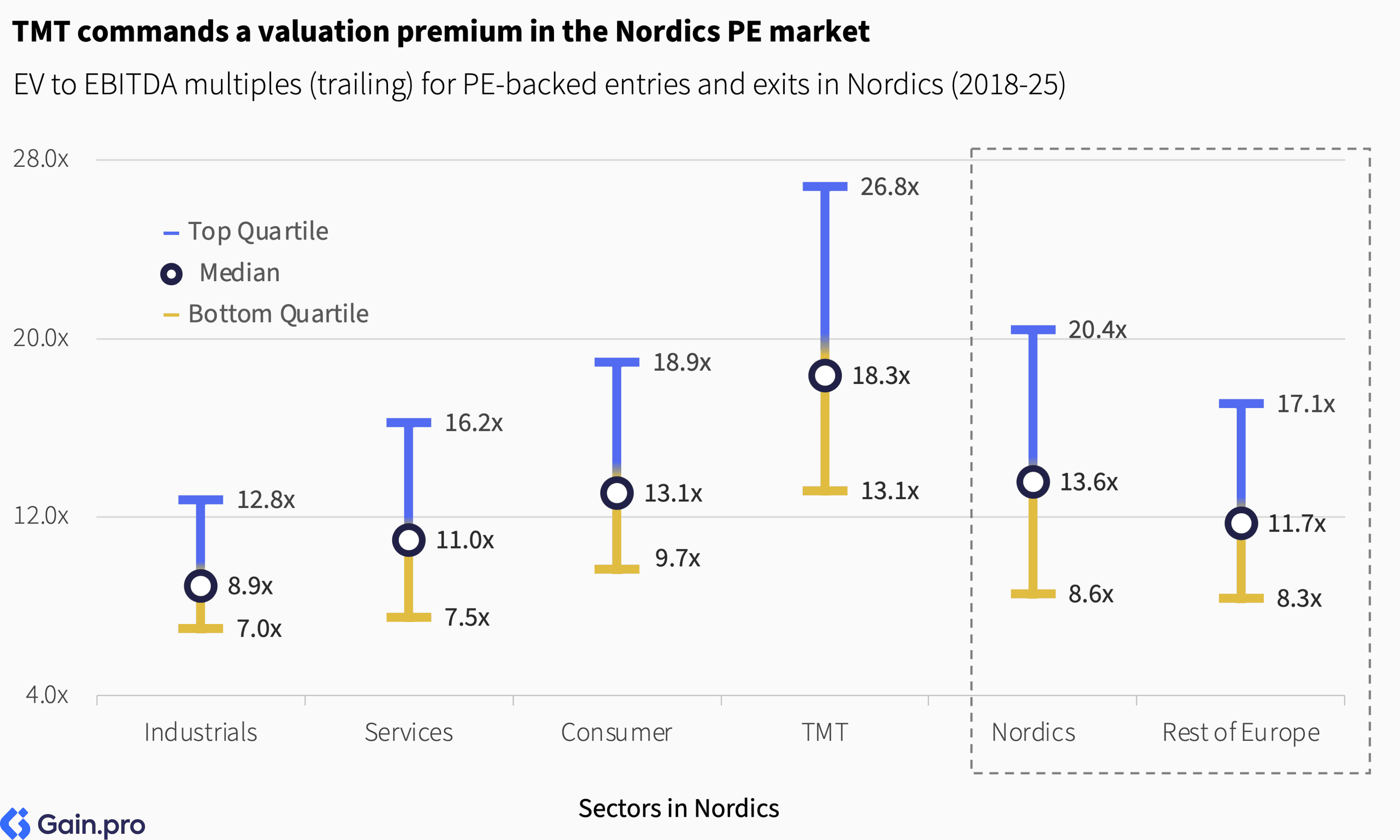
TMT commands a healthy premium over other sectors, driven by higher growth rates and margins. On the other hand, multiples are significantly lower for Industrials, which have both lower growth and margins. Broadly, the Nordic PE market trades at a premium compared to the rest of Europe, partly due to its higher TMT sector exposure.
Entries by Region
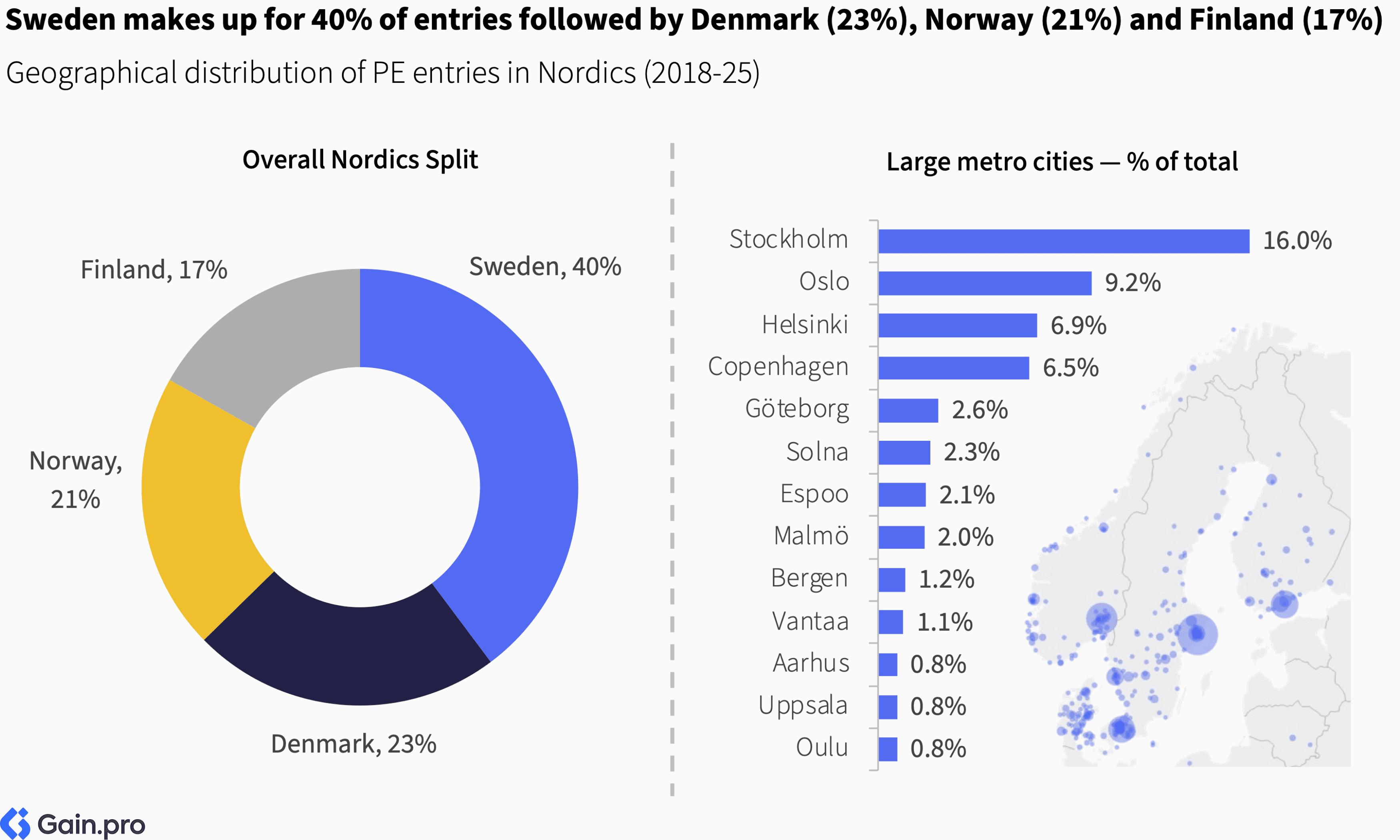
Sweden accounts for 40% of all Nordic PE entries, reflecting its larger economy and a more established investor ecosystem. By city, Stockholm alone represents 16% of all activity, followed by Oslo (9.2%), Helsinki (6.9%) and Copenhagen (6.5%), followed by a long tail of cities.
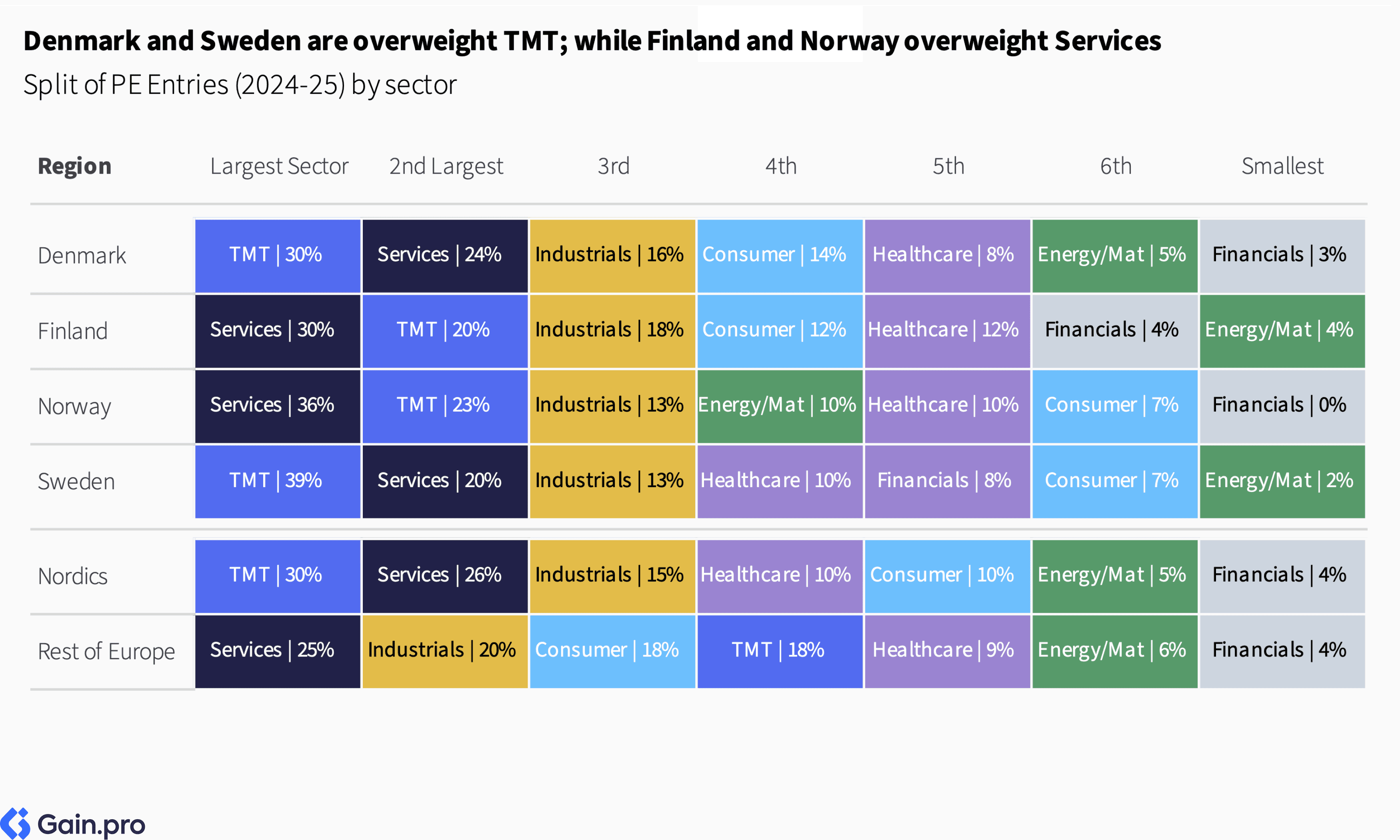
Denmark and Sweden are overweight TMT, while Finland and Norway are overweight Services. Industrials is the third largest sector across regions, though smaller in size than in the rest of Europe. Consumer is also notably smaller compared to the rest of Europe.
Entries by Deal Type
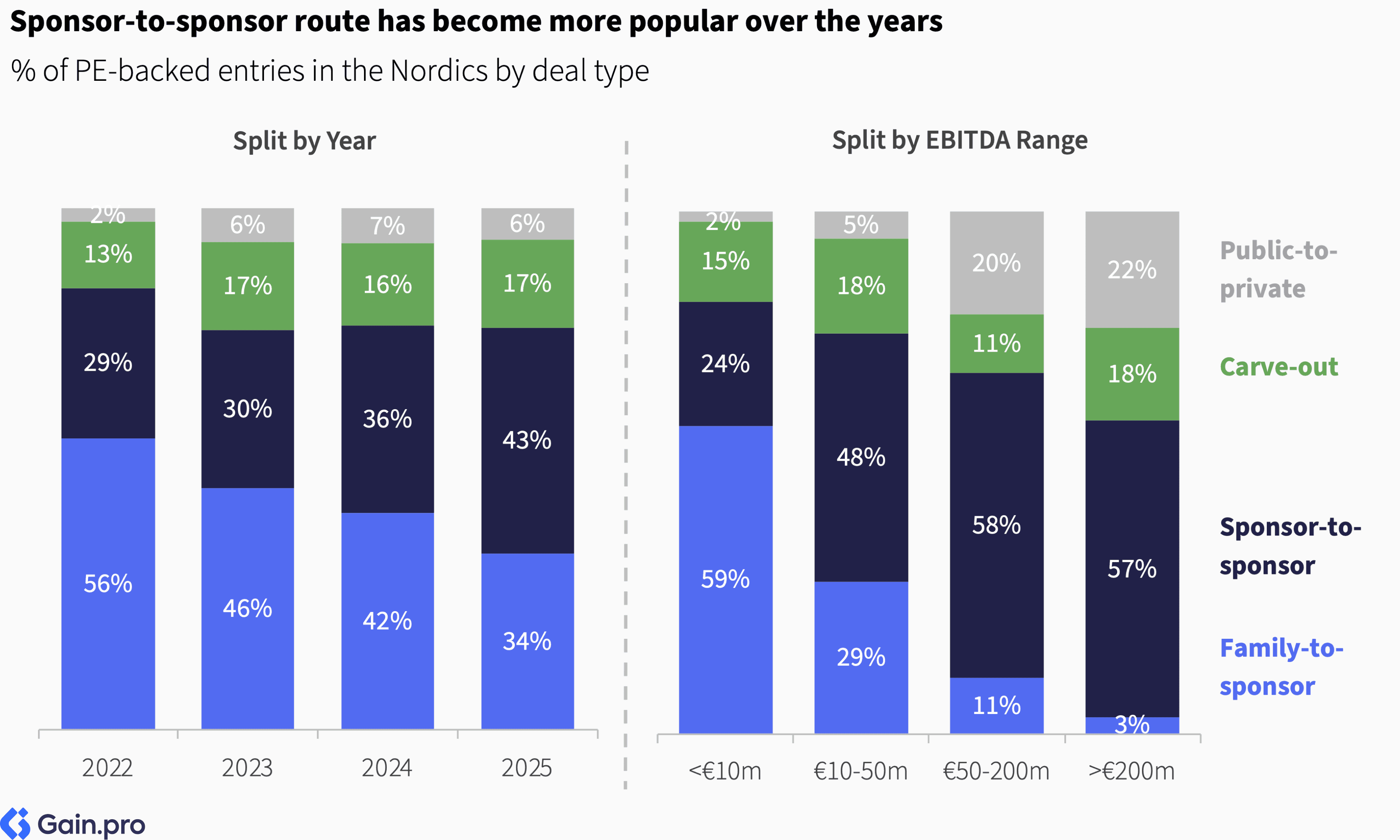
By entry deal type, sponsor-to-sponsor transactions continue to gain traction, while family-to-sponsor deals continue to decline. Notably, lower EBITDA ranges are dominated by family-to-sponsor deals, while carve-outs and take-privates become more popular as target size increases. Among transactions above €200m EBITDA, 18% are carve-outs and 22% are take-privates.
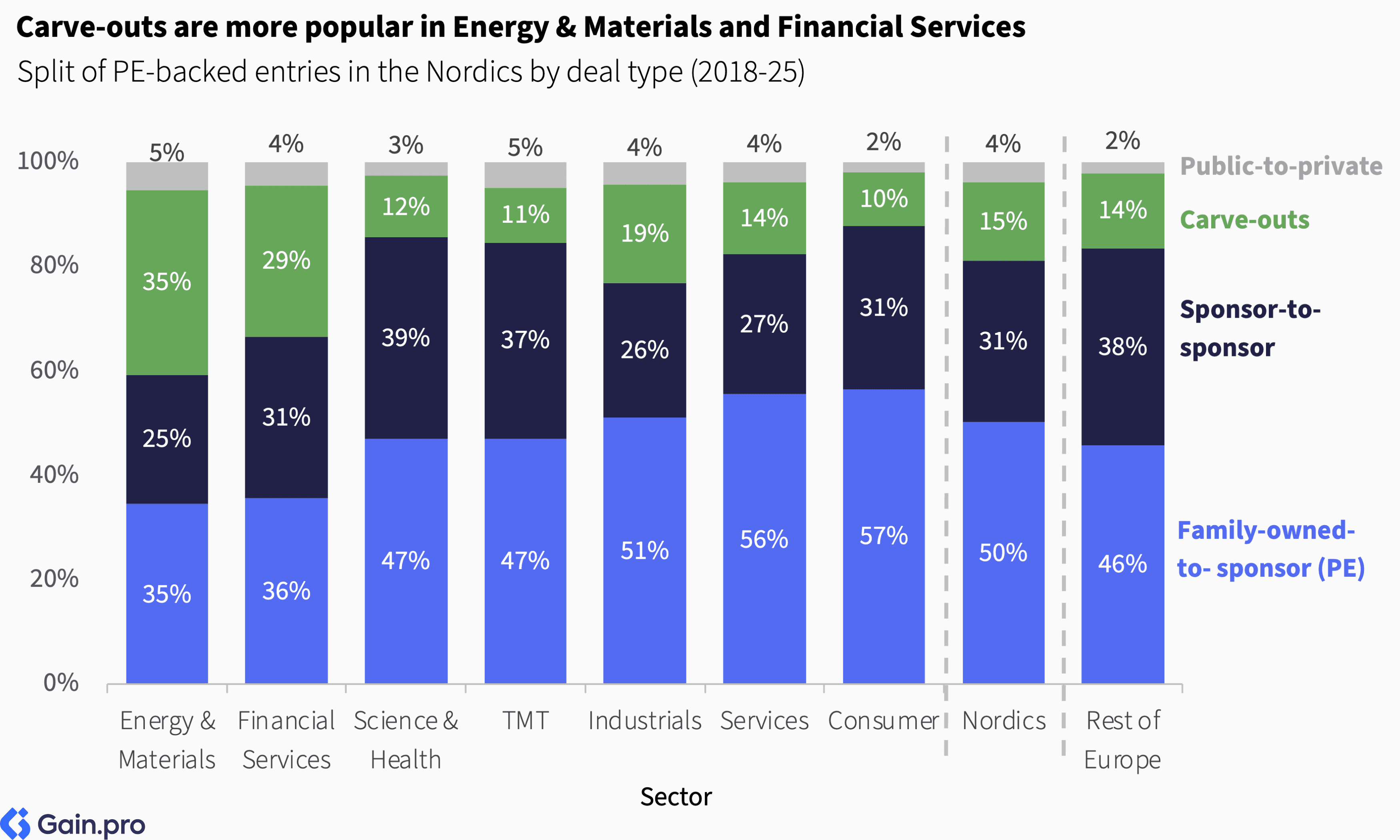
Family-to-sponsor deals are the leading entry type across sectors, although there are some sectoral differences. Carve-outs are notably more popular in Energy & Materials and Financial Services. Broadly, public-to-private deals are also more common in the Nordics than the rest of Europe, accounting for 17% by deal value (vs. 10% for the rest of Europe).
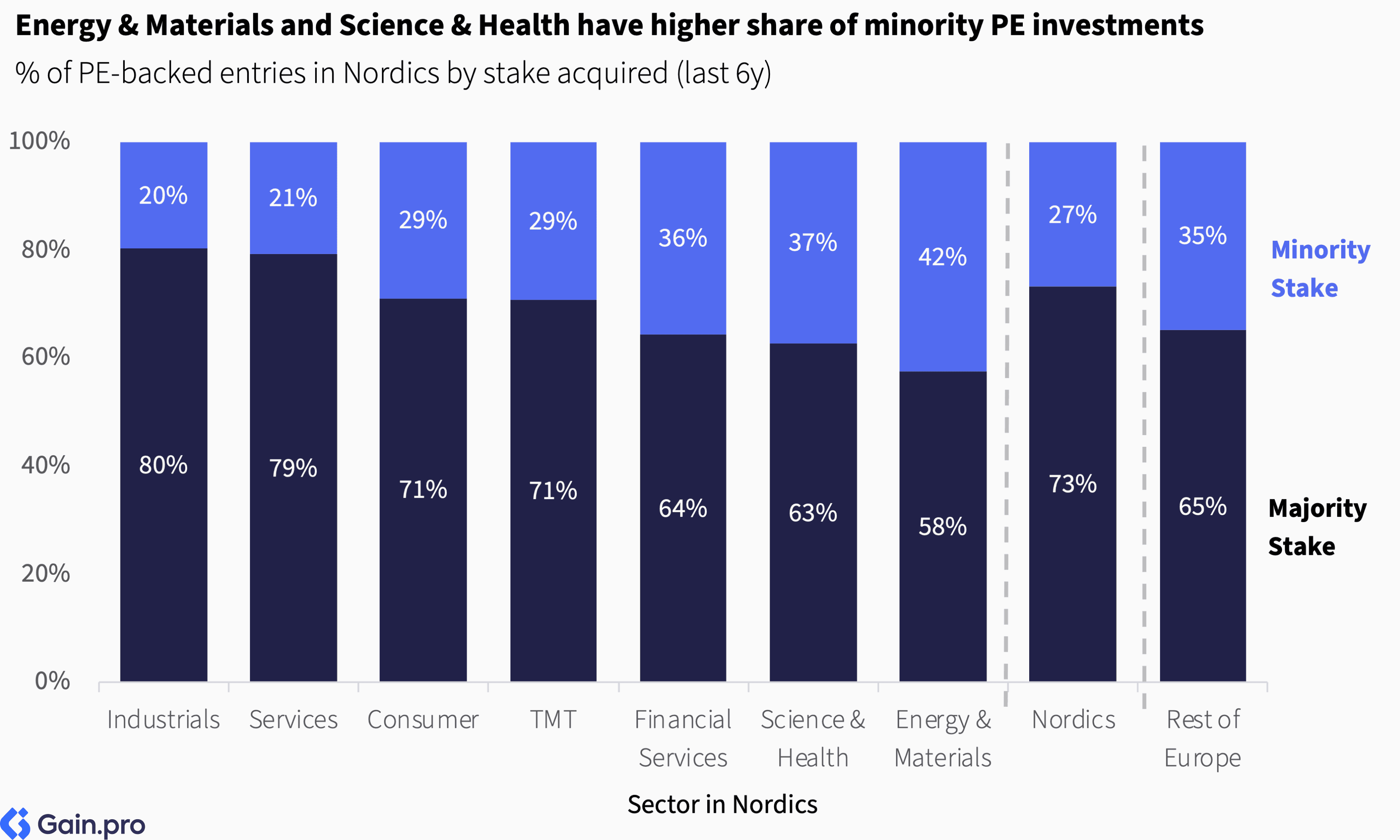
Minority stakes are less common in the Nordics than in the rest of Europe, reflecting cultural preferences for concentrated ownership and fewer consortium-backed deals. By sector, the preference for control is most pronounced in Industrials and Services, where 80% and 79% of deals, respectively, involve majority stakes.
Buy-and-Build
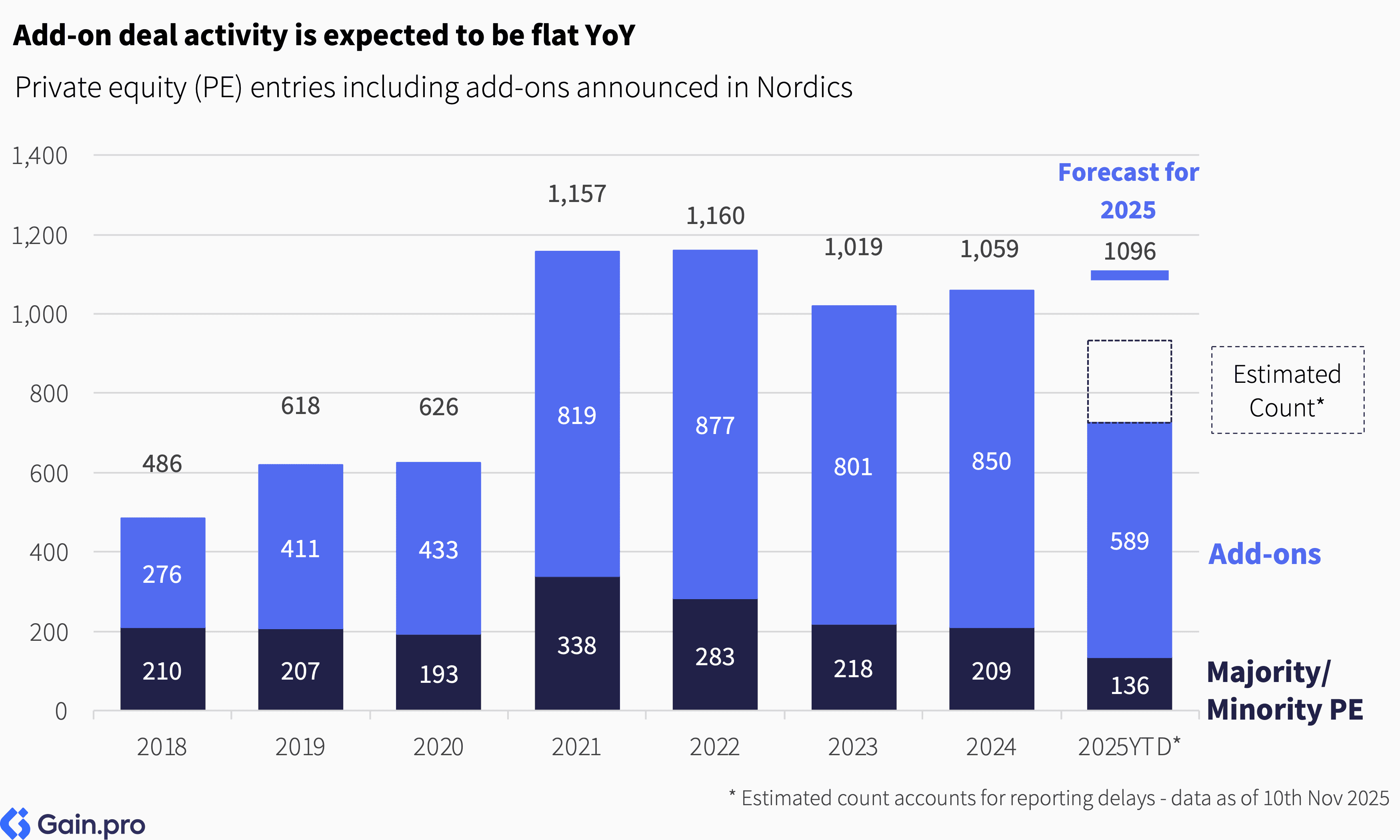
Add-on deal activity in 2025 is expected to be broadly flat vs. 2023 and 2024. Amid a muted exit environment, sponsors have remained focused on portfolio value creation, with buy-and-build being the key strategy.
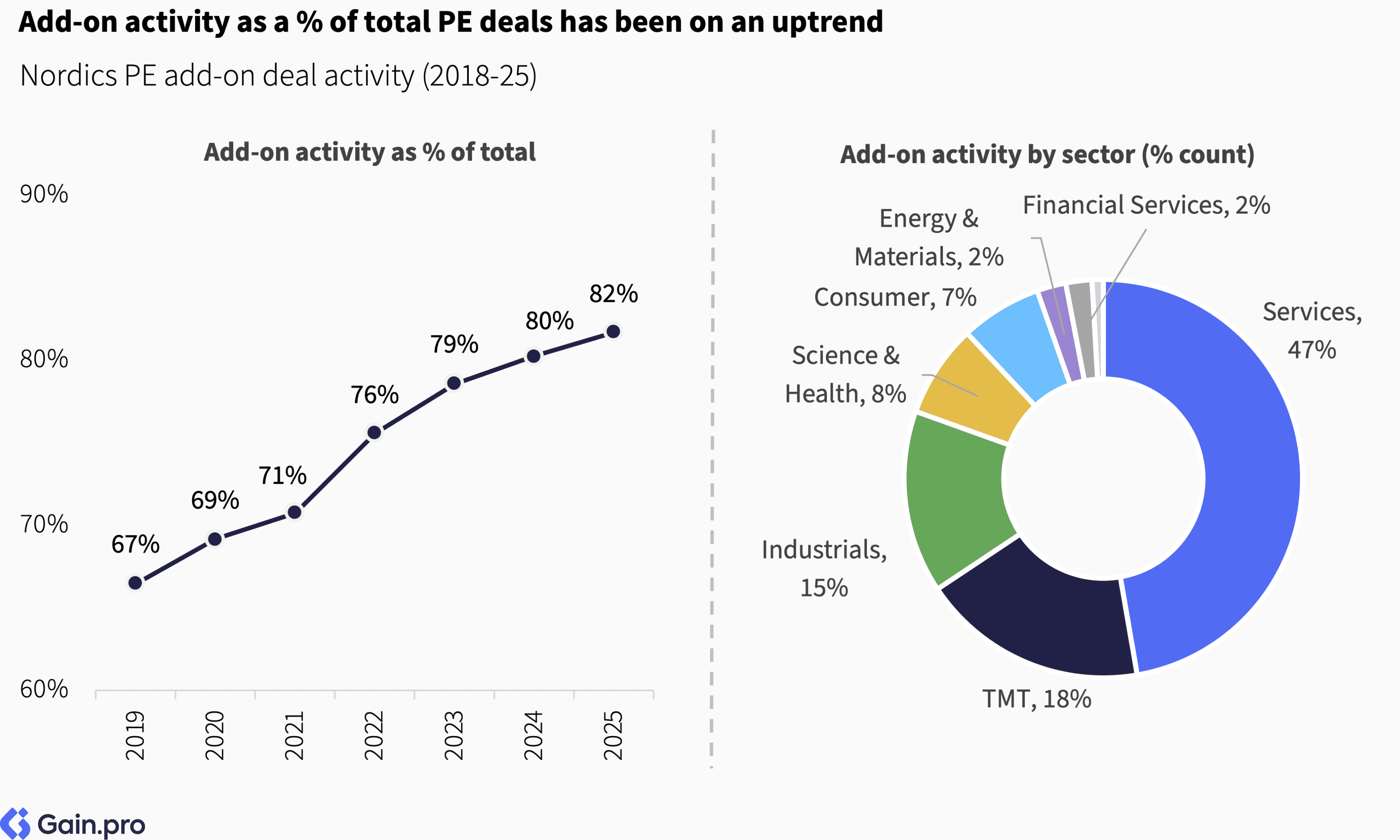
82% of all PE deals in 2025 were add-ons, up slightly from 80% in 2024. By sector, Services was the largest sector for add-ons (47% of deals), followed by TMT (18%) and Industrials (15%).
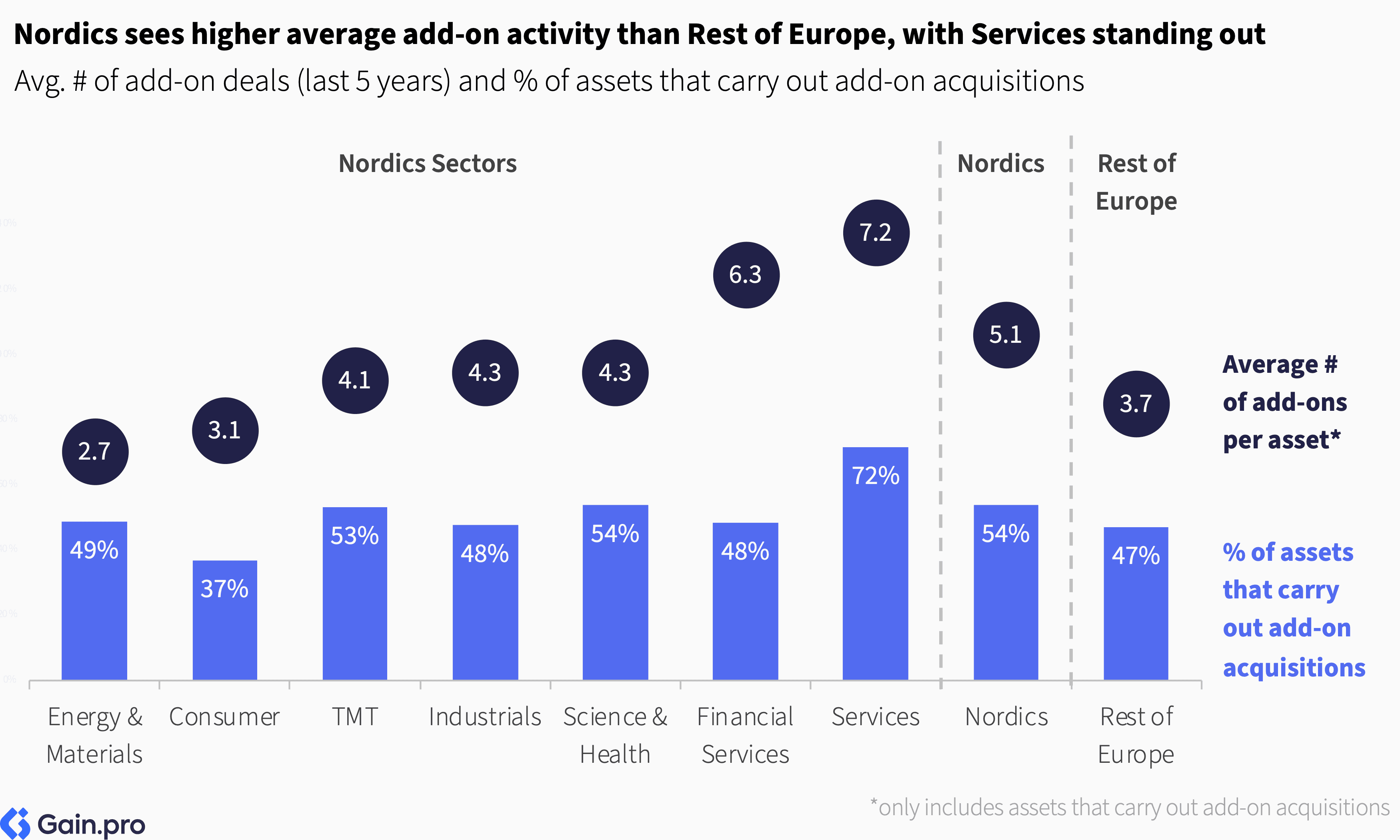
The Nordics is the most add-on-heavy region in Europe, with 54% of portfolio companies there pursuing a buy-and-build strategy. Besides having a Services-heavy economy, the fairly integrated local market between Sweden, Denmark and Norway makes bolt-on acquisitions very effective there. This approach also offers a lower-risk path to growth by acquiring established businesses with existing revenues and customers.
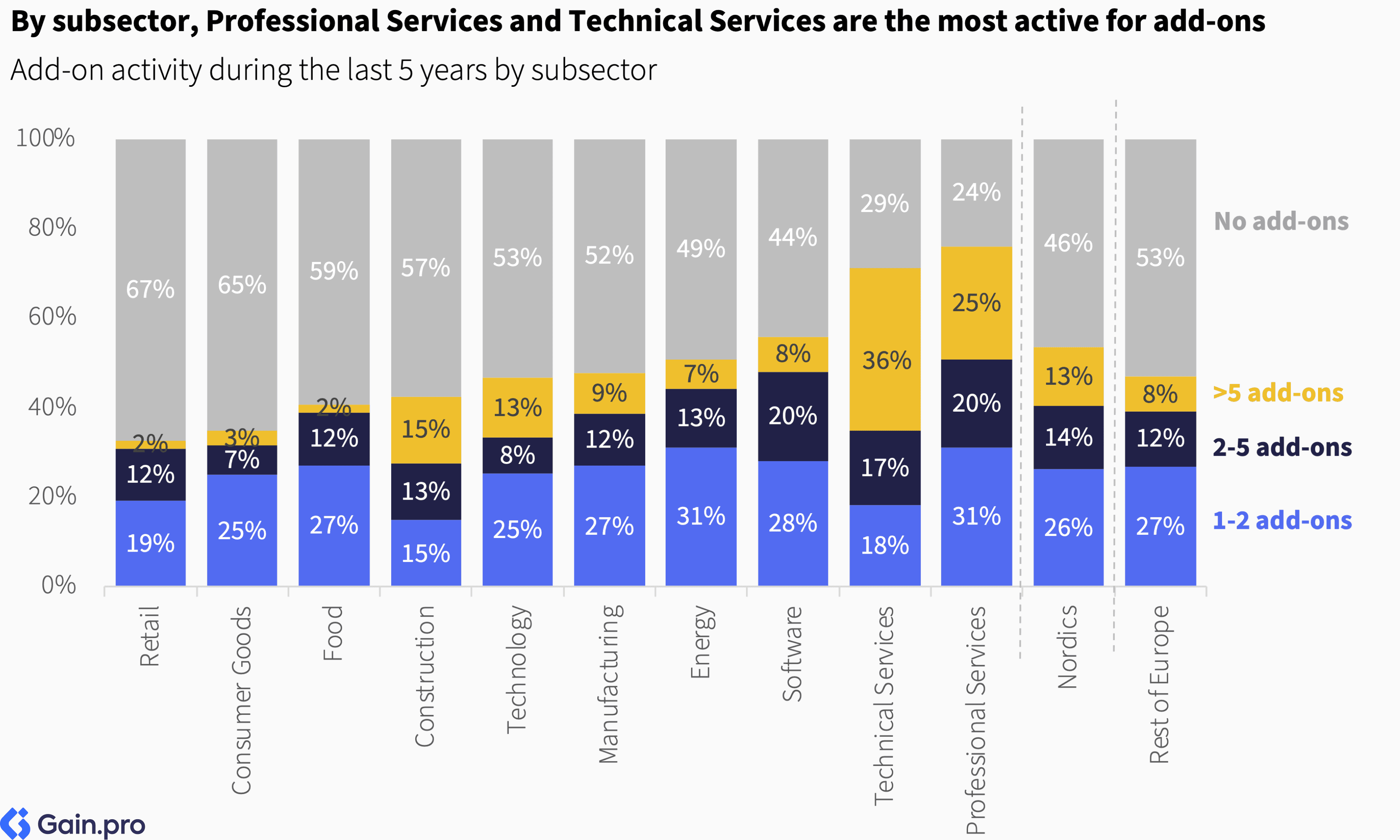
Professional and technical services record the highest add-on activity at the subsector level. Both subsectors are characterized by fragmented markets with numerous regional operators and strong consolidation potential through scalable, standardized service models.
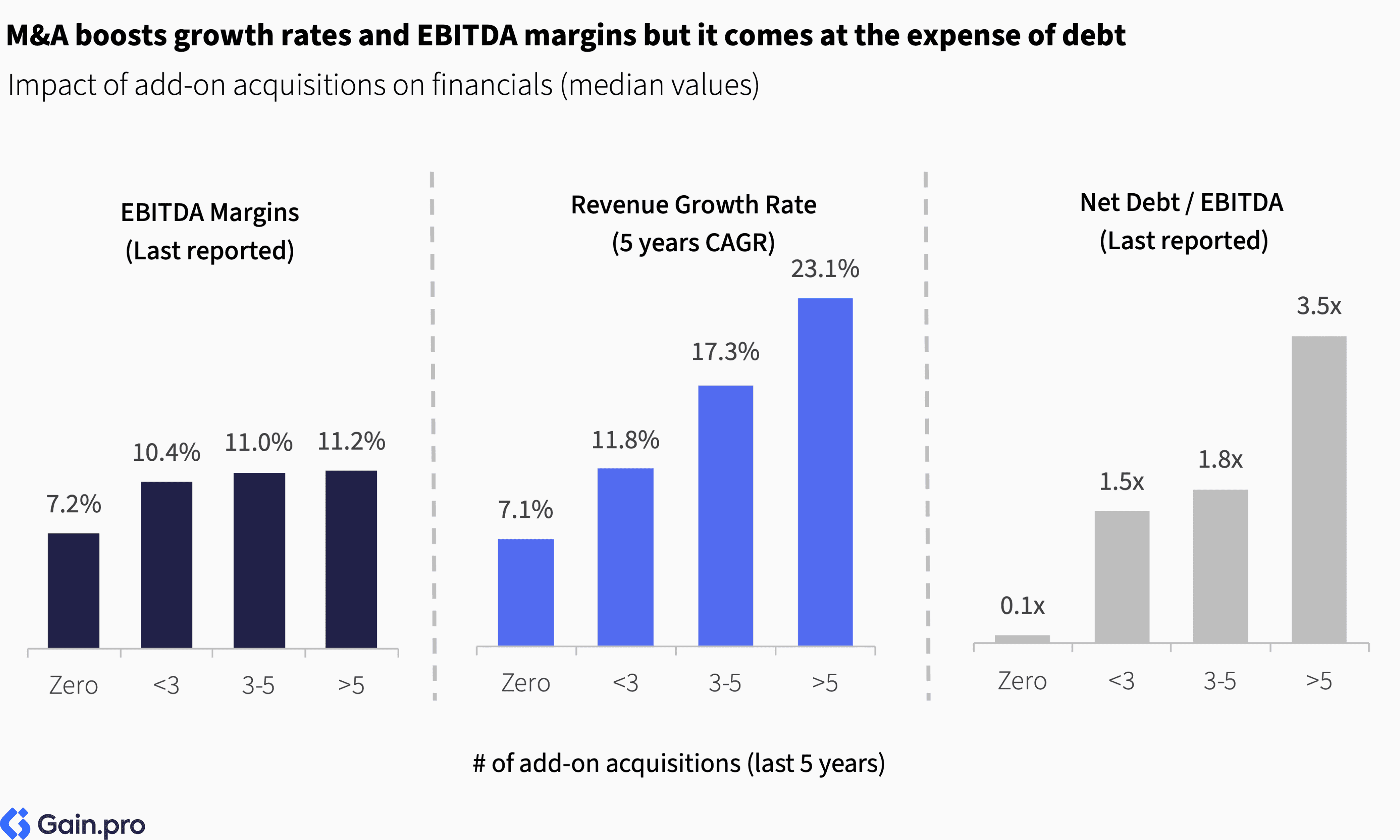
Add-ons can drive a lot of value by accelerating revenue growth and cost synergies. PE-backed businesses in Nordics with over 5 acquisitions grew at a 5-year CAGR of 23.1% compared to 7.1% for businesses with no acquisitions. These businesses also benefit from improved margins. However, we do see an increase in debt to finance those acquisitions, which increases the overall risk profile of the investment.
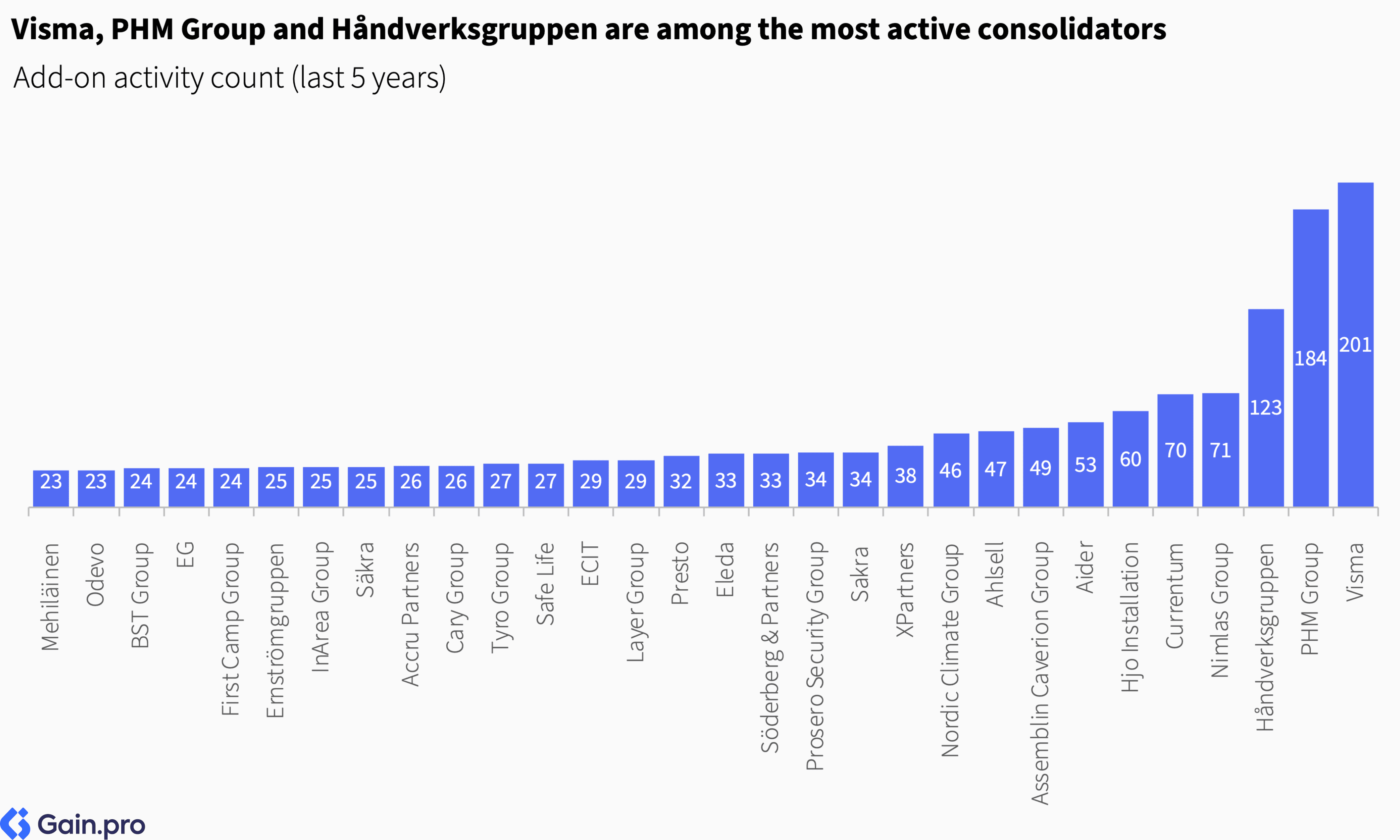
Visma, PHM Group and Håndverksgruppen are by far the most active buy-and-build platforms in the Nordics. PHM's expansion is driven by aggressive consolidation in the fragmented residential property maintenance and management market, while Visma's strong activity reflects its vertical software strategy targeting fragmented accounting, ERP and payroll segments. Nordic PE-backed companies are among the most active serial acquirers in Europe, accounting for 32 of the top 100 European platforms by add-on count (despite representing just 12% of all European PE portfolio companies).
Chapter 03: Exits
Overall PE Exits
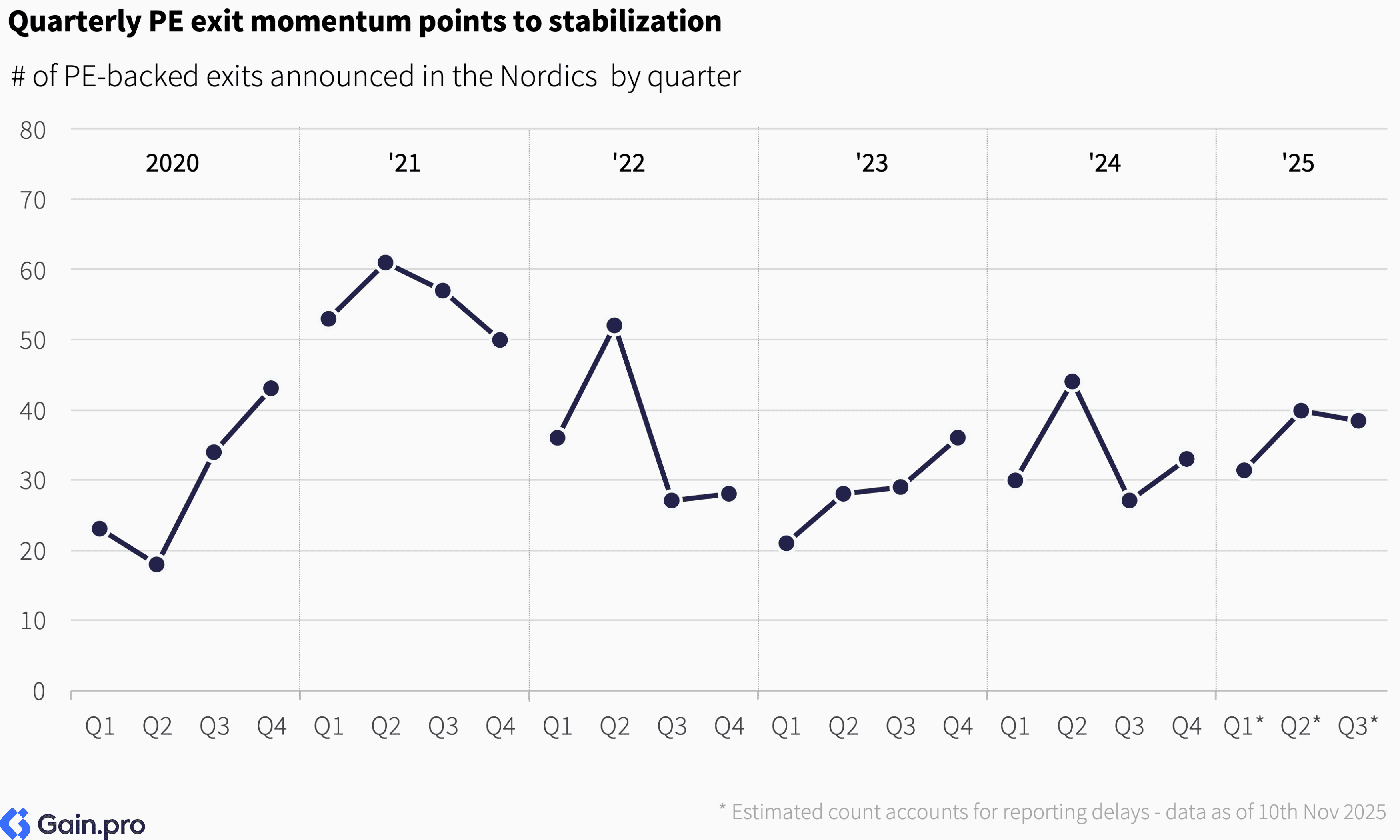
Exit activity is expected to be up marginally in 2025. Despite subdued valuations, investors are prioritizing liquidity for LPs and bringing a backlog of delayed exits to the market.
Quarterly PE exit activity points to stabilization. After a slow start in Q1, exits gained momentum through Q2 before leveling off in Q3.
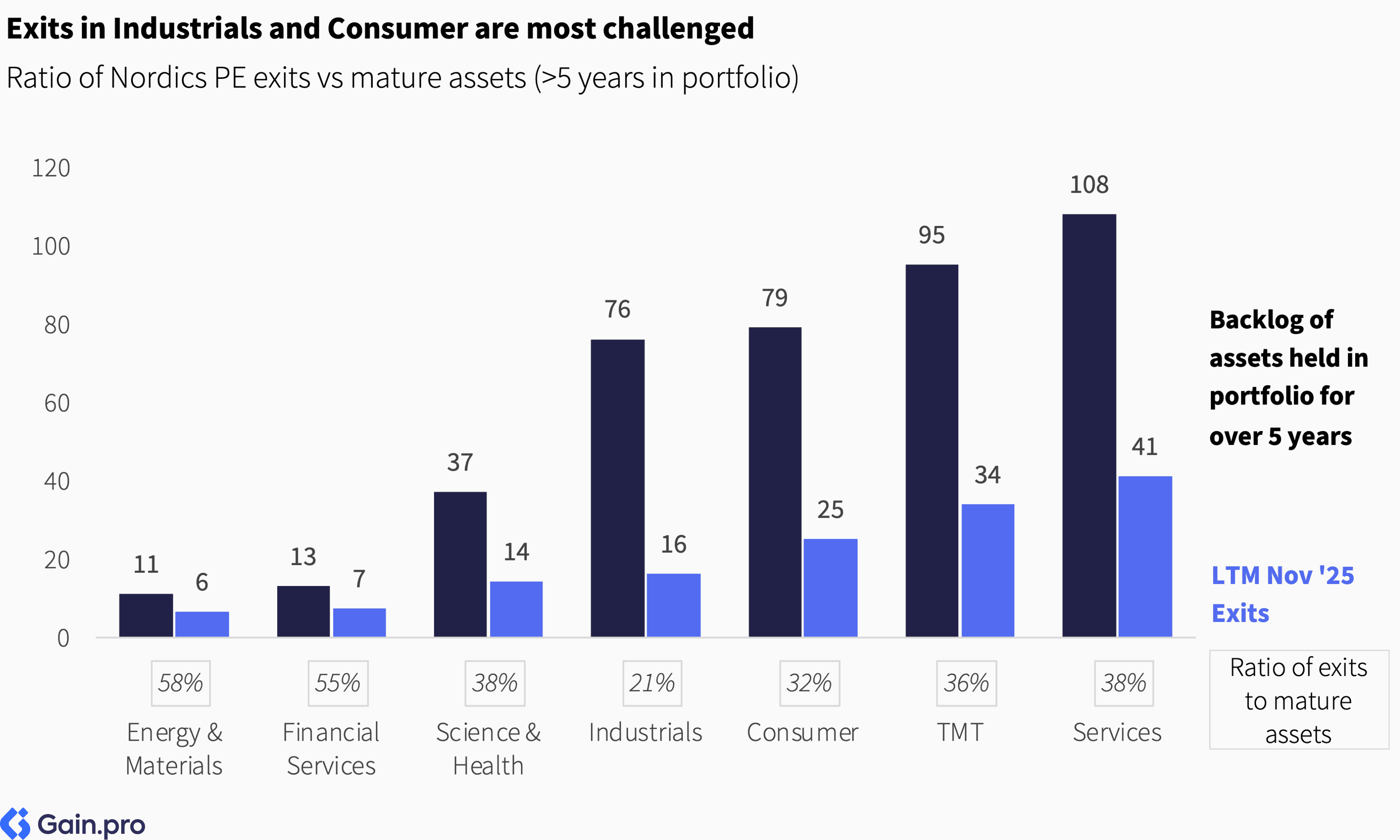
By sector, exits in Industrials and Consumer are most challenged relative to the backlog. Both these sectors have seen growth and margins slow down post-pandemic, which has clouded the outlook for these assets.
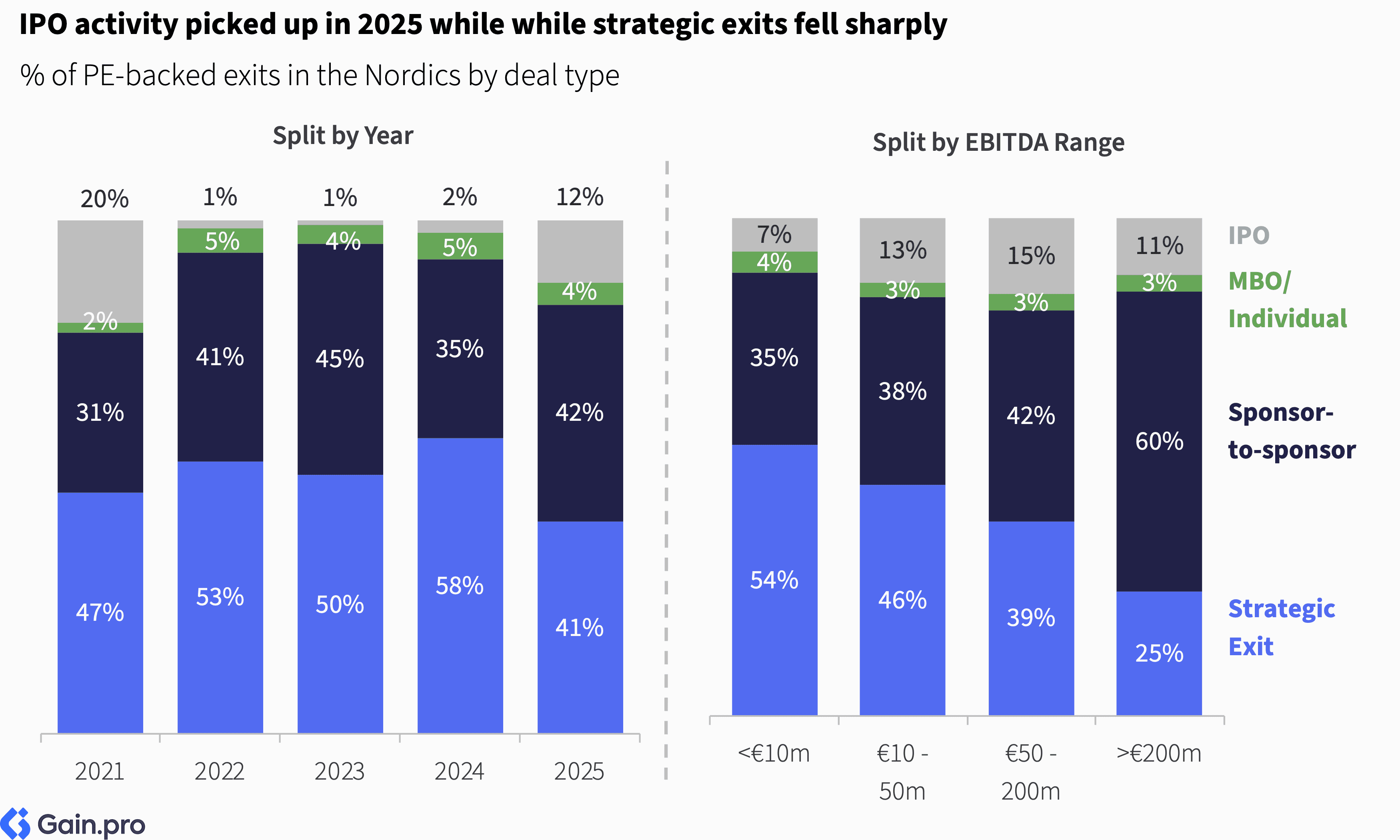
By deal type, IPOs and sponsor-to-sponsor activity picked up in 2025 while strategic exits lagged. By size, sponsor-to-sponsor transactions dominated exits of larger firms, while strategic exits were more common among smaller firms (<€10m EBITDA).
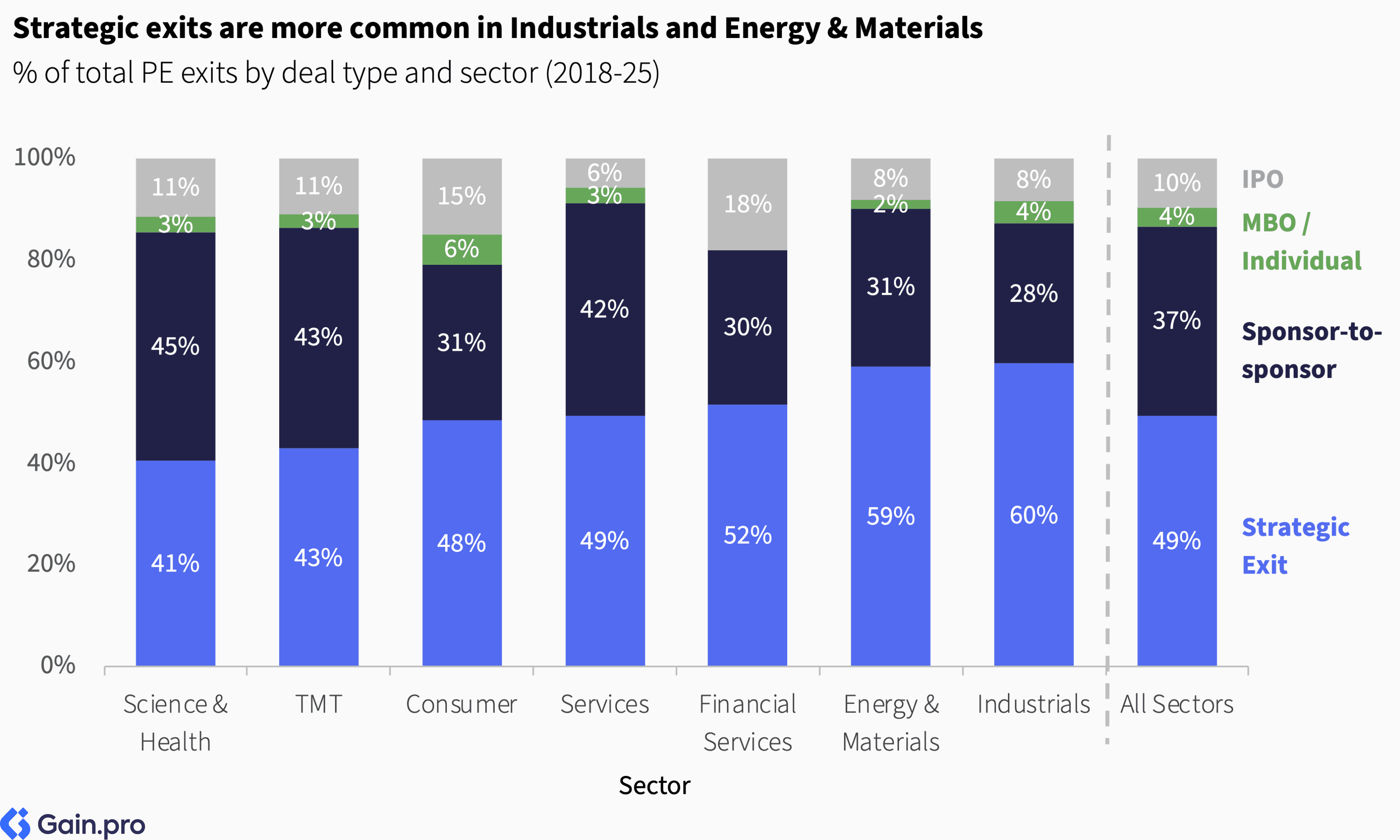
By sector, strategic exits were more common in Industrials and Energy & Materials, while sponsor-to-sponsor deals were more common in Science & Health, TMT and Services. Finally, Financial Services and Consumer had more IPOs compared to other sectors.
Holding Periods
Holding periods in the Nordics are hovering near their all-time high. The median company exiting in 2024/25 spent 6.2 years in portfolios, up from 4.3 years in 2020. Notably, 40% of exits in 2024/25 involved assets held for more than seven years, compared to just 15% in 2020.
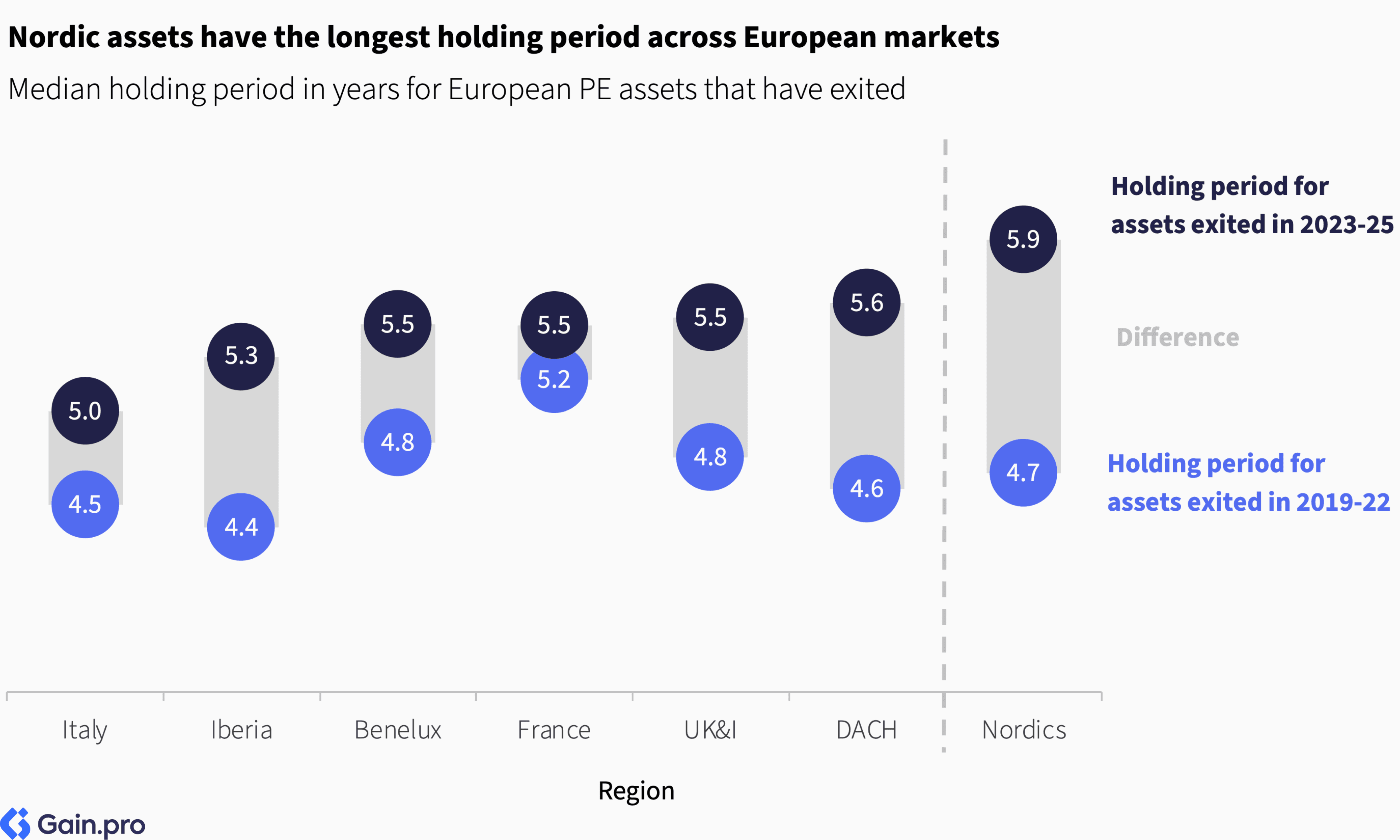
Nordic PE assets have the highest holding periods among European regions, reflecting slower exit activity particularly in Industrials and Consumer sectors. Additionally, rather than exit at depressed valuations, sponsors are extending holds and focusing on portfolio value creation through active buy-and-build strategies.
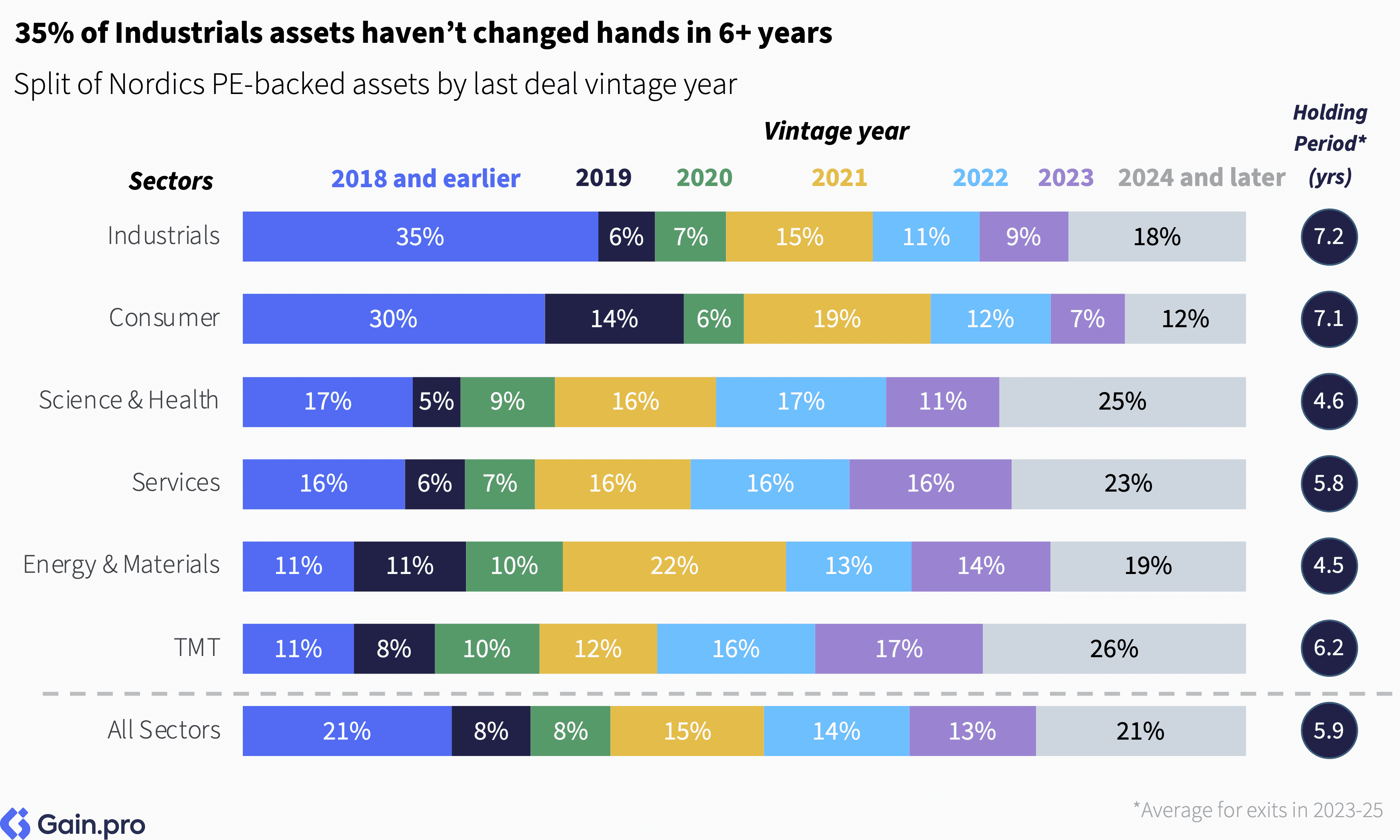
35% of Industrial assets haven't changed hands in over six years — the highest among all sectors. The sector has endured prolonged macroeconomic headwinds including weak manufacturing demand, elevated energy costs and supply chain disruptions that have compressed margins and delayed exits. The consumer sector has also been hit hard, with holding periods among the longest in the region at 7.1 years.
Chapter 04: Asset Insights
PE Penetration & Employment
PE-backed businesses in the Nordics employ ~1m people. That’s roughly ~6% of the Nordics’s working-age population. By sector, the largest employers are in Services (40%), followed by Industrials (18%), Consumer (13%) and Science & Health (14%).
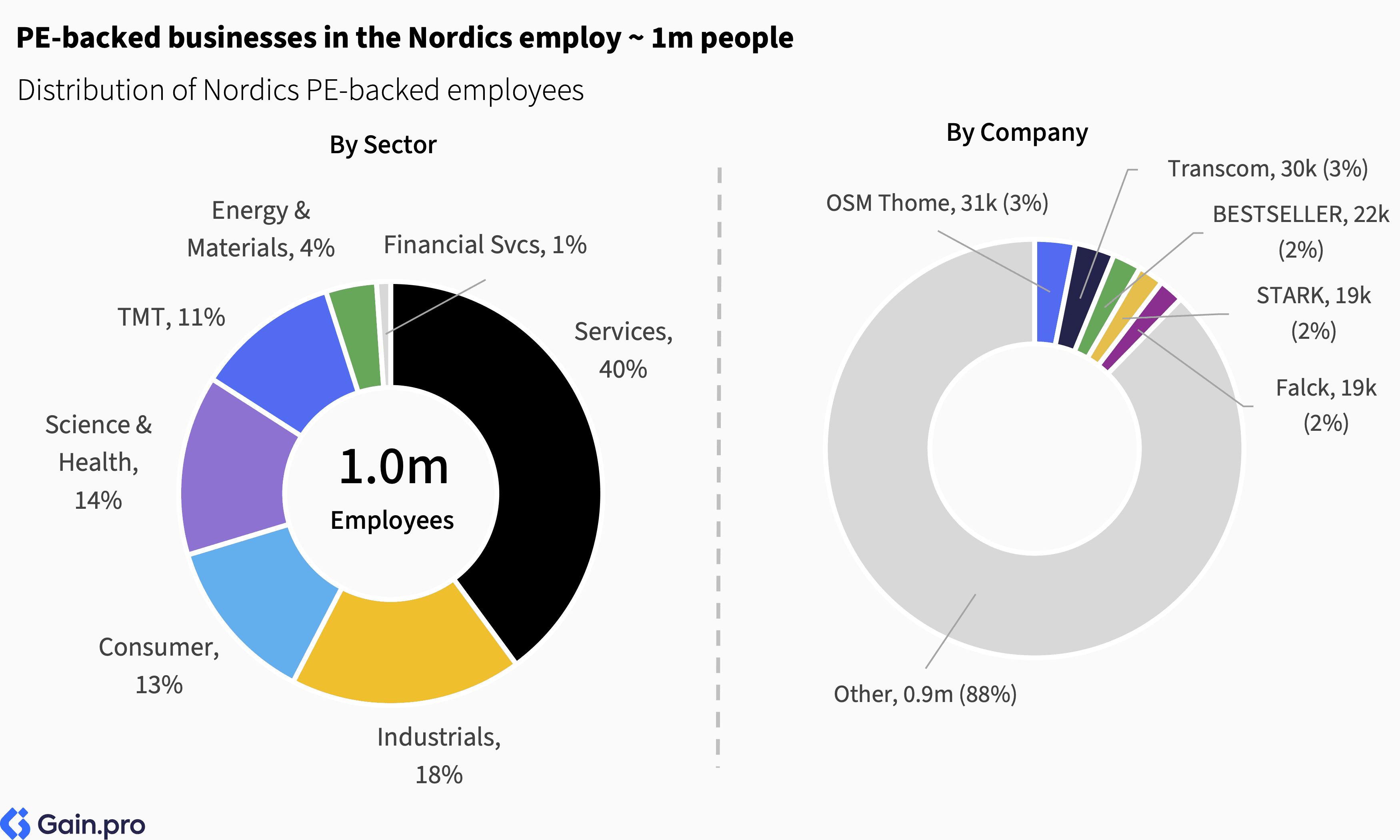
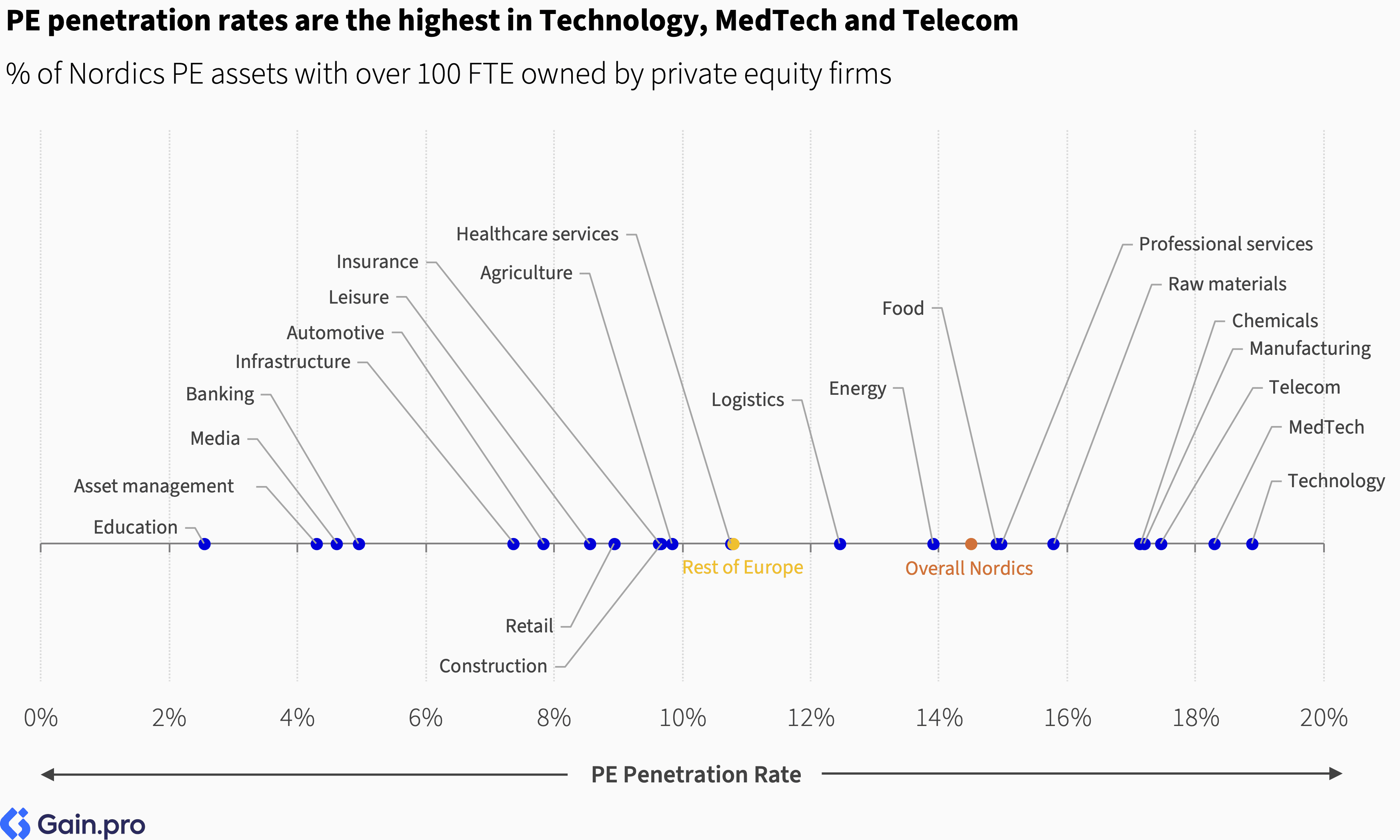
PE penetration in the Nordics stands at 15%, notably higher than 11% in the rest of Europe. The region is home to a large pool of mid-sized family firms that PE firms frequently acquire. Additionally, the business-friendly regulatory environment with strong rule of law, transparent governance standards and efficient bankruptcy procedures makes PE transactions more favourable. By sector, PE ownership is highest in Technology, MedTech and Telecom, and lowest in Education and Asset Management.
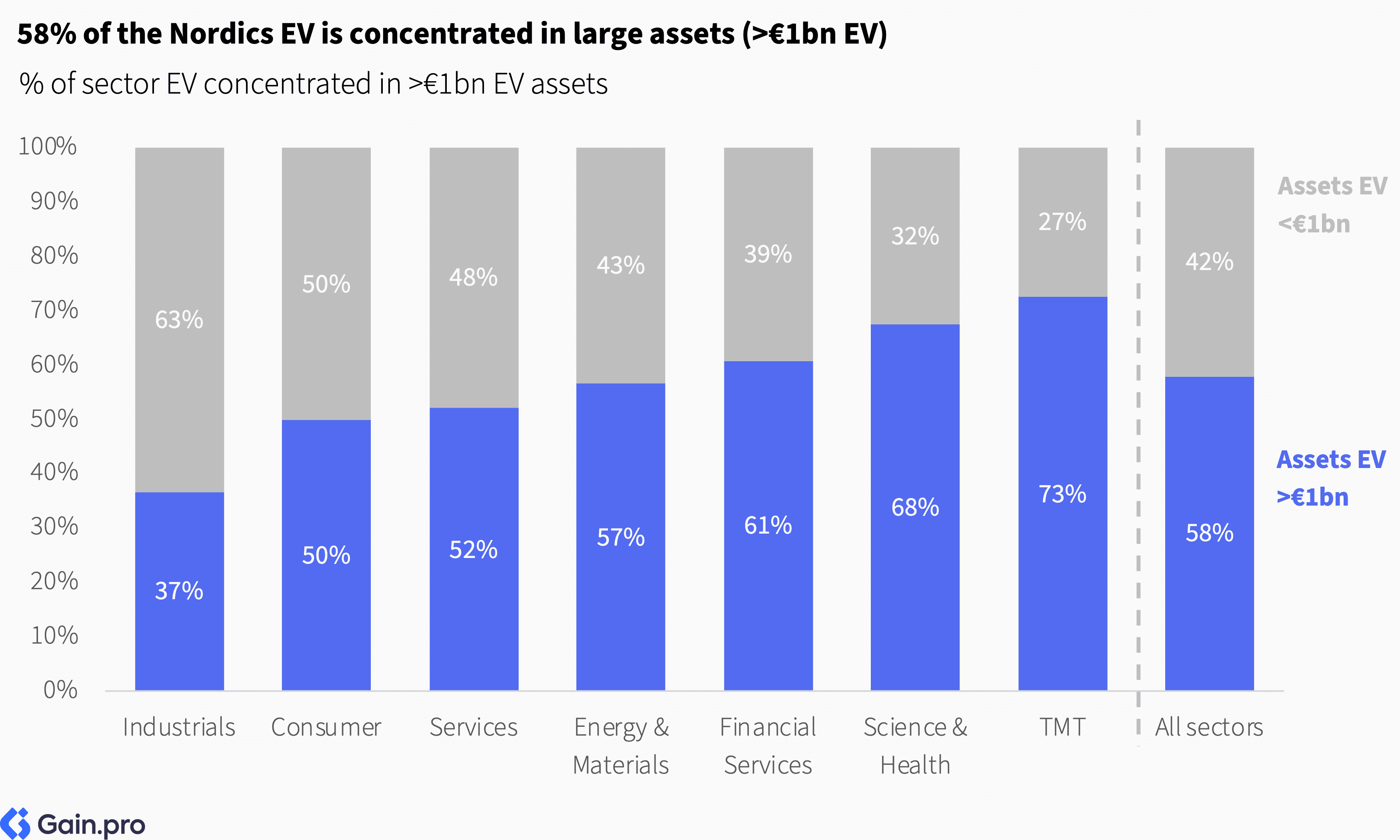
TMT is dominated by larger assets in the Nordics, with over 75% of the sector's companies valued at >€1bn. In contrast, Industrials and Consumer show a relatively lower proportion of assets >€1bn, indicating a more diverse landscape.
Growth & Margin
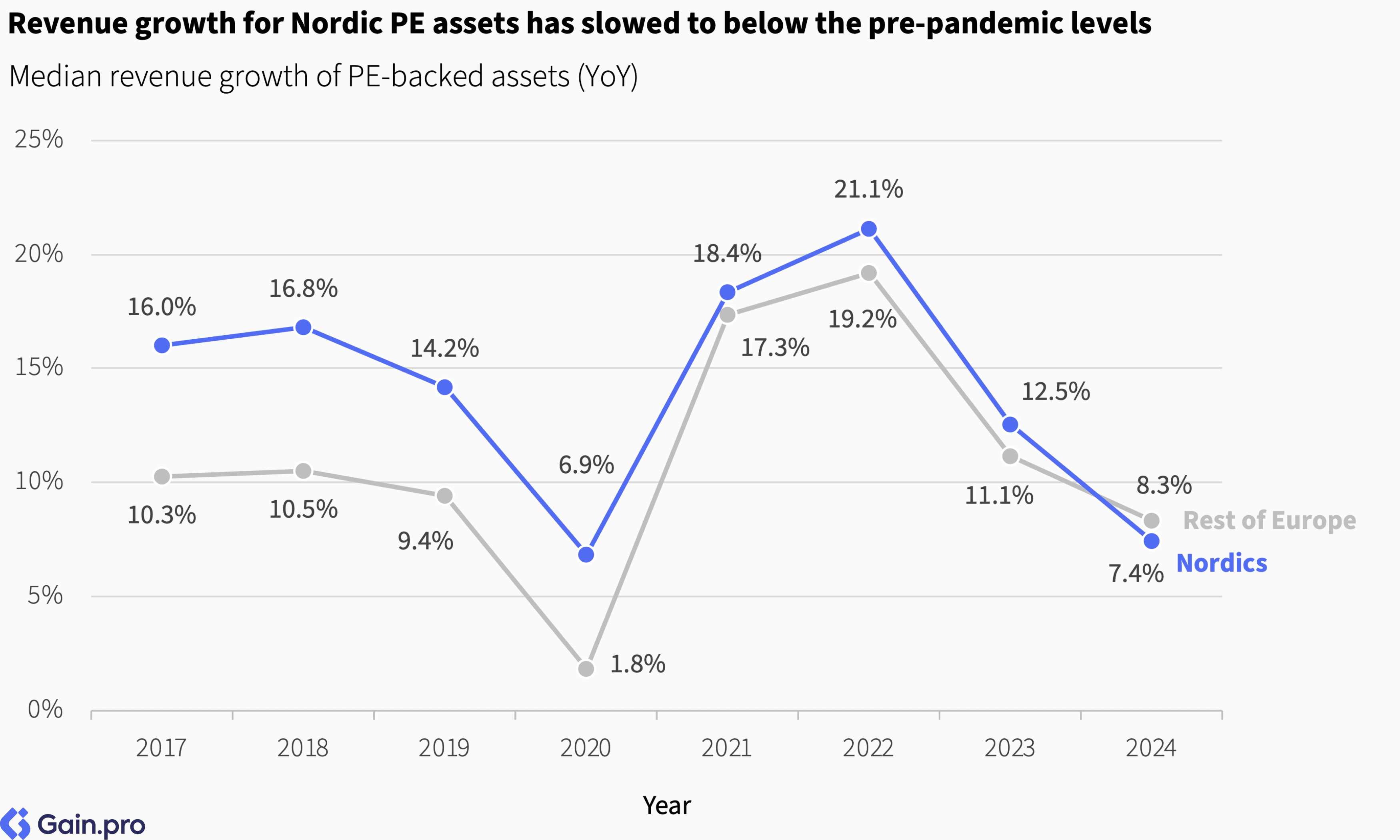
Growth for Nordic PE-backed assets has structurally declined below pre-pandemic levels. The slowdown is led by Industrials, Consumer and Energy & Materials — which together make up over 40% of Nordic PE asset count.
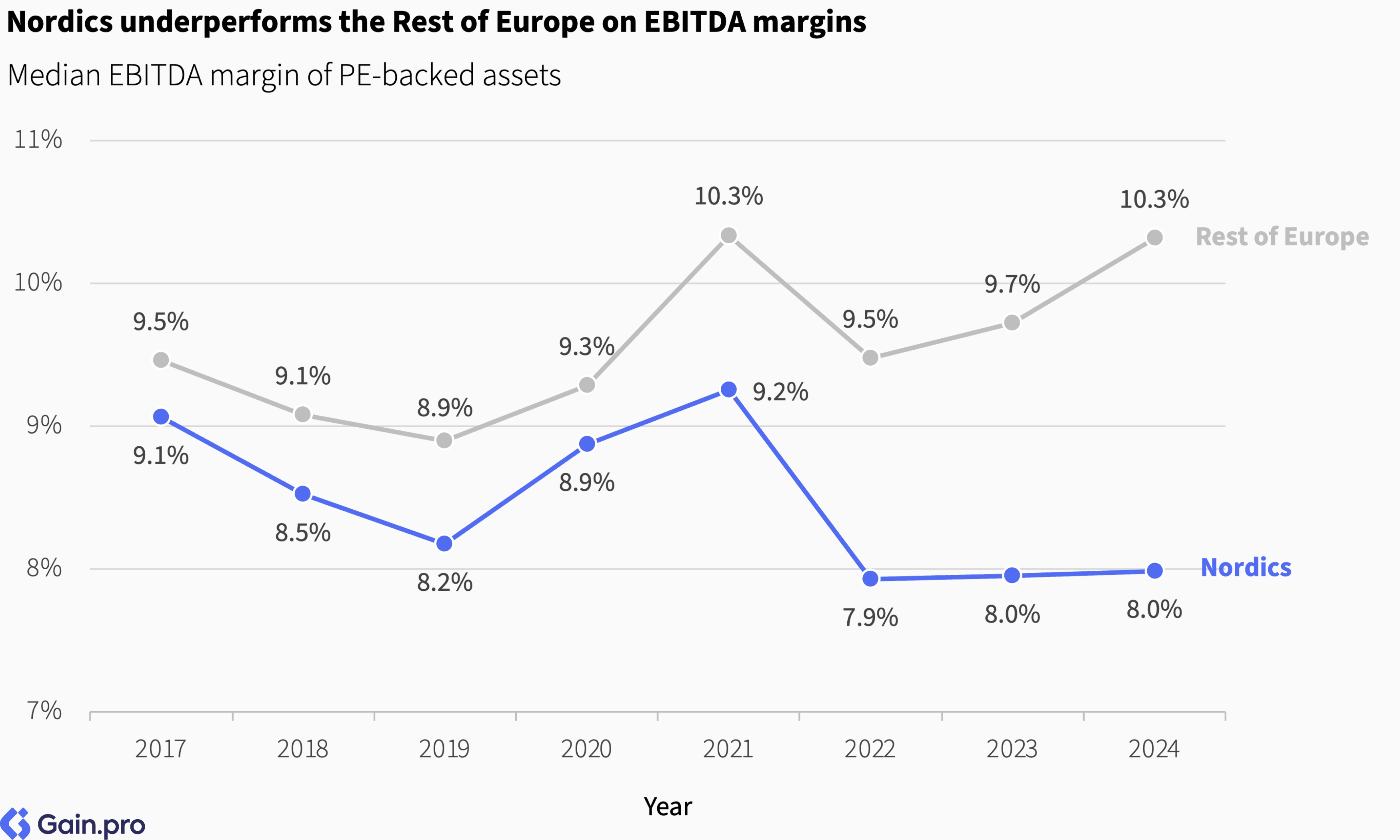
EBITDA margins in Nordic PE-backed assets have consistently lagged those in the rest of Europe. Nordic countries have some of Europe's highest wage levels, comprehensive social benefits and strong worker protections that increase total employment costs. Stringent regulatory compliance and early adoption of environmentally responsible practices also weigh on margins.
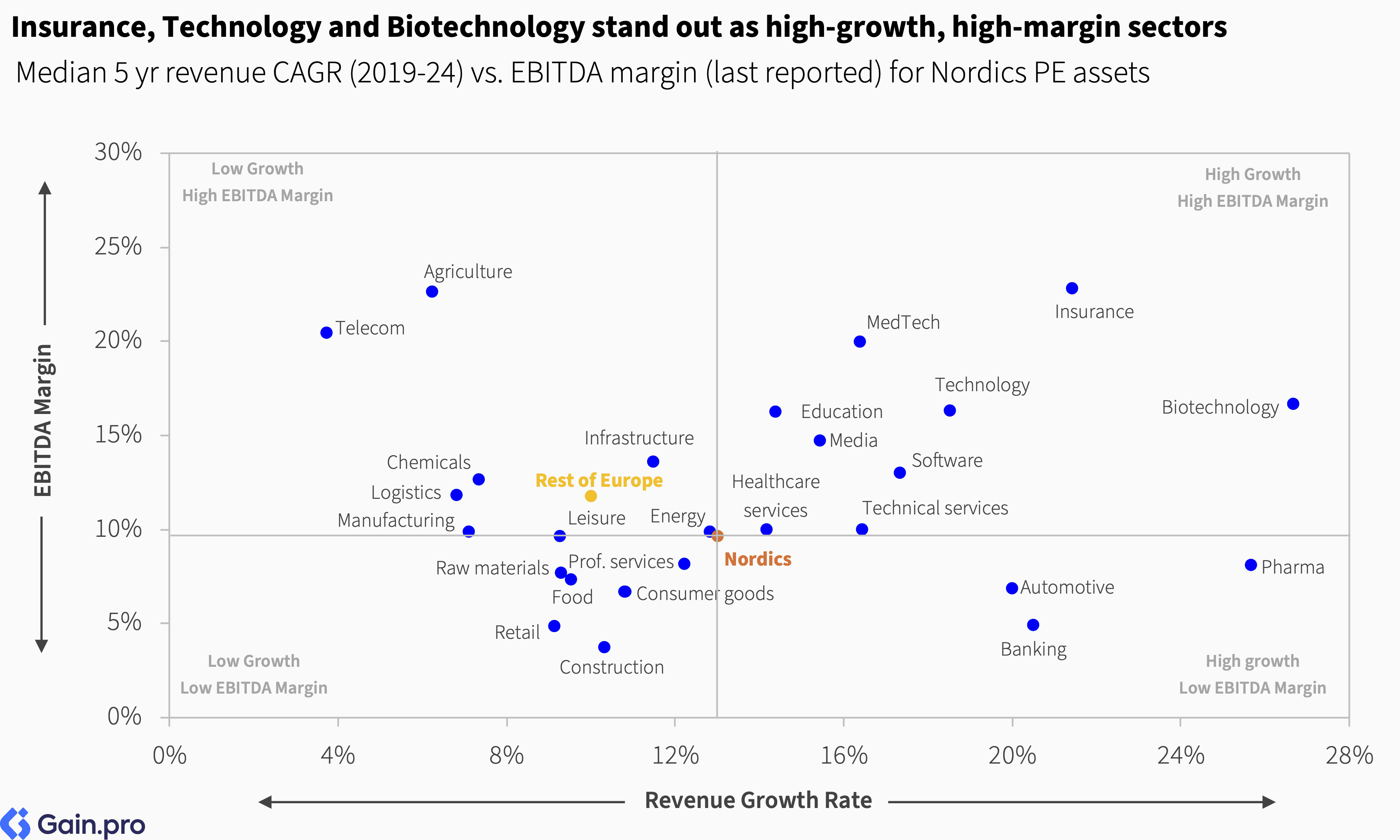
Insurance, Biotechnology, Technology and MedTech stand out as high-growth, high-margin sectors in the Nordics. In contrast, Retail, Raw Materials, Food, Construction and Consumer goods assets lag, showing lower growth and profitability.
Methodology
The data for this report comes from Gain.pro.
Rankings
We take a novel approach to our ranking, which is based on total managed enterprise value (EV). At Gain.pro, we track over 17,400 investor portfolios in detail.
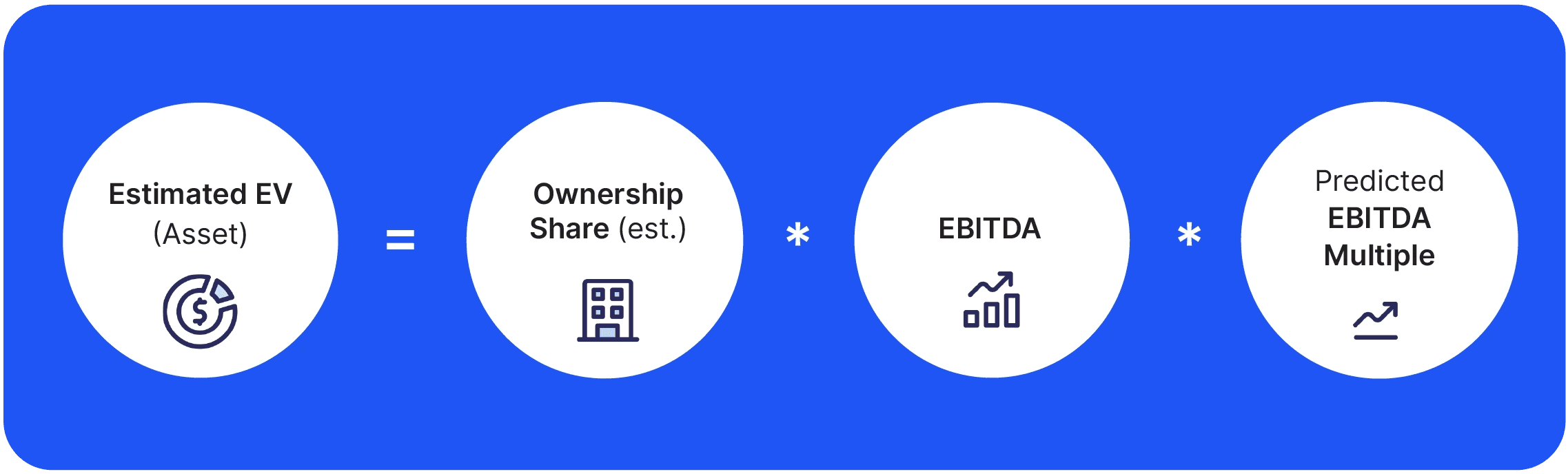
To estimate the managed enterprise value (EV), we estimate the EV for each asset in an investor’s portfolio. We begin with the latest reported deal value (last 2 years), where publicly available. If it's not available, we estimate the EV by multiplying EBITDA by the predicted exit multiple. The total EV is then aggregated at the investor level. We scale the last reported deal value by a growth multiplier to estimate its current holding value. We also adjust EV for the investor's estimated ownership share in an asset.
Where there aren't reported deal figures or financials, we estimate them using the asset's revenue, subsector margins and revenue/FTE calculations.
To predict exit multiples, we consider an asset's sector, size, growth rate, margin profile and cash generation.
We only consider majority buyout and minority-owned PE assets for our rankings. We exclude any VC investments and publicly listed stakes. To predict exit multiples, we consider an asset’s sector, size, growth rate, margin profile and cash generation.
Further, we exclude any inactive investors from the largest global investors in the Nordics ranking with: i) <3 portfolio companies in the Nordics; ii) <2 entries in the Nordics since 2019 and iii) <2 positive portfolio EBITDA values.
For the largest Nordics investors rankings, we exclude investors with: i) <5 portfolio companies in Europe; ii) <5 entries since 2019 in Europe and iii) <3 positive portfolio EBITDA values.
We classify an investor’s HQ based on the country where the company’s core operational activities are primarily based.
Entries & Exits
We define PE-backed entries as those in which a PE firm took a minority or majority stake. We define PE-backed exits as those in which a PE firm sold a minority or majority stake. We exclude any VC rounds from our analysis. Both entries and exits exclude aborted deals.
Unless otherwise stated, we only focused our analysis on assets HQ’d in the Nordics.
We estimate the deal count based on prior deal history and the percentage of deals that are announced or added post-quarter close.
Financials
Unless stated otherwise, the financial metrics in the report are last reported. Where possible, we have used 2024 metrics. In cases where 2024 numbers are still being reported, we have relied on 2023 metrics.
For metric calculations, we only included assets that had a hand-curated profile on Gain.pro (14-16+ hours of primary research).