

Industry research
HR Technology
Scope
Europe
Companies
171
Table of contents
Report collaborator:

Konstantin Kugler, Strategy & Transactions Partner at OMMAX, provided expert insights for this report. Read the interview transcript here.
Key takeaways
What is the scope of this industry report?
The European HR technology market comprises businesses that develop software that addresses human capital management needs. Identified players offer a range of technology modules for HR administration, payroll, recruitment and workforce planning, among others.
We segmented the market into:
HR software,
Recruitment software,
Engagement & performance software,
Payroll software & services,
Niche software,
Workforce management software.
What does the HR technology landscape look like in Europe?
The European HR technology market is fragmented and less consolidated than in the US, reflecting Europe's many national markets, languages, labour laws and tax regimes. Most vendors therefore remain focused on their home markets, with only several achieving cross-border scale. The market spans sticky, suite-like systems of record such as HR and payroll, sizable specialists with differentiated offerings followed by a long tail of more easily replaced point applications across recruitment, engagement, workforce management and niche tools. Payroll is the most attractive model because of its compliance-driven, deeply embedded nature. Consolidation is picking up at the ownership level, driven by US strategic buyers and PE-backed buy-and-build platforms seeking cross-border scale and cross-sell. Competition remains centred on best-of-suite versus best-of-breed, with global suites strongest in enterprise and European players competing mainly in the mid-market and below. AI reshapes all segments, creating opportunities for premium monetisation while making simpler tools easier to replicate. This favours integrated stacks built around a sticky core, while best-of-breed specialists remain well-positioned where deeper functionality and user experience matter most.
What is the level of investor activity in the HR technology market landscape in Europe?
Sponsor-led interest has been very high, with ~83% of assets being backed by financial sponsors (September 2026).
Investors are primarily attracted by:
Persistent European employment and skills shortages supporting durable demand for recruitment, retention, engagement and workforce management software,
The ongoing cloud transition and accelerating AI adoption creating scope for premium AI monetisation,
Tightening EU labour and AI regulation driving demand for compliance, payroll and analytics tools.
Key deterrents are:
Buyers rationalising fragmented stacks towards integrated suites as AI commoditises simpler tools,
Revenue sensitivity to customer headcount amid weak hiring limiting seat growth,
Greater ROI scrutiny increasing acquisition costs and lengthening sales cycles serve as key deterrents for investors.
What are the key ESG considerations in Europe's HR technology industry?
ESG considerations in the European HR technology market primarily relate to social issues. A key risk is the sensitive employee data these platforms hold, which exposes them to GDPR-related privacy and security breaches and prompts vendors to strengthen data safeguards. Bias in AI-driven hiring is another concern and is increasingly regulated under the EU AI Act, which classifies such tools as high risk and introduces greater transparency and accountability requirements. Vendors are addressing this through anonymised, skills-based screening, bias testing, human oversight and independent AI audits.
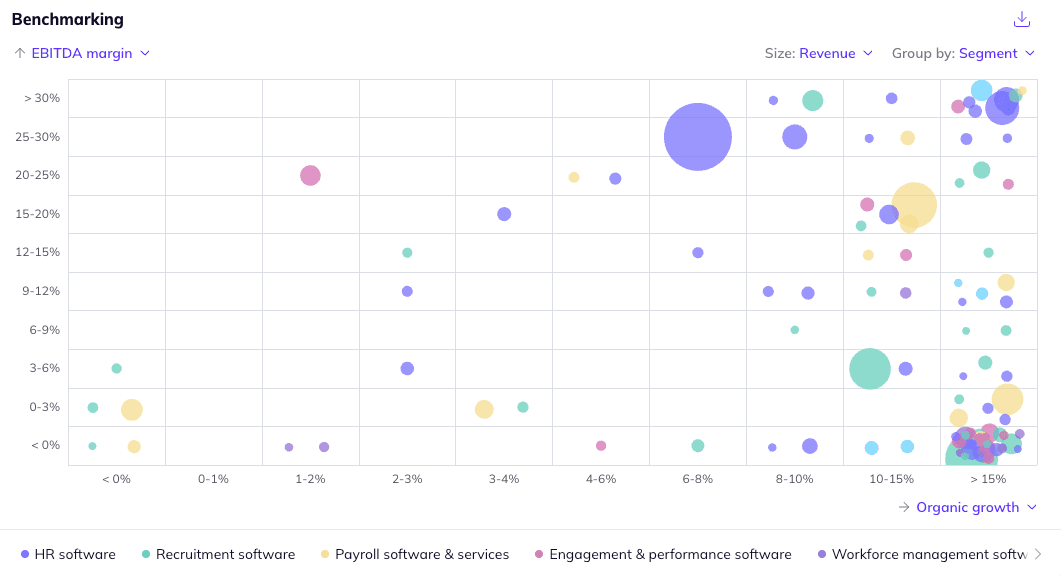
Company benchmarking
Market growth
The European HR software market was ~€8–10bn in 2025 and is forecasted to grow at ~8–10% CAGR through the end of the decade (OMMAX expert interview)
The DACH HR software market generated ~€2bn in revenue in 2025 and is expected to grow to ~€3.4–3.5bn by 2030, at a CAGR of ~11–12% (OMMAX expert interview)
Positive drivers
The EU faces a persistent shortage of workers and skills, with the job vacancy rate at ~2% in Q3 2025 and ~68% of medium-sized companies reporting skills shortages as a serious issue. This keeps talent challenges high on the corporate agenda, supporting durable demand for recruitment, retention, engagement and workforce management software (European Union, March 2026)
The ongoing shift from legacy on-premises HR systems to the cloud drives mid-term growth for HR Technology players. For example, only ~23% of European companies use SaaS payroll software, while ~32% still rely on self-built tools (e.g. spreadsheets). Additionally, low AI adoption (only ~19% of core HR processes enhanced by gen AI) provides further runway for vendors to monetise AI through premium modules and higher-value tiers, increasing revenue potential per customer (OMMAX expert interview; McKinsey & Company, July 2025; SD Worx, March 2024)
Increasing EU employment regulation, particularly around pay transparency and AI governance, raises employers' compliance burden (e.g. EU Pay Transparency Directive requiring companies with >150 employees to report gender pay gap data from June 2027). This supports HR tech demand, as rising compliance complexity drives adoption of automated payroll, compensation analytics and reporting tools (OMMAX expert interview; EU Artificial Intelligence Act, March 2026; KPMG, April 2025)
Negative drivers
Standalone niche products face increasing pressure as buyers rationalise fragmented stacks into integrated suites (e.g. ~49% of organisations use ~2-4 paid HR applications and ~37% use ≥5). At the same time, AI lowers the barrier to replicating niche functionality. This dynamic pressures differentiation and weakens the competitive advantage of best-of-breed vendors, particularly for the more easily replicated tools (OMMAX expert interview; Eightfold AI, January 2026; SHRM, April 2025)
Cyclically weak hiring across Europe, with German employment sentiment at its lowest level since May 2020, limits seat expansion and constrains vendors' organic growth. This is driven by HR tech revenue being sensitive to customer headcount, as per-seat pricing links vendors' growth to workforce expansion among their clients (OMMAX expert interview; ifo Institute, December 2025; The Register, November 2025)
Amid macroeconomic uncertainty, corporates increasingly demand clear ROI from HR technology, while perceived ROI is at an all-time low, dissatisfaction among budget owners has risen ~33% YoY and ~33% of HR software applications go regularly unused. As proving value becomes more challenging, vendors may face weaker retention, with dissatisfied customers cutting or not renewing underused tools, alongside higher customer acquisition costs and longer sales cycles (OMMAX expert interview; Mercer, May 2025; SHRM, April 2025)
Fill out the form to request your copy of the HR Technology industry report
With the full report, you’ll gain access to:
Detailed assessments of the market outlook
Insights from c-suite industry executives
A clear overview of all active investors in the industry
An in-depth look into 171 private companies, incl. financials, ownership details and more.
A view on all 977 deals in the industry
ESG assessments with highlighted ESG outperformers
Discover hundreds of niche industry reports on Gain
Deep dive into additional industries to understand their market outlook, positive and negative drivers, and more!