
Written by Josh O’Neill
Head of Intelligence Origination at Gain
The Problem With Financial News as Deal Intelligence
Financial news and deal intelligence are not the same thing, yet the industry has spent decades pretending otherwise.
For dealmakers operating in private markets, the distinction matters more than most care to admit. Traditional financial news was built to inform, to narrate events as they unfold, or after they've taken shape. To be sure, that's a legitimate function. But somewhere along the way, it became the default infrastructure for deal origination and M&A intelligence too. This is where the model breaks down.
The problem becomes structural when data lives inside prose. A company referenced in one article has no live connection to the sponsor behind it, the fund driving the mandate, or the adviser running the process. Hyperlinks to another article are about as good as linkages get. Over the years, providers have responded by bolting databases onto their newsrooms after the fact – cherry-picking information from articles and labelling it structured data. Latency is baked into this model and AI is not a silver bullet – large language models struggle to parse unstructured news articles with accuracy at scale.
In my experience, subscribers to B2B news providers are primarily paying for data, not prose. I bet you've been here. Ten tabs open, piecing together how a transaction evolved and who was involved at each stage. No single source of truth.
Thousands of words that say very little of real value. An analyst assigned to trawl news platforms and flag every deal a sponsor is reportedly active on – hours of work, for something you needed yesterday. That's not analysis, it's archaeology. It’s also an expensive misuse of talented people’s time.
Building Deal Intelligence the Right Way
I spent over a decade in financial newsrooms watching the same problem play out, constantly scratching my head as to why no one had built a private equity deal intelligence platform truly fit for purpose. I understand why the model evolved the way it did. But I also saw exactly where it fails the people who rely on it most.
Which is why, last September, I joined Gain, to build out its Intelligence Origination function. I started by hiring experienced financial journalists with backgrounds in covering private equity and private credit deals. Now, just seven months on, we employ more than 10 Intelligence Originators and analysts, whose task is to translate proprietary market conversations into structured, verified deal data.
I still believe deeply in journalistic methods. The rigour, the verification, the source relationships cultivated over years – that's still the plumbing of this product feature. What we've cut is the article. Turns out that's the one corner you can cut without sacrificing anything dealmakers actually need.
Why Live Deal Intelligence Requires Human Sources
AI will reshape newsroom workflows – I think that's inevitable, and to some of my peers in journalism, that's a contrarian view. But the one thing AI cannot replicate is a proprietary conversation with a real person. The Intelligence Origination team is built around exactly that – sourcing deals and updates through human relationships, while technology handles everything it's better equipped to do. Efficiency gains are there to be exploited. The question is, therefore, how you use the time you get back.
At Gain, we've built around a simple conviction: the one thing AI cannot replicate is a proprietary conversation with a real person. So we've structured our Intelligence Origination function around exactly that – sourcing deals and updates through human relationships, while technology handles everything it's better equipped to do. Journalistic rigour, redefined for private markets in the automation age.
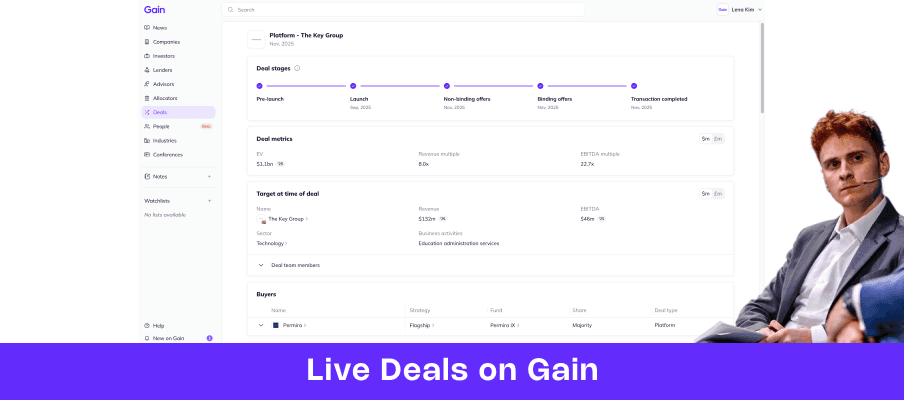
Not everything slots neatly into a data model, and we're not pretending otherwise. Transaction Intelligence notes exist precisely because sometimes you need the colour. But a sellside advisory appointment, a set of marketed financials and a list of bidders? That belongs in structured data, connected to the entities it touches – not buried inside ten paragraphs that take five minutes to parse.
Structured Private Equity Live Deals Data, Not Just News.
The linkages point is the one I'd push hardest, because it's the most consistently underestimated. Weak underlying company entities. Mis-tagged profiles. Missing or shallow connections to sponsors, their funds, their LPs, their people. These aren't minor UX gripes – they're foundational failures that no live deals intelligence platform should tolerate. Partial data compounds into wasted hours, and wasted hours kill confidence fast. When serving dealmakers, confidence is hard-won yet easily lost. Research into a deal can start with a news article but end elsewhere, perhaps in a corporate registry or yet another platform. Not on Gain.
One piece of feedback from a Big Four client has stuck with me:
"I've had people approach me internally to try and do what you do – cover all sectors across regions – and I told them to go and try and get back to me so they can see how hard it is. Our internal teams can't compete. It's one thing to scrape news and another thing entirely to be ahead of the news. And you are ahead."
That's the standard we're building to. Not another newswire. Not another database bolted onto a newsroom, repackaging financial news as deal intelligence. Deal intelligence treated as its own discipline, with the journalistic integrity it deserves, the proprietary deal sourcing it requires, and the structured data infrastructure that dealmakers in private equity actually need.